
Abstract
As enterprise IT infrastructure pivots toward hybrid cloud environments, IoT integration, and intensive edge computing, the foundational switching layer must evolve beyond simple packet forwarding. This whitepaper explores the architectural frameworks of the Cisco Catalyst 9300 Series, focusing specifically on the C9300-24S 24-port Gigabit Ethernet SFP fiber switch. Driven by the demands of Software-Defined Access (SD-Access) and highly secure fiber distribution topologies, modern enterprise campuses require robust programmable silicon and advanced telemetry. By examining the Unified Access Data Plane (UADP) 2.0 ASIC, real-time streaming telemetry capabilities, and stateful high-availability engineering, network architects will understand how to leverage this hardware to eliminate bottlenecks. Readers will learn practical strategies for optimizing StackWise-480 bandwidth, deploying containerized applications directly on the switch fabric, and implementing zero-trust security frameworks at line rate to maximize return on infrastructure investment.
The Evolutionary Paradigm of Enterprise Campus Networks: Why the Cisco Catalyst 9300 Series Matters
Enterprise local area networks (LANs) are undergoing a structural shift. Historically configured via manual, box-by-box command-line interfaces (CLI), legacy campus designs struggle to scale securely amidst the exponential proliferation of unmanaged endpoint devices and high-bandwidth real-time video applications. According to industry analyses, over 75% of network outages are attributed to manual misconfigurations, while enterprise bandwidth consumption continues to grow at an annualized rate exceeding 30% (Source: Gartner Enterprise Networking Report, 2025).
To resolve these operational deficits, modern infrastructure requires Intent-Based Networking (IBN)—a closed-loop operational model wherein business intents are translated into automated network policies, continuously monitored, and assured via artificial intelligence and machine learning (AI/ML).
The Cisco Catalyst 9300 Series represents the premier fixed-stackable switching platform designed specifically for security, IoT, mobility, and cloud integration within this IBN architecture. Serving as the foundational building block for Cisco Software-Defined Access (SD-Access), the series transforms traditional static networking into a dynamic, automated fabric. Within this elite portfolio, the C9300-24S occupies a strategic position as a dedicated small form-factor pluggable (SFP) fiber aggregation platform. It delivers secure, non-blocking optical connectivity designed for aggregation layers, secure fiber-to-the-desk (FTTD) military/financial deployments, and high-density downstream switch interconnections.
Technical Architecture and Silicon Deep Dive: Inside the C9300-24S Hardware
At the core of the C9300-24S lies an advanced hardware blueprint architected to balance line-rate throughput with extensive programmatic flexibility. Unlike commercial off-the-shelf (COTS) merchant silicon, which often sacrifices deep feature capabilities for raw speed, Cisco utilizes specialized custom ASICs paired with an enterprise-grade x86 compute subsystem.
The Unified Access Data Plane (UADP) 2.0 ASIC
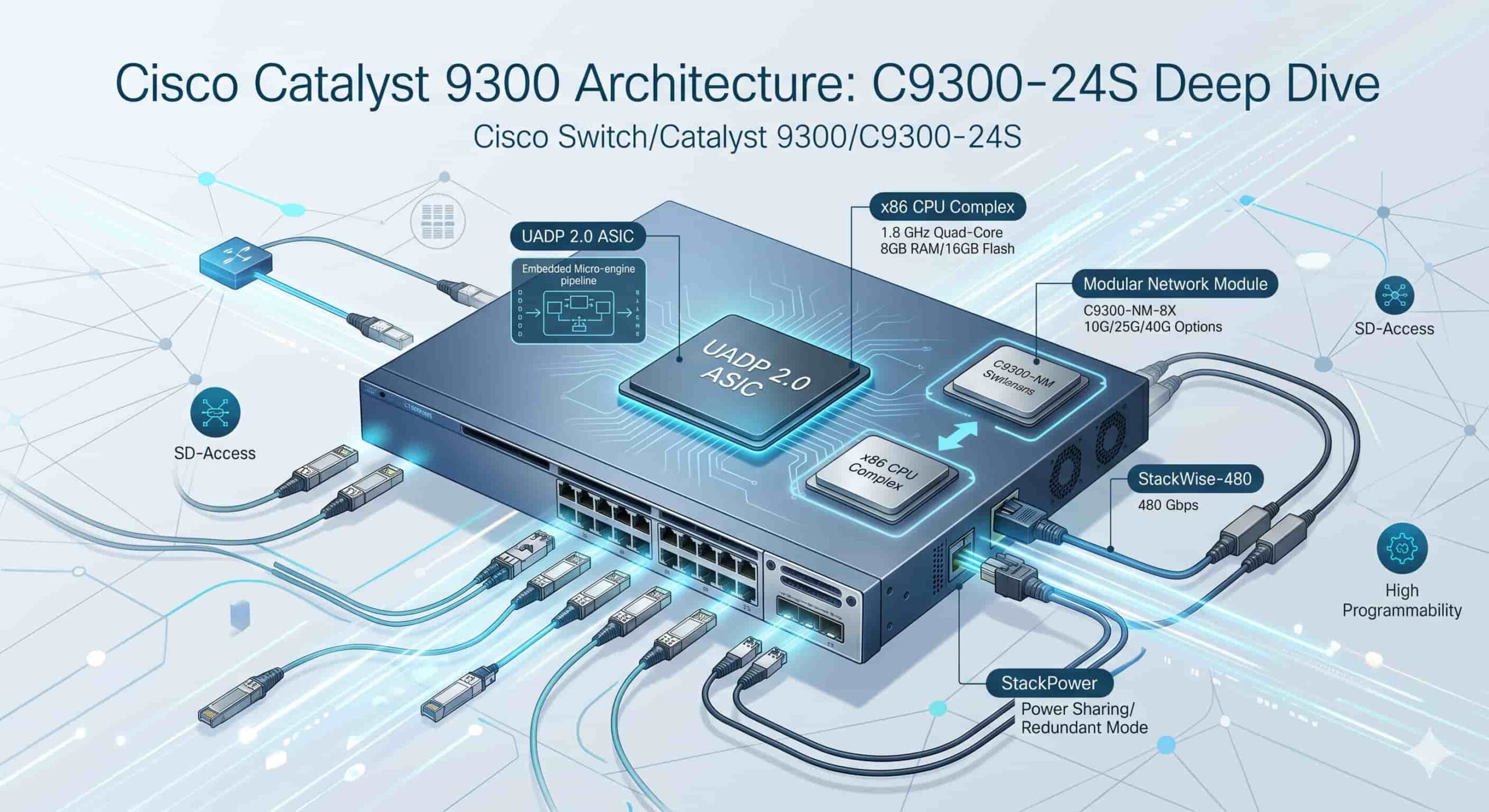
The computing muscle of the platform is driven by the UADP 2.0 Application-Specific Integrated Circuit. Architected with dual-core capabilities capable of processing up to 160 Gigabits per second (Gbps) of bandwidth per ASIC, the UADP 2.0 features a programmable micro-engine pipeline. This programmability enables the switch to adapt to emerging Layer 2 through Layer 4 protocols via simple software updates rather than requiring costly forklift hardware upgrades.
Key micro-architectural specifications of the UADP 2.0 ASIC within the C9300-24S include:
-
Flexible Shared Packet Buffers: Optimized buffer allocation dynamically prevents packet drops during transient micro-bursts commonly generated by modern storage and high-definition video arrays.
-
Configurable Forwarding Tables: Administrators can leverage predefined hardware templates (such as Core, Access, or SD-Access profiles) to alter the physical allocation of static routing entries, MAC address tables, and Access Control Lists (ACLs) within the Ternary Content-Addressable Memory (TCAM).
-
Hardware-Accelerated Encryption Engines: Native support for 256-bit MACsec encryption occurs at hardware speeds, eliminating the processing latency typically introduced by software-based cryptographic engines.
Processing Complex and Memory Capacity
To support intensive control plane operations, embedded wireless controller functions, and edge application hosting, the switch is equipped with an Intel x86 1.8 GHz quad-core processor. Complementing this processor is 8 GB of DDR4 System RAM and 16 GB of internal Flash memory. This highly provisioned compute boundary allows the switch to host decoupled Linux-based containerized applications directly on the hardware fabric without compromising core routing and switching performance.
Port Configuration and Modular Uplink Extensibility
The base physical configuration of the C9300-24S features 24 dedicated 1 Gigabit Ethernet SFP ports. Because these interfaces utilize fiber optics rather than copper RJ45 connections, the platform natively supports extended distance terminations, complete immunity to electromagnetic interference (EMI), and enhanced physical layer security.
For uplink scalability, the chassis incorporates a modular network module slot. Network administrators can hot-swap various uplink configurations depending on upstream aggregation speeds, supporting modules such as:
-
C9300-NM-4G: 4x 1G SFP slots
-
C9300-NM-8X: 8x 10G SFP+ slots
-
C9300-NM-2Q: 2x 40G QSFP+ slots
-
C9300-NM-2Y: 2x 25G SFP28 slots
This modularity future-proofs the distribution tier, allowing an enterprise to seamlessly transition from 10G uplinks to 25G or 40G backbones as upstream bandwidth thresholds are breached.
Core Software Capabilities: Cisco IOS XE and Intent-Based Programmability
The true operational multiplier of the Cisco Catalyst 9300 Series is Cisco IOS XE, an open, modular operating system running atop a customized Linux kernel. Unlike monolithic operating systems where a single failing process can crash the entire kernel, IOS XE executes individual network functions (e.g., OSPF, BGP, Spanning Tree) as distinct, protected daemons.
Model-Driven Telemetry (MDT)
Legacy network monitoring relies on Simple Network Management Protocol (SNMP), a highly resource-intensive polling mechanism that provides delayed, coarse-grained visibility. IOS XE implements Model-Driven Telemetry, utilizing standard YANG data models to stream contextual metrics continuously to management platforms like Cisco Catalyst Center (formerly DNA Center) or third-party time-series databases (e.g., Prometheus, Grafana). Using transport protocols such as gRPC over HTTP/2, administrators achieve sub-second visibility into interface utilization, queue depths, and buffer drops.
Network Programmability and Automation APIs
Modern infrastructure-as-code (IaC) paradigms require seamless device interactions. The C9300-24S exposes robust Northbound APIs, bypassing the CLI entirely:
-
NETCONF and RESTCONF: Enabling standardized configuration modifications using XML or JSON payloads validated against standard native Cisco or OpenConfig YANG models.
-
On-Box Python Scripting: An embedded Python runtime environment permits network engineers to execute automated scripts locally on the switch. This facilitates event-driven remediation, such as dynamically modifying routing tables if specific interface errors are detected.
-
Zero-Touch Provisioning (ZTP): Leveraging Preboot Execution Environment (PXE) boot mechanisms, unconfigured switches power on, request an IP address via DHCP, locate an image server, and download their designated IOS XE image and golden configuration templates without manual staging.
Application Hosting Architecture
Through the integrated Cisco IOx framework, the C9300-24S supports running third-party Docker containers and KVM virtual machines directly on the switch. This edge computing deployment model is critical for real-time protocol translation in IoT environments, hosting network probes like ThousandEyes Enterprise Agents, or running localized packet capture analyzers directly at the aggregation layer.
High Availability and Resiliency Engineering
Downtime at the aggregation or distribution layers impacts downstream users disproportionately. The architectural engineering of the C9300-24S incorporates physical and logical redundancies designed to deliver 99.999% (“five nines”) availability.
StackWise-480 Technology
Cisco’s proprietary stacking architecture allows up to eight physical Catalyst 9300 switches to operate as a single logical virtual switch, sharing a unified management plane, control plane, and IP address.
-
Bandwidth: The dedicated rear stacking cables establish a closed-loop dual-ring topology delivering 480 Gbps of stacking bandwidth.
-
Stateful Switchover (SSO): The stack elects an Active switch and a Standby switch. The Active unit continuously synchronizes stateful routing and switching tables to the Standby unit. If the Active hardware experiences a catastrophic failure, the Standby unit assumes control plane operations within sub-milliseconds, preventing dropped transport layer sessions.
-
Non-Stop Forwarding (NSF): Working alongside SSO, NSF ensures that the data plane continues forwarding packets based on known routing entries while the control plane converges during an active-to-standby transition.
StackPower Infrastructure
Traditional power distribution requires each switch to rely strictly on its internal power supplies. Cisco StackPower technology interconnects the power supplies of up to four stacked switches (expandable to eight with an exclusive power expansion ring) to create a collective shared power pool.
Operating in either Power Sharing Mode or Redundant Mode, the system intelligently redistributes wattage across specialized rear cabling. If a local power supply unit (PSU) fails within a mission-critical switch, the chassis instantly draws requisite operating power from adjacent stack members, preserving continuous uptime without requiring dedicated external Uninterruptible Power Supply (UPS) installations for every single rack unit.
Comparative Analysis: C9300-24S vs. Alternative Catalyst Configurations
To ensure highly optimized hardware procurement, technical decision-makers must evaluate how the fiber-optimized C9300-24S measures against standard copper models and higher-tier modular variants within the Catalyst portfolio.
| Architectural Dimension | C9300-24S | C9300-24T | C9300-24P | C9300X-24Y |
| Primary Physical Media | 24x 1G SFP (Fiber Optic) | 24x 1G RJ45 (Copper) | 24x 1G RJ45 (Copper) | 24x 10G/25G SFP28 |
| PoE/PoE+ / UPOE Support | N/A (Fiber media) | No | Yes (PoE+, up to 30W/port) | N/A (Fiber media) |
| ASIC Generation | UADP 2.0 | UADP 2.0 | UADP 2.0 | Silicon One Q200 / UADP 2.0sec |
| Switching Capacity | 208 Gbps (up to 688 Gbps with Stacking) | 208 Gbps (up to 688 Gbps) | 208 Gbps (up to 688 Gbps) | 2.0 Terabits per second (Tbps) |
| Stacking Bandwidth | 480 Gbps (StackWise-480) | 480 Gbps (StackWise-480) | 480 Gbps (StackWise-480) | 1 Tbps (StackWise-1T) |
| MACsec Hardware Encryption | 256-bit AES line-rate | 256-bit AES line-rate | 256-bit AES line-rate | 256-bit AES line-rate |
| Optimal Architectural Role | Secure Fiber Access / Small Aggregation | Traditional Data Access | VoIP / Access-Point Deployment | High-Density Core / Top-of-Rack |
Strategic Takeaways from the Matrix
-
Media Specificity: The C9300-24S is engineered exclusively for environments where copper infrastructure is prohibited due to security (e.g., TEMPEST standards requiring prevention of electronic eavesdropping) or distance limitations (exceeding the standard 100-meter Ethernet barrier).
-
Power over Ethernet (PoE) Limitations: Because SFP transceivers transmit optical photons rather than electrical currents, the C9300-24S cannot supply power to end-devices. Organizations requiring PoE line power for VoIP hardware or Wi-Fi 6E/7 Access Points must route aggregation pipelines through the C9300-24P/U variants.
-
Throughput Dynamics: While identical in localized packet processing architectures to the copper variants, the C9300-24S integrates directly into higher-tier fiber backbones without requiring active media converters, significantly reducing overall network point-of-failure footprints.
Strategic Deployment Scenarios for Fiber Aggregation Switches
Deploying the C9300-24S requires precise alignment with physical campus Topologies. Below are three primary architectural implementations validated for enterprise scale.
Scenario 1: Secure Distribution Layer Aggregation
In a standardized hierarchical three-tier campus design (Core, Distribution, Access), access layer switches distributed across multiple physical buildings require centralized interconnections. Using single-mode or multi-mode SFP optical modules, the C9300-24S aggregates access-layer uplinks via high-speed EtherChannel bundles.
By configuring Multi-Chassis EtherChannel (MEC) across a StackWise-480 pair of C9300-24S switches, administrators create an active-active forwarding path. This design eliminates blocked links typically managed by Spanning Tree Protocol (STP), maximizing available upstream distribution capacity.
Scenario 2: Fiber-to-the-Desk (FTTD) for High-Security Endpoints
Government entities, defense contractors, and specialized financial trading floors frequently mandate that physical client workstations connect via optical links to prevent signal interception via copper induction.
Deploying the C9300-24S in secure access closets allows direct point-to-point SFP patching to desktop fiber Network Interface Cards (NICs). Enabled with IEEE 802.1X port-based authentication and continuous Encrypted Traffic Analytics (ETA), the switch analyzes network packet flow behavior directly in silicon. This enables the detection of malicious malware payload footprints hidden within encrypted end-user web traffic without requiring bulk decryption overhead.
Scenario 3: SD-Access Fabric Border / Control Plane Node
In highly automated environments driven by Cisco Catalyst Center, the C9300-24S acts as an exceptional intermediate node. When provisioned as an SD-Access Fabric Border Node, the switch handles the complex control plane encapsulation and decapsulation of Virtual Extensible LAN (VXLAN) headers.
It acts as the secure gateway bridging the internal automated SD-Access fabric with exterior legacy data center routing domains, leveraging internal routing protocols like Locator/ID Separation Protocol (LISP) to track endpoint identity mappings with absolute scale.
Licensing Tiers: Network Advantage vs. Network Essentials
Every C9300-24S switch requires a base OS license paired with a corresponding subscription tier (typically mandated for 3, 5, or 7-year intervals during original hardware checkout).
-
Cisco DNA / Catalyst Essentials: Provides fundamental Layer 2 and Layer 3 routing functionality. This includes OSPF, Routed Access, basic PIM multicast operations, standard network telemetry export, and basic automated orchestration via Catalyst Center.
-
Cisco DNA / Catalyst Advantage: Unlocks unrestricted enterprise-class capabilities. Essential for maximum-scale engineering, this tier delivers full BGP routing capabilities, VRF (Virtual Routing and Forwarding) segmentation, programmatic YANG model customization, Encrypted Traffic Analytics, full SD-Access Fabric capabilities, and advanced application hosting integration.
Optimizing Procurement Workflows
Organizations designing distribution hubs must calculate clear total cost of ownership models. While the upfront acquisition cost of pure fiber aggregation layers may index higher than unmanaged copper edges due to additional optical module dependencies, the operational returns achieved via automated network telemetry and unified physical stacking loops yield a proven reduction in maintenance expenditures (Source: IDC Enterprise Infrastructure ROI Study, 2024).
For complex deployment scenarios, sourcing strategies should leverage trusted technical hubs. Infrastructure architects can directly evaluate availability, verify custom build profiles, and access verified configuration paths via verified product catalogs like the C9300-24S platform page.
Frequently Asked Questions (FAQs)
1. Can I stack a C9300-24S fiber switch with standard C9300 copper switches?
Yes. The C9300-24S natively supports mixed stacking with any standard Cisco Catalyst 9300 Series switch utilizing StackWise-480 rear interconnect cables. However, mixed stacking with Catalyst 9300X models is not supported due to architecture differences between StackWise-480 and StackWise-1T backplanes. All stack members must run identical IOS XE software versions.
2. What types of transceivers are officially validated for the C9300-24S base ports?
The base 24 ports support standard Gigabit Ethernet Small Form-Factor Pluggable (SFP) optics. Validated form factors include Cisco 1000BASE-SX (short-reach multimode), 1000BASE-LX/LH (long-reach single-mode), 1000BASE-ZX (extended reach), and direct-attach copper (DAC) patch assemblies. Third-party transceivers function using the service unsupported-transceiver CLI command, though Cisco TAC reserves support validation.
3. Does the C9300-24S support Power over Ethernet (PoE) injection?
No. The C9300-24S base interfaces are standard optical SFP slots designed to receive fiber transceivers. Fiber optic links transmit light signals and cannot carry physical electrical currents to power end devices. For PoE deployment needs, network architects must utilize the RJ45 copper models within the Catalyst 9300 family.
4. What is the operational difference between the C9300-NM-4G and C9300-NM-8X uplink modules?
The C9300-NM-4G module provides four additional 1 Gigabit Ethernet SFP uplink slots. The C9300-NM-8X provides eight multi-rate slots supporting 10 Gigabit Ethernet SFP+ modules or standard 1G SFP modules. Selecting between them depends entirely on your required uplink oversubscription ratios and core distribution throughput bandwidth targets.
5. How does Cisco StackPower function on the C9300-24S platform?
StackPower allows up to four switches to pool their internal power supplies using specialized rear cabling. If configured in Power Sharing mode, total available power is distributed dynamically across the stack. In Redundant mode, the highest-wattage power supply is reserved as an immediate offline backup to cover automated operational failovers instantly.
6. What is the maximum throughput capability of the C9300-24S standalone chassis?
A standalone C9300-24S switch achieves a localized switching capacity of 208 Gbps with a forwarding rate of 154.76 Million Packets Per Second (Mpps). When integrated into a maximum eight-member StackWise-480 topology, the cumulative switching capacity scales linearly to deliver an aggregate throughput footprint of 688 Gbps.
7. What software licensing tier is mandatory to deploy SD-Access on this switch?
To deploy the switch as a fully integrated Software-Defined Access (SD-Access) edge, border, or control plane node, administrators must purchase the Cisco DNA Advantage (or Catalyst Advantage) subscription tier. The base Essentials tier does not support automated VXLAN fabric overlays or advanced LISP control plane mechanisms.
8. Can the C9300-24S perform line-rate hardware encryption?
Yes. The platform implements hardware-based IEEE 802.1AE MACsec-256 encryption directly within the UADP 2.0 ASIC processing pipeline. This dedicated silicon logic encrypts all packets traversing authenticated links at absolute line rate, guaranteeing secure, uncompromised transit across physical distribution pathways without degrading processor cycles.
Conclusion and Strategic Call to Action
The modern enterprise campus cannot function effectively on brittle, legacy network architecture. As infrastructure scaling models require zero-trust security enforcement, deep operational visibility, and automated lifecycle management, switching assets must provide robust processing silicon and open programmability. The C9300-24S excels as a purpose-built optical aggregation layer within the broader Cisco Catalyst 9300 Series. By combining the robust flexibility of the programmable UADP 2.0 ASIC with resilient hardware redundancies like StackWise-480 and StackPower, this platform provides the rock-solid foundation required for high-security campus deployments and next-generation SD-Access automated fabrics.
Network architects, IT infrastructure directors, and lead system integrators must proactively audit their core aggregation layers to eliminate legacy bottlenecks. Transitioning toward fiber-dense intent-based routing frameworks guarantees long-term return on investment, minimizes vulnerability cross-sections, and ensures enterprise operational readiness for future workloads.
Call to Action: Ready to transition your enterprise distribution layer to a high-performance fiber switching fabric? Explore complete technical datasheets, request validated pricing models, and secure priority global inventory options by visiting the dedicated Cisco Catalyst C9300-24S deployment portal today. Accelerate your hybrid enterprise journey with uncompromising network reliability.

Leave a comment