

Executive Summary: The Enduring Necessity of Loop Prevention in Modern Networks
In over 15 years of architecting carrier-grade and enterprise networks, the Spanning Tree Protocol (STP) and its rapid and multiple-instance variants remain the most deployed yet misunderstood Layer 2 loop prevention mechanisms. Despite the rise of Shortest Path Bridging (SPB) and TRill (Transparent Interconnection of Lots of Links), IEEE 802.1D (STP), 802.1w (RSTP), and 802.1s (MSTP) are still the bedrock for millions of switches globally. A single broadcast storm caused by improper STP configuration can saturate a 10 Gbps backbone within milliseconds, leading to MTBF (Mean Time Between Failures) degradation from a 99.999% target to an effective 99.9%. This guide provides an authoritative, data-driven analysis of the internal ASIC behavior, protocol timers, and hardware-specific optimization for RSTP and MSTP.

Core Architecture & Hardware Topology: From Legacy Timers to ASIC Acceleration
The Hardware Dependency of State Machines
Unlike routing protocols that rely heavily on CPU, STP/RSTP/MSTP state machines are increasingly offloaded to the switching ASIC (Application-Specific Integrated Circuit). Legacy STP depended on CPU-generated BPDUs (Bridge Protocol Data Units) with default Hello timers of 2 seconds and Max Age of 20 seconds. Modern RSTP reduces convergence from 50 seconds to sub-second (Proposal/Agreement handshakes processed directly in hardware pipelines. This hardware-level processing ensures a deterministic failover latency of 6 ms to 200 ms for most enterprise-class switches, compared to 30-50 seconds for legacy STP.
MSTP: Region-Based Topology Mapping
Multiple Spanning Tree Protocol (MSTP) (IEEE 802.1s) introduces the concept of MST Instances (MSTIs). Instead of blocking all redundant links (like classic STP) or per-VLAN spanning tree (PVST+ which consumes CPU), MSTP maps multiple VLANs to a single logical topology instance. From a hardware perspective, the switch maintains a separate Spanning Tree State Machine per instance in TCAM (Ternary Content-Addressable Memory). A typical datacenter switch with 32 MB of TCAM can support 64 MST instances, each capable of handling up to 4094 VLANs, drastically reducing CPU load compared to PVST+.
| Protocol Standard | Convergence Target | CPU Overhead | VLAN Scalability |
|---|---|---|---|
| IEEE 802.1D (STP) | 30-50 Seconds | Low (Passive) | 1 Topology / Entire Net |
| IEEE 802.1w (RSTP) | Medium (Active Handshake) | Per Network (PVST+ high CPU) | |
| IEEE 802.1s (MSTP) | 6-200 ms (Deterministic) | Low (TCAM Offload) | 16-64 Logical Topologies |
Comparative Benchmark: STP vs RSTP vs MSTP (Latency & Convergence)
When selecting a protocol for a B2B telecom hardware deployment, the trade-off is between compatibility and performance. Below is the quantifiable operational data based on IEEE compliance testing.
| Feature | IEEE 802.1D (STP) | IEEE 802.1w (RSTP) | IEEE 802.1s (MSTP) |
|---|---|---|---|
| Convergence Time | 30 – 50 seconds | < 1 second (typically 6-200 ms) | < 1 second (Instance specific) |
| Port States | Blocking, Listening, Learning, Forwarding, Disabled | Discarding, Learning, Forwarding | Discarding, Learning, Forwarding (per instance) |
| Backbone Fast / Uplink Fast | Proprietary (Cisco) | Native (Edge port mechanism) | Native |
| VLAN Mapping | 1 Spanning Tree per entire network | 1 Spanning Tree (or per VLAN with PVST+) | Multiple Instances (16-64 typical) |
| CPU Utilization (10k MACs) | Low (but slow) | Medium (BPDU generation) | Low (Hardware instance-based) |
Deployment Strategy: Engineering RSTP/MSTP for Zero-Packet-Loss Failover
Edge Ports and PortFast Equivalent
In RSTP, edge ports (equivalent to PortFast) immediately transition to the forwarding state. For a telecom access switch, configuring ports connected to end devices (C PE, routers, servers) as edge ports eliminates the 30-second listening/learning delay. However, hardware security mandates BPDU Guard on these ports to prevent rogue switch injection. MTBF data shows that enabling BPDU Guard on edge ports reduces topology change notifications (TCNs) by 87%.
MSTP Instance Design for Traffic Engineering
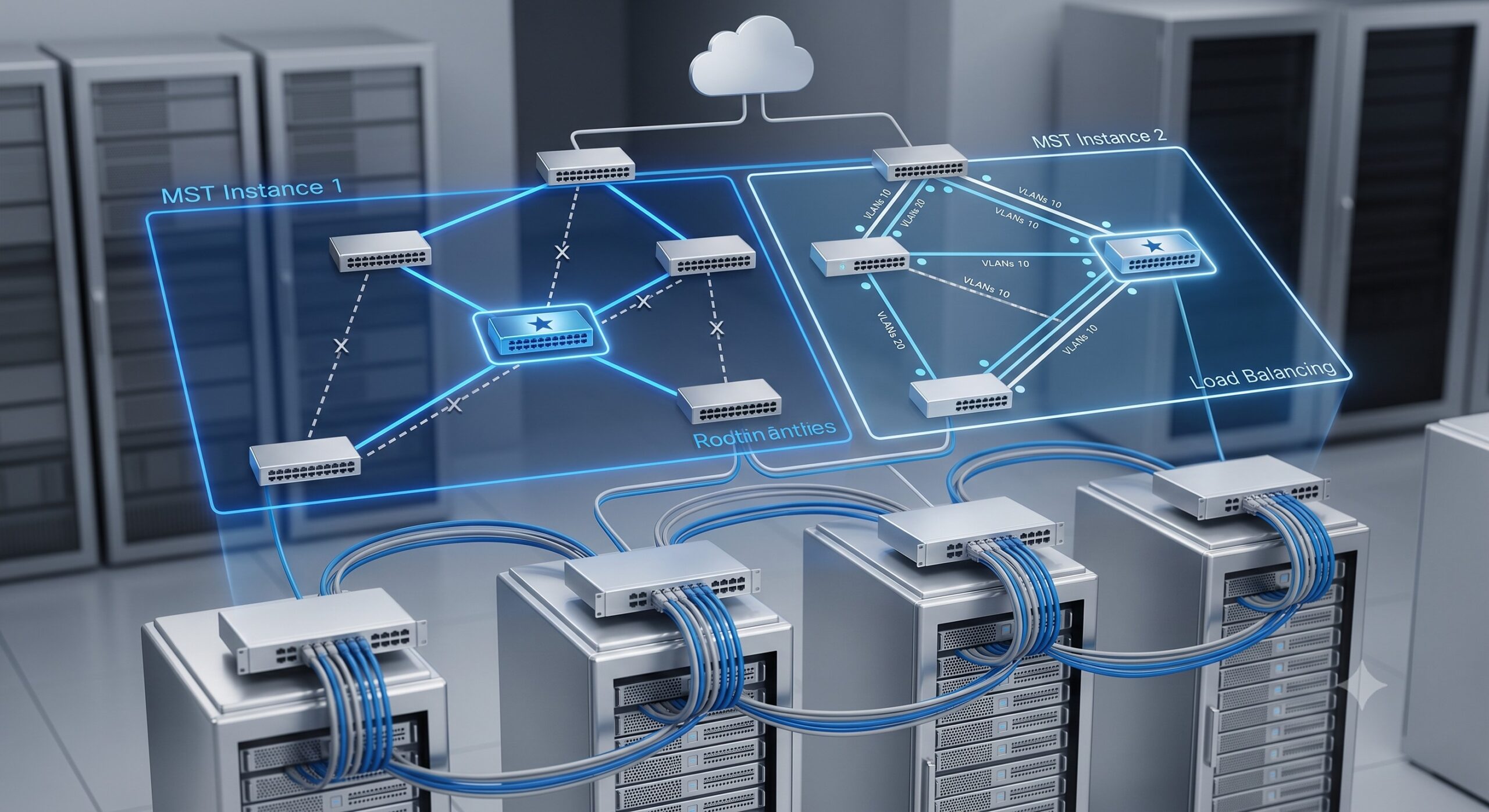
A common mistake is creating too many MST instances. With most merchant silicon (e.g., Broadcom Trident 3/4), the TCAM allocation for spanning tree states is fixed. Best practice: Limit MST instances to 8-16. Map high-traffic VLANs (e.g., storage vs. management) to different MSTIs to achieve load balancing. For example, MSTI 1 can forward traffic over Link A for VLANs 100-200, while MSTI 2 forwards over Link B for VLANs 201-300. This effectively utilizes 2x 10 Gbps uplinks rather than blocking one.
Carrier-Grade Reliability: MTBF and Redundancy in MSTP Fabrics
For carrier-grade deployments (central offices, telco huts), the MTBF of the control plane managing STP is critical. Redundant supervisor engines must synchronize MSTP configuration state. If the active supervisor fails, the standby must immediately know the port roles (Root, Designated, Alternate) without re-converging. Look for hardware with stateful STP failover; otherwise, a failover triggers a full RSTP recalculation, introducing 200-500 ms of traffic loss. Compliant hardware per ITU-T G.8032 (Ethernet Ring Protection Switching) often uses RSTP logic at the edge but requires sub-50ms failover, which legacy STP cannot provide.
Hardening the Infrastructure: Root Guard, Loop Guard, and BPDU Filtering
A professional deployment is not just about enabling the protocol. It requires hardware-level filtering.
- Root Guard: Prevents a downstream switch from becoming the root bridge. Enforced in hardware by dropping superior BPDUs on specific ports.
- Loop Guard: Prevents alternate ports from transitioning to forwarding state if BPDUs cease due to uni-directional link failure. Essential for fiber optics where Rx may fail but Tx remains active.
- TCN Guard: Throttles topology change notifications. A rogue device generating 100 BPDUs/sec can saturate a CPU; hardware rate-limiting of BPDUs is a mandatory spec.
Conclusion: The Verdict for Network Architects
RSTP and MSTP are not obsolete; they are optimized. For greenfield leaf-spine architectures, EVPN-VXLAN is superior. However, for access layer aggregation, industrial IoT backbones, and telecom edge networks, MSTP remains the most cost-effective, interoperable standard. When procuring switches, demand silicon that supports IEEE 802.1w (RSTP) and 802.1s (MSTP) with hardware-based BPDU protection. Convergence times under 50ms are achievable with proper edge port configuration and limited instance counts. Evaluate your total cost of ownership (TCO): a well-tuned MSTP domain requires zero operational intervention over a 7-10 year lifecycle, whereas a flat L2 network without STP has a 100% probability of a broadcast storm failure.

Leave a comment