
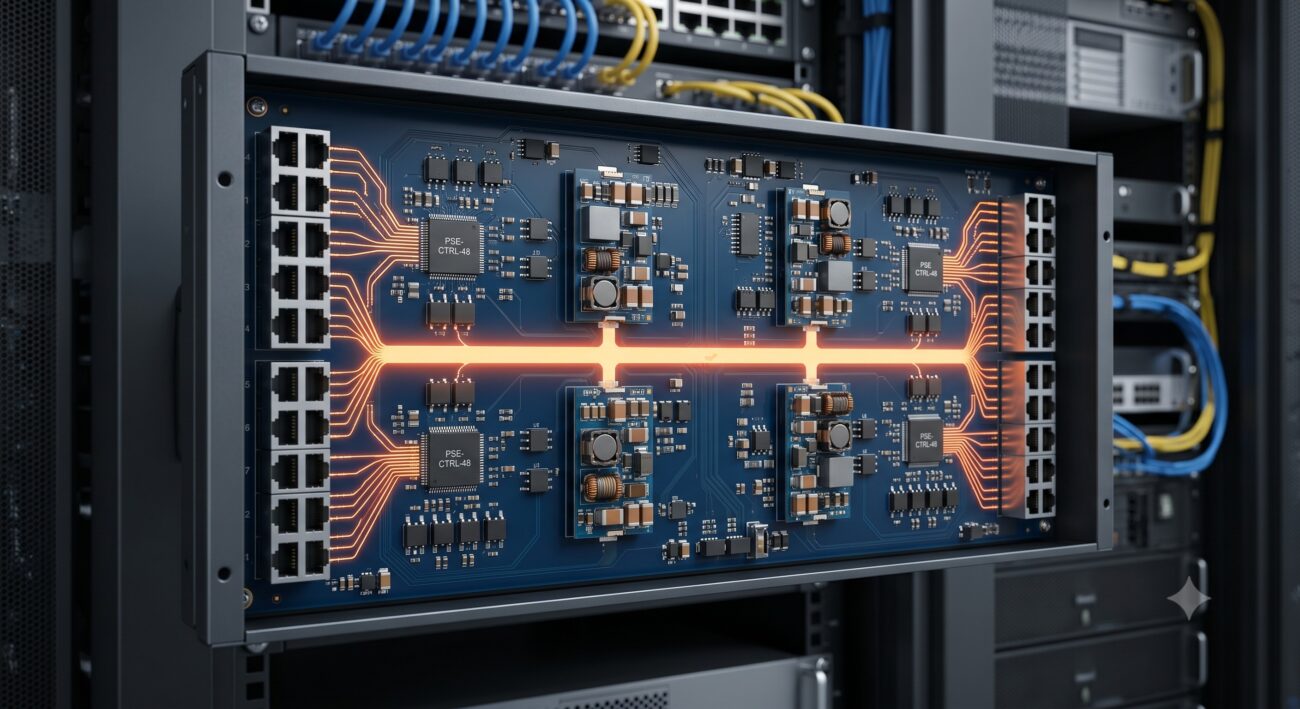
Executive Briefing: Why PoE Power Budget Dictates Network Reliability
In modern enterprise and carrier-grade networks, Power over Ethernet (PoE) has transcended mere convenience to become a critical infrastructure pillar. The PoE power budget is not a marketing number—it is the absolute ceiling of available wattage your switch chassis can deliver simultaneously across all ports. Exceeding this budget triggers indiscriminate port shutdowns, network brownouts, and physical security system failures. This guide dissects the architecture, IEEE standards (802.3af/at/bt), and real-world deployment math that separates resilient networks from costly field failures.
Core Architecture & Hardware Topology of PoE Power Budgeting
The Power Sourcing Equipment (PSE) Internal Bus
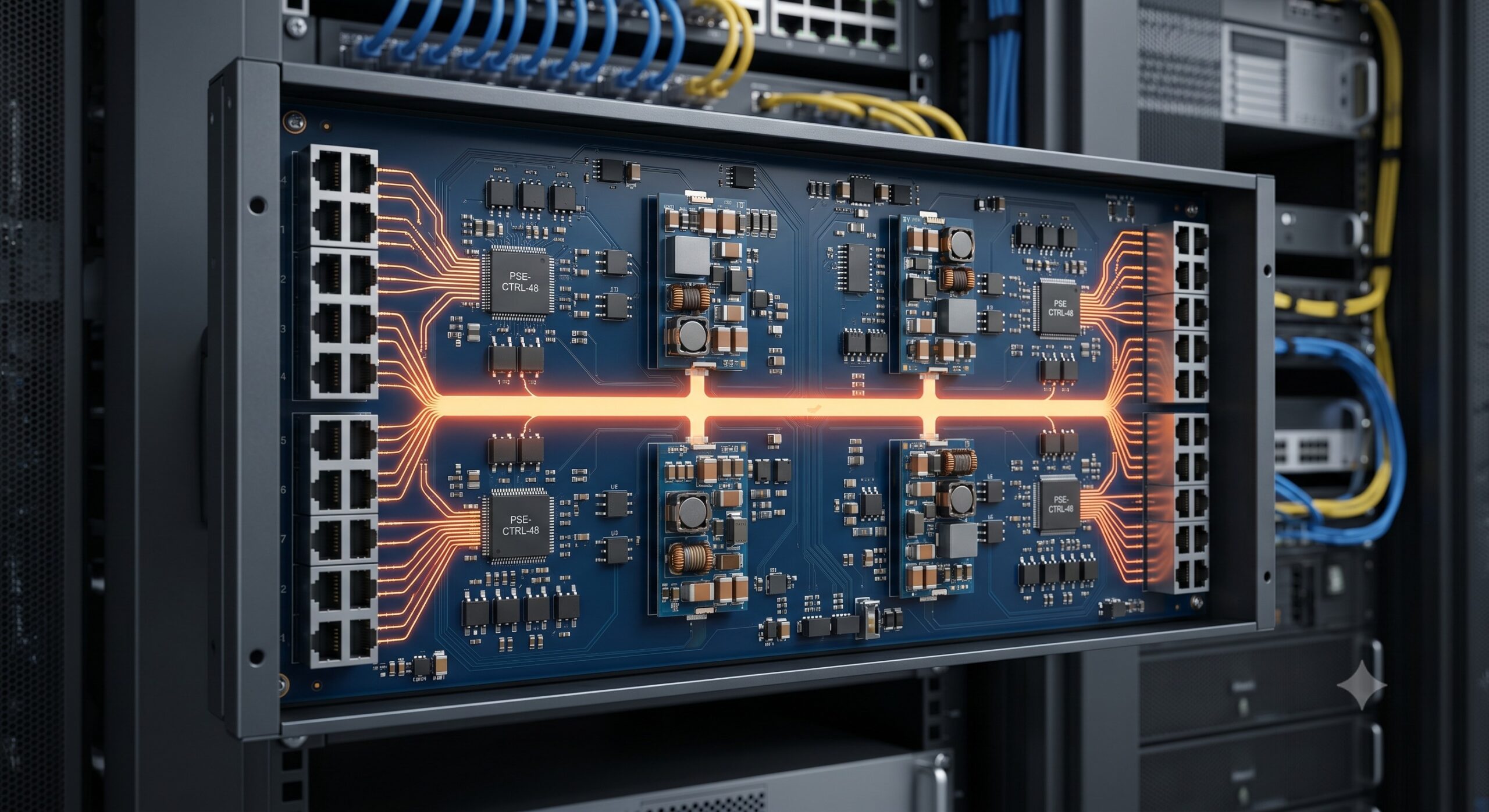
Inside any managed PoE switch, the power budget originates from the backplane’s DC-DC converter stage. Unlike data forwarding (which uses ASICs), PoE power is drawn from a shared power supply unit (PSU)—typically 150W to 1600W for enterprise models. The PSE controller (e.g., Microchip PD69104 or TI TPS23881) allocates per-port power based on hardware classification (Class 0-8). Critically, the system PoE power budget is always less than the PSU’s total rating due to conversion losses (typically 5-8% overhead) and reserved headroom for management plane functions.
Dynamic Power Allocation vs. Static Budgeting
High-density switches implement Dynamic Power Allocation (DPA) via LLDP Power Negotiation (IEEE 802.3at-2009 Clause 33). Instead of reserving the maximum per-port class power (e.g., 30W for 802.3at), DPA grants actual consumed wattage (measured via inrush current sensing). This can increase usable port density by 30-45% under mixed loads. However, many carrier-grade switches still default to conservative static budgets for deterministic operation (e.g., MTBF > 500,000 hours).
| IEEE Standard | Max Per-Port Power | Typical Use Case | Minimum Switch PoE Budget for 24 Ports |
|---|---|---|---|
| 802.3af (PoE Type 1) | 15.4W | VoIP phones, basic sensors | > 370W (after 15% overhead) |
| 802.3at (PoE+ Type 2) | 30W | PTZ cameras, 802.11ac APs | > 720W |
| 802.3bt Type 3 | 60W | LED lighting, Thin Clients | > 1440W |
| 802.3bt Type 4 | 90W (max 100W) | Laptop docks, outdoor heaters | > 2160W |
Carrier-Grade Deployment: Calculating Real-World Power Envelopes
Per-Port Budget vs. Total System Ceiling
A common engineering mistake is assuming a 48-port switch with 802.3bt (90W per port) supports 48 × 90W = 4,320W. In reality, the total PoE power budget (e.g., 740W on a Cisco Catalyst 9300-48UXM) dictates that only 8 ports can deliver full 90W simultaneously. The remaining ports drop to lower classes or fail to power up.
Temperature Derating and Thermal Management
For every 10°C rise above 40°C ambient, internal MOSFET resistance (Rds(on)) increases by 20-30%, reducing effective power budget. Deploying switches in non-ventilated enclosures without accounting for thermal derating typically erodes 15-20% of nominal budget. High-reliability designs use active cooling with N+1 fan redundancy and budget power de-rating curves directly from the vendor’s MTBF reports (e.g., Allied Telesis or HPE Aruba).
Field-Failure Case Study: Under-budgeting for PTZ Cameras
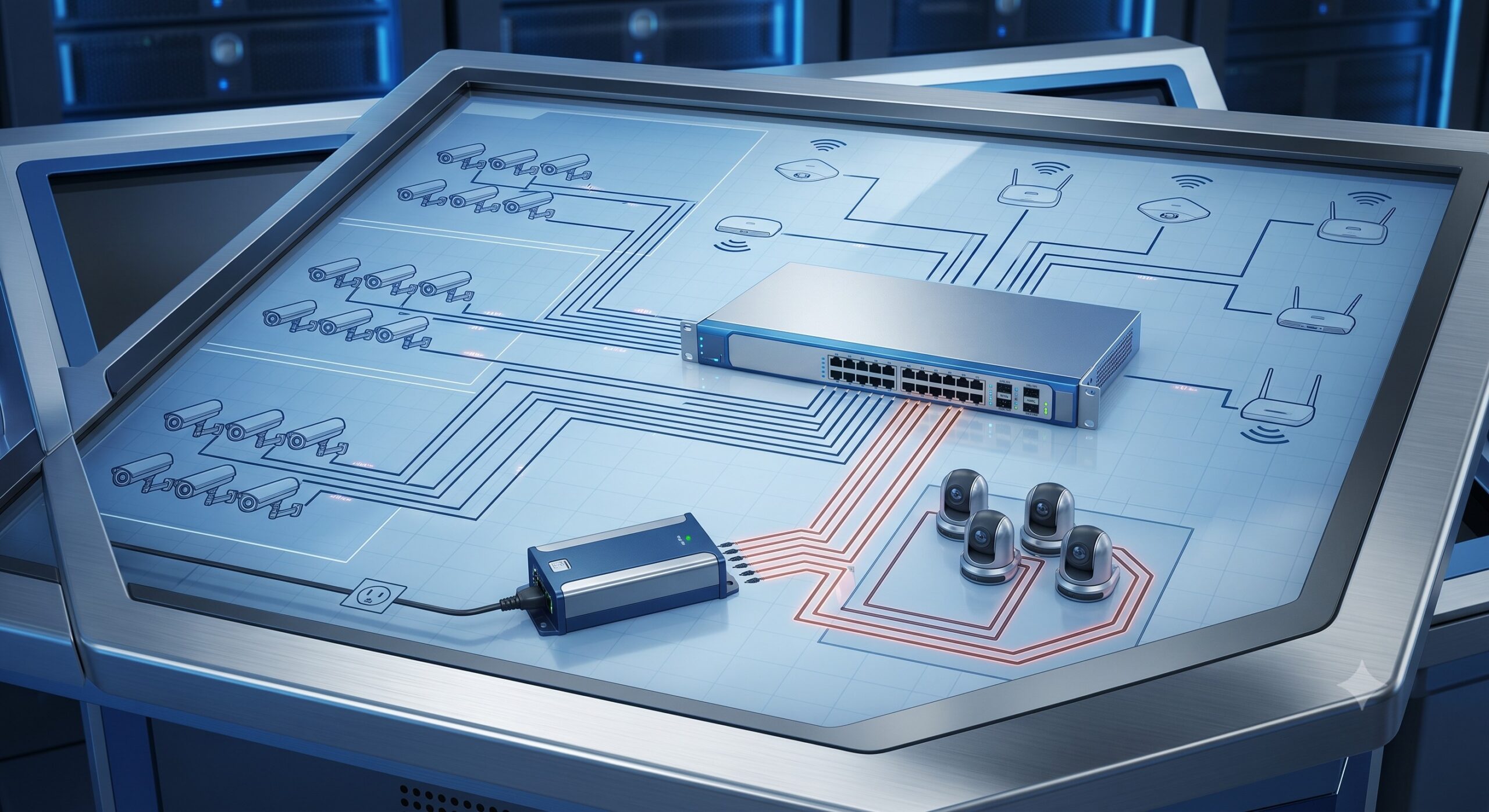
A regional ISP deployed 24 x High-Power PoE (802.3bt Type 4) outdoor PTZ cameras (65W peak with heaters). They used a 24-port switch advertising a 600W total budget. However, the switch’s PSE reserved 20% for control plane headroom—leaving 480W usable. At -20°C start-up, 18 cameras simultaneously demanded 65W inrush = 1,170W requirement. Result: cascading port shutdowns, network flapping, and site dispatch costs exceeding $12,000. The solution: deploy a PoE power injector midspan with independent 1200W budget and per-port prioritization (Critical/High/Low).
Specification Deep Dive: Standards, Negotiation, and Vendor Lock-in
Always request the PSE Power Budget Table from the datasheet, not just the marketing summary. Look for:
- Budget per PSU (e.g., 400W default, 800W with redundant module)
- Port power priority queuing (Critical ports never depowered)
- Fast PoE fault detection (
- ITU-T K.21 surge compliance for outdoor deployments (important for carrier-grade environments)
- RoHS 3 and WEEE compliance for green tenders
Vendor note: Some low-cost switches measure budget as peak PSU output (including non-PoE load). Always demand the dedicated PoE power budget figure measured at PSE output pins after all internal losses.
Conclusion: The 80% Rule for Production Networks
Never design a PoE-powered network above 80% of the total system power budget. The remaining 20% accommodates inrush current spikes, temperature-related derating, and future device upgrades (e.g., moving from 802.3at 30W to 802.3bt 60W). For mission-critical installations (access points, surveillance, industrial IoT), deploy per-port power metering via SNMP and set alerts at 70% sustained load. The PoE power budget is your network’s circuit breaker—respect its physics, or plan for midnight dispatches.

Leave a comment