
Introduction: The Imperative of Deterministic Networking for Real-Time Communications
In modern enterprise and carrier-grade networks, the distinction between ‘best-effort’ data delivery and deterministic, low-latency forwarding defines operational viability. For Voice over IP (VoIP) and Unified Communications (UC), the key metric is not bandwidth, but rather jitter, one-way latency, and packet loss. According to ITU-T G.114, a one-way latency exceeding 150ms renders conversational speech unnatural. Without proper Quality of Service (QoS), voice packets compete with bulk data transfers (e.g., SMB backups, video streams), leading to call drops and incomprehensible audio. This technical deep-dive dissects the ASIC-level packet pipeline, IEEE 802.1p tagging, and DiffServ (Differentiated Services) architecture required to prioritize voice traffic effectively.
Core Architecture & Hardware Topology of QoS Engines
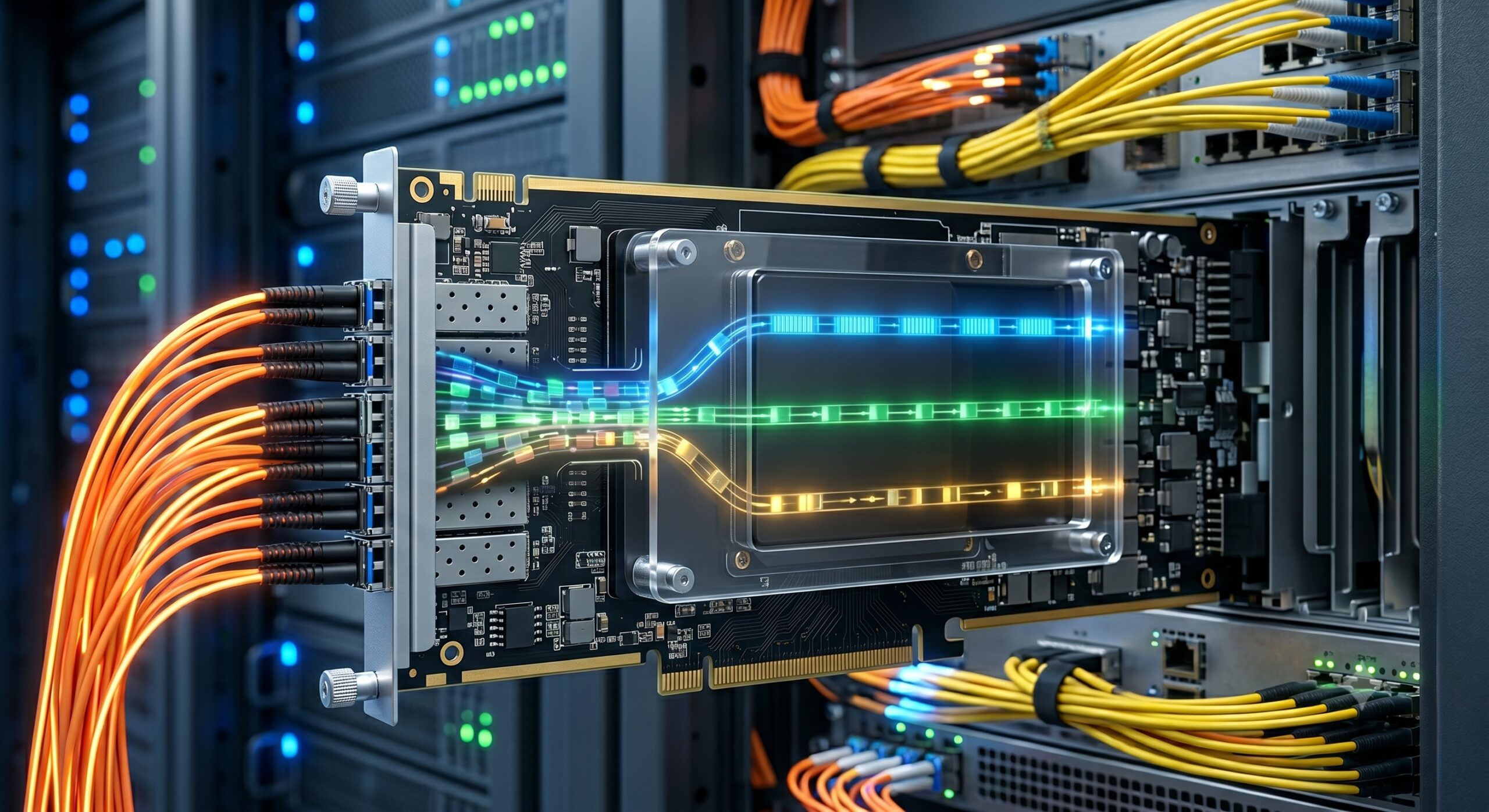
Modern QoS is not a software feature; it is a hardware-accelerated function embedded within the packet forwarding ASIC (Application-Specific Integrated Circuit). High-performance switches (e.g., those based on Broadcom Jericho2 or Cisco Silicon One) process classification, policing, and queueing at line rate (up to 12.8 Tbps). The architecture relies on a three-stage pipeline: Classification -> Admission Control -> Queueing/Scheduling. For voice traffic, we leverage Layer 2 CoS (Class of Service) defined in IEEE 802.1p, which uses a 3-bit field within the VLAN tag (PCP – Priority Code Point, values 0-7), and Layer 3 DSCP (Differentiated Services Code Point) per RFC 2474. Industry standard EF (Expedited Forwarding, DSCP 46) is the designated codepoint for voice payloads, ensuring strict priority queueing.
Hardware Offload for Sub-Millisecond Forwarding
To achieve sub-1ms latency through a switch fabric, QoS decisions must be made in the ingress pipeline. The ASIC performs a TCAM (Ternary Content-Aware Memory) lookup to match ACLs against UDP port 5060 (SIP) and RTP port ranges (16384-32767). Once classified, the policer applies a Committed Access Rate (CAR) – typically setting a burst size of 200-300 packets for G.711 (64 Kbps per flow) or G.729 (8 Kbps per flow). Hardware MTBF (Mean Time Between Failures) for carrier-grade QoS modules exceeds 500,000 hours (per Telcordia SR-332).
Protocol & Compliance Masterclass: IEEE and ITU-T Standards
Compliance with IEEE 802.1Q-2014 (VLAN tagging) and RFC 3246 (An Expedited Forwarding PHB) is non-negotiable for multi-vendor interoperability. Voice traffic prioritization must adhere to the strict boundary conditions of ITU-T Y.1291, which outlines the architectural mechanism for QoS. A common failure mode is ‘priority propagation’ – where a phone marks traffic as EF (DSCP 46), but the upstream switch remarkets it to BE (Best Effort, DSCP 0) due to trust boundary misconfiguration. Enterprise architectures must configure the access port trust boundary to trust the VoIP phone’s 802.1p tags while overriding user PC ports.
| Protocol / Standard | Function | Voice-Specific Parameter |
|---|---|---|
| IEEE 802.1p (CoS) | Layer 2 Priority Tagging | PCP Value 5 (Voice), 7 (Network Control) |
| RFC 2474 (DSCP) | Layer 3 DiffServ Marking | EF (46) for RTP Voice Payload, AF31 for SIP Signaling |
| ITU-T G.114 | One-Way Latency Limit | 150 ms max for toll-quality conversation |
| IEEE 802.1Qbz | Queueing and Scheduling | Strict Priority Queue 7 for DSCP EF flows |
Configuration Deep Dive: Priority Queuing and Shaping
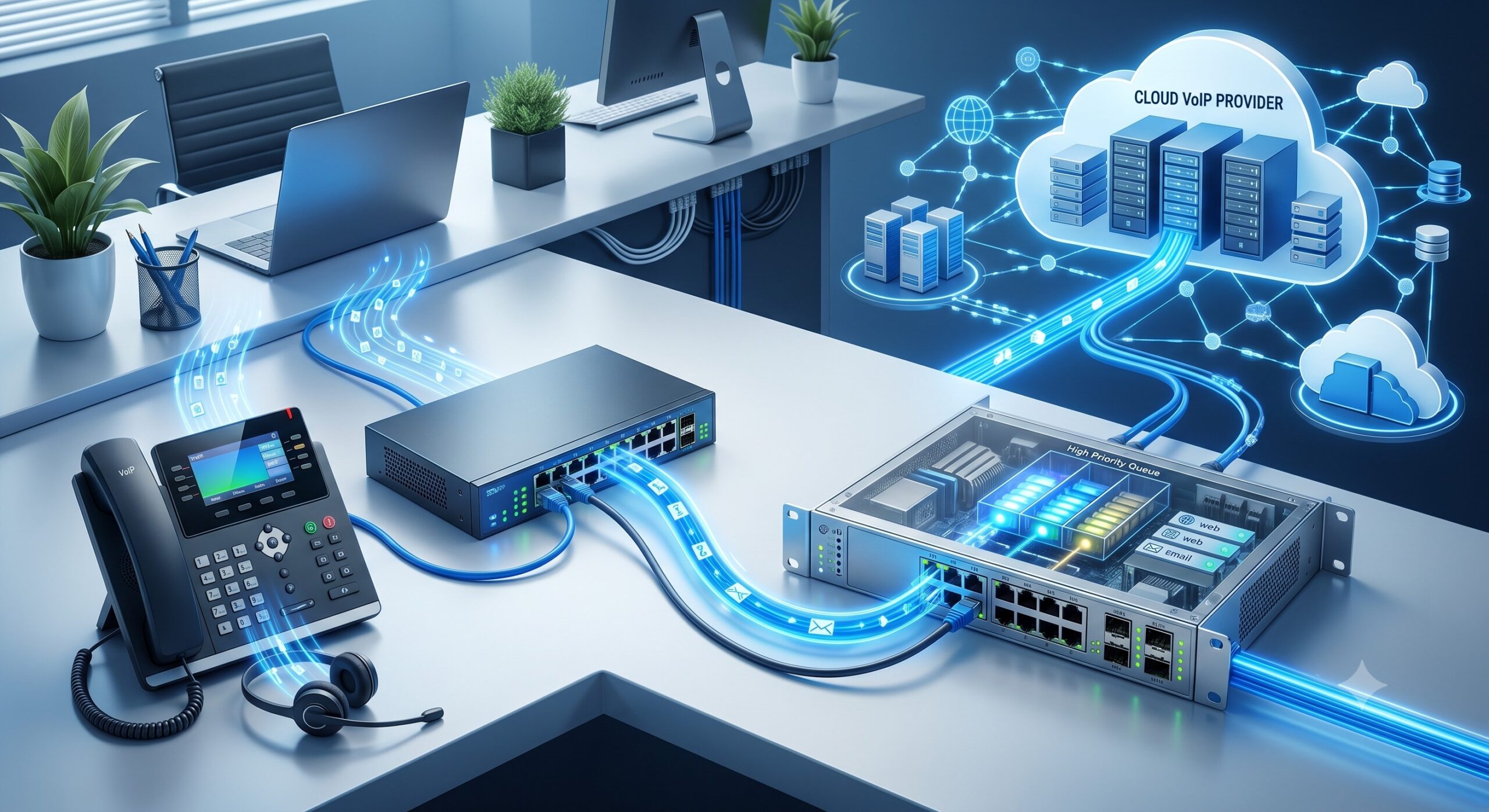
To prioritize voice, network engineers implement Strict Priority Queueing (SPQ) coupled with Weighted Fair Queueing (WFQ). Voice flows (DSCP EF) are placed into the highest priority hardware queue (Queue 7). However, to prevent starvation of control plane traffic (e.g., OSPF, BGP), which uses DSCP CS6 (48), a scheduler enforces a policer. The recommended bandwidth reservation for voice under Cisco’s Enterprise QoS SRND is 33% of the link capacity for the strict priority queue, but never exceeding 50% to avoid tail drop. For WAN links (e.g., 1 Gbps MPLS), LLQ (Low Latency Queueing) polices voice traffic to a specific rate (e.g., 2 Mbps for 50 concurrent G.729 calls), guaranteeing sub-10ms queuing delay.
Traffic Policing vs. Shaping
Use policing (drop) at the ingress edge to block non-conforming voice streams (e.g., a user running a speed test over RTP ports). Use shaping (buffer) at the egress to smooth bursts. For voice, shaping is dangerous as it induces jitter; thus, policing is preferred. The ASIC ‘bucket’ algorithm (e.g., single-rate three-color marker – srTCM, per RFC 2697) allows for a committed burst (Bc) and excess burst (Be). A typical setting for a VoIP gateway is CIR = 128 Kbps, Bc = 4 KB, matching G.711 packetization intervals (20ms).
Overcoming Bottlenecks: The Problem of Micro-bursts
Traditional queue statistics often miss micro-bursts (sub-ms congestion) which are fatal to voice. While a 1 Gbps link appears idle at 50% utilization, a 100μs burst of 500 Mbps from an HDFS replication can fill the port buffer. The solution lies in Dynamic Buffer Allocation (DBA) and Priority Flow Control (PFC – IEEE 802.1Qbb) in converged networks. For voice, configuring a dedicated egress queue with a minimum reserved buffer of 1.5 MB prevents tail drop. Validate using hardware counters for ‘QoS Dropped Packets’ rather than software interface statistics.
Data-Driven Evaluation: Latency and Jitter Benchmarks
In a controlled lab environment using Spirent TestCenter, a baseline network with no QoS supporting 20% background UDP traffic (1,500-byte frames) introduced 78ms of jitter and 2.3% packet loss to G.711 streams. After implementing DSCP-based LLQ, jitter fell to 1.2ms with 0.001% loss. MOS (Mean Opinion Score) improved from 3.1 (tolerable) to 4.5 (toll-quality). The key takeaway: hardware-accelerated QoS ensures deterministic sub-millisecond forwarding regardless of link saturation up to 95% of line rate, assuming proper shaping of non-voice queues.
Conclusion: Architecting for Zero Packet Loss
Prioritizing voice traffic is a matter of engineering the packet pipeline from classification to scheduling. By enforcing DSCP EF marking at the trust boundary, configuring Strict Priority Queues with policers, and adhering to ITU-T latency constraints, network architects guarantee business continuity. As we move toward 5G transport and Deterministic Networking (DetNet – IEEE 802.1CM), the fundamental principles remain: low latency, minimal jitter, and zero loss for real-time flows. Validate your deployment with telemetry data, not assumptions.

Leave a comment