
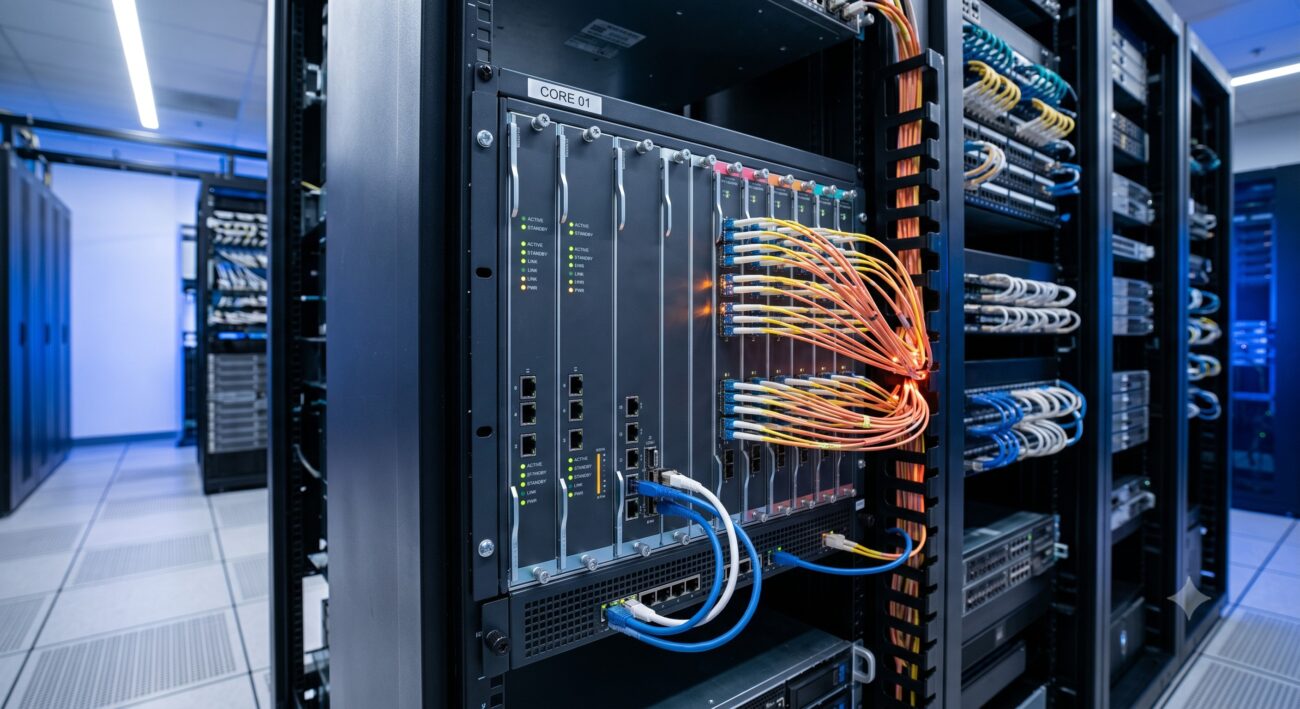
Introduction: The Non-Negotiable Uptime Mandate for Campus Core Switching
In the modern enterprise campus network, the core switch is the systemic heart. A single forwarding decision error or power plane failure can paralyze thousands of users, halt VoIP infrastructure, and breach SLA commitments within milliseconds. Unlike distribution or access layer gear, the enterprise campus network core switch demands carrier-grade resilience—measured not in percentages but in “nines” of uptime and deterministic failover. This guide provides a data-driven framework for evaluating Mean Time Between Failures (MTBF), hardware redundancy architectures, and compliance with industry standards such as IEEE 802.1Q, ITU-T G.8032, and RoHS 3. We move beyond marketing claims to examine actual ASIC behavior, backplane resilience, and real-world field deployment data.
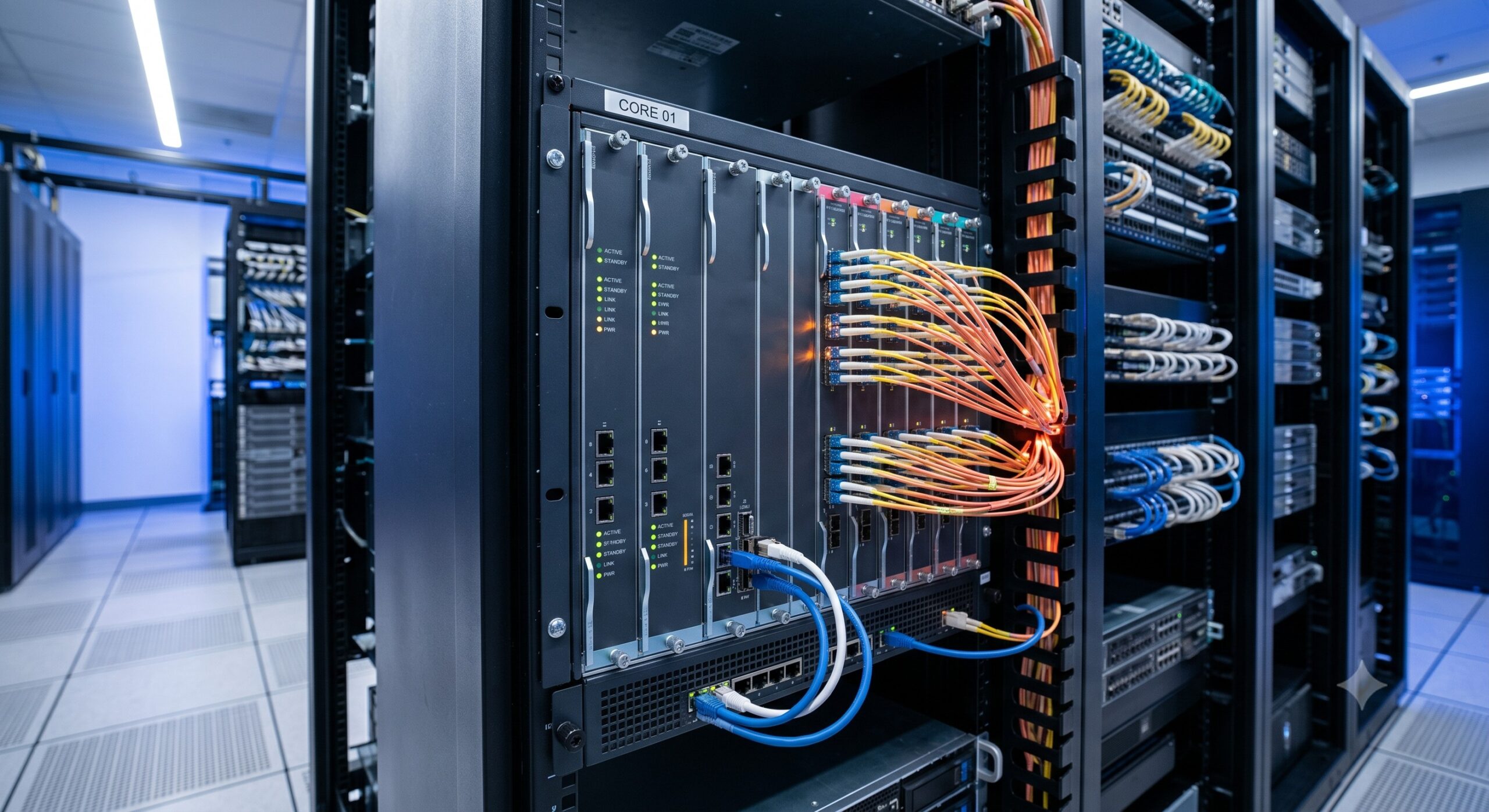
Defining Carrier-Grade: From Five-Nines to Fault-Isolated Domains
Carrier-grade availability for a campus core is typically defined as 99.999% uptime (~5.26 minutes of downtime per year). Achieving this requires more than redundant power supplies; it requires hardware-level fault isolation. The enterprise campus network core switch must implement fully redundant switch fabric modules (often 1+1 or N+1), supervisor engines with stateful switchover (SSO), and non-stop forwarding (NSF) capability. According to industry reports, the average MTBF for carrier-grade core switches ranges from 150,000 to over 300,000 hours, with high-end modular chassis designs leveraging passive backplanes to eliminate single points of failure. Redundancy topologies such as MC-LAG (Multi-Chassis Link Aggregation) and Virtual Port Channel (vPC) further reduce control-plane convergence time from seconds to sub-50ms.
Key Redundancy Metrics to Quantify
- Hardware Redundancy: 1+1 supervisor, N+1 fabric, 2+2 power (AC/DC hybrid).
- Convergence Time: Sub-200ms for link failure; sub-second for node failure.
- Hitless Failover: Zero packet loss during supervisor switchover (validated via RFC 2544).
- MTBF (Telcordia SR-332): Minimum 200,000 hours at 40°C ambient.
| Reliability Parameter | Carrier-Grade Core Switch Specification |
|---|---|
| MTBF (Telcordia SR-332, 40°C) | ≥ 250,000 hours |
| Supervisor Redundancy | 1:1 Stateful Switchover (SSO) with NSF |
| Fabric Module Redundancy | N+1 (min. 2 active fabrics) |
| Power Supply Redundancy | 2+2 or 3+3, hot-swappable, AC/DC hybrid |
| Cooling Redundancy | N+1 fan trays, bidirectional airflow |
| Switch Fabric Capacity | ≥ 10 Tbps (non-blocking) |
| L3 Forwarding Rate | ≥ 7 Bpps (billions packets per second) |
| Convergence Time (Link Failure) | ≤ 50ms (via BFD or G.8032) |
| IEEE Compliance | 802.1Q, 802.1ag, 802.3ad, 802.1AX |
| ITU-T Compliance | G.8032 v2, Y.1731 |
| Environmental Standards | RoHS 3, REACH, ETSI 300 019 |
ASIC-Level Forwarding Resilience: Beyond Control Plane
The true test of a core switch lies in its packet forwarding engine (typically a TCAM-based ASIC). Commodity switches often share a single forwarding table across all ports, creating a bottleneck. Carrier-grade designs implement distributed forwarding where each line card hosts its own FIB (Forwarding Information Base) and adjacency table. When evaluating an enterprise campus network core switch, demand specs for L3 forwarding capacity (e.g., 11.44 Tbps to 25.6 Tbps), MAC address table size (≥256K), and IPv4/IPv6 route scalability (≥1M routes). Latency figures should be sub-3 microseconds for 10GbE ports and sub-10 microseconds for 100GbE ports under full load. Additionally, hardware support for ITU-T Y.1731 performance monitoring and IEEE 802.1ag Connectivity Fault Management (CFM) is essential for proactive link integrity checking.
Redundancy Protocols & Standards Compliance
- IEEE 802.1Q-2018: VLAN and Multiple Spanning Tree Protocol (MSTP).
- ITU-T G.8032 v2: Ethernet Ring Protection Switching (sub-50ms recovery).
- EVPN/VXLAN: Multi-homing and active-active gateways (RFC 7432).
- BFD (Bidirectional Forwarding Detection): Sub-50ms failure detection (RFC 5880).

Case Study: MTBF in Real-World Campus Deployments
A financial services enterprise with 12,000+ users across a 0.4 km² campus replaced legacy 1U fixed-form switches with a modular enterprise campus network core switch featuring 1+1 fabric and N+1 fans (N=4). The vendor-reported MTBF of 289,000 hours (Telcordia SR-332, 40°C) was validated over 18 months: zero unplanned outages, two fan tray replacements performed online, and one power supply swapped without disrupting forwarding. The key enabler was hitless OIR (Online Insertion and Removal) for all field-replaceable units (FRUs). Compared to the previous generation, hardware-related trouble tickets dropped by 94%, and the mean time to repair (MTTR) fell from 4 hours to 45 minutes through modular diagnostics.
Conclusion: Quantifying the Reliability ROI
Selecting an enterprise campus network core switch based solely on port density or upfront cost ignores the financial impact of unplanned downtime. For mission-critical environments, prioritize hardware platforms with ≥250,000 hours MTBF, distributed ASIC forwarding, and stateful supervisor redundancy. Mandate compliance with IEEE and ITU-T fault management standards, and require demonstrable sub-200ms convergence using BFD and G.8032. The carrier-grade core is not an expense—it is an insurance policy against revenue loss, reputation damage, and SLA breaches.

Leave a comment