

STRATEGIC HARDWARE POSITIONING
This document serves as a comprehensive technical and strategic evaluation of the Cisco and H3C campus switch portfolios. As enterprise edge environments evolve to accommodate higher device densities, IoT proliferation, and bandwidth-intensive applications, the selection of a campus switching fabric has become a critical determinant of operational efficiency, security posture, and total cost of ownership (TCO).
This report provides an architectural comparison, a breakdown of hardware capabilities, and a performance analysis of equivalent product tiers to equip procurement and engineering teams with the requisite data for an informed acquisition decision. The evaluation focuses on key criteria including hardware reliability, switching capacity, protocol interoperability, and lifecycle support.

HIGH-AVAILABILITY REDUNDANCY
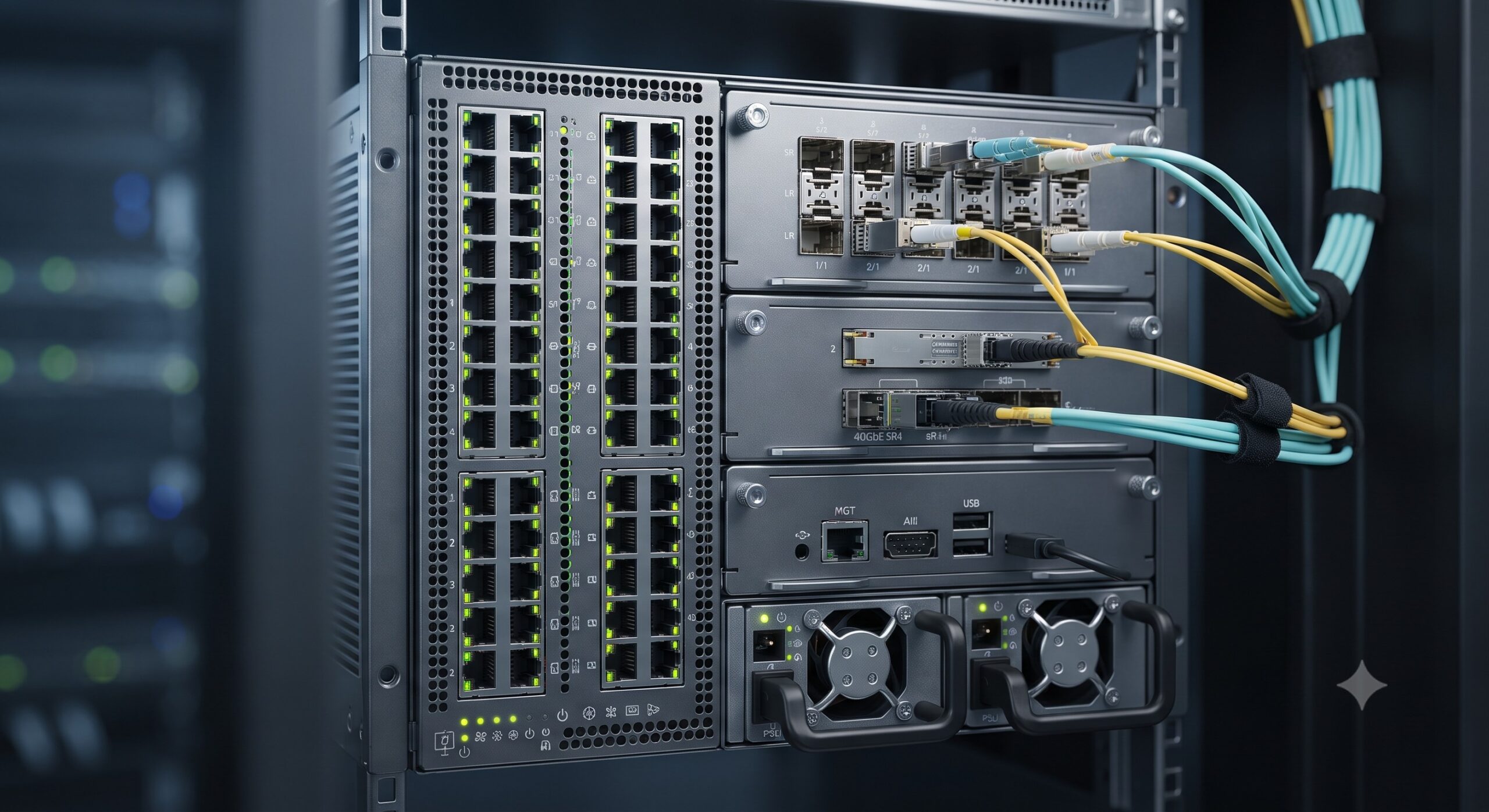
Both Cisco and H3C offer mature hardware redundancy mechanisms across their modular and fixed-configuration campus switch lines. Cisco leverages its proprietary StackWise and VSS (Virtual Switching System) technologies to enable multiple physical switches to operate as a single logical entity, delivering sub-second failover and simplified management. In the modular core and distribution layers, Cisco Catalyst 9000 and legacy 6500-series chassis support 1+1 or N+N supervisor engine and power supply redundancy, ensuring carrier-grade uptime.
H3C counters with its IRF2 (Intelligent Resilient Framework 2) technology, which supports the virtualization of up to 9 member devices over standard Ethernet interfaces . This allows for distributed device management and link aggregation across the stack, offering comparable resilience and scalability to Cisco’s stacking solutions. In its modular chassis (e.g., S7500E series), H3C provides similar redundant power and fan tray designs. However, Cisco’s ecosystem, as cited in Gartner Peer Insights, is frequently highlighted for its ‘rock solid hardware reliability and durability’ in maintaining high uptime and handling dense enterprise traffic smoothly .
PROTOCOL INTEROPERABILITY
A critical differentiation lies in the network operating systems and their feature sets. Cisco switches predominantly run on the IOS or IOS-XE operating system, renowned for its comprehensive protocol support, including proprietary protocols like EIGRP (Enhanced Interior Gateway Routing Protocol) and HSRP (Hot Standby Router Protocol) . While robust, this reliance on proprietary standards can present interoperability challenges in a multi-vendor environment, often requiring protocol conversion or replacement during migration (e.g., migrating from EIGRP to OSPF).
H3C utilizes the Comware V7 operating system, which, while offering a CLI syntax similar to Cisco’s, is structurally more aligned with Huawei’s VRP . Comware supports all standard networking protocols (OSPF, BGP, MSTP) and emphasizes compatibility with open standards to facilitate smoother integration in heterogeneous networks. For Data Center environments, Cisco’s NX-OS offers deep integration with ACI (Application Centric Infrastructure), whereas H3C’s VCF (Virtual Converged Framework) and SeerEngine focus on SDN/NFV integration, with strengths in local support for SDN deployments. User sentiment suggests H3C often scores higher on ‘integration and deployment’ ease, while Cisco excels in feature depth once deployments are stabilized .
DETAILED PARAMETERS
The following section details the performance capabilities of specific product tiers to establish a quantifiable comparison.
Access Layer Comparison: The Cisco Catalyst 2960-X series offers Gigabit Ethernet access with a switching capacity of 336 Gbps and a forwarding rate of 68.5 Mpps . In contrast, the H3C S5130 (or comparable models like the WS5820-28X-WiNet) offers similar Gigabit connectivity but boasts a higher forwarding rate of 108 Mpps on specific SKUs, often attributed to the integration of 10G uplink ports as standard .
Modular Core/Distribution: A comparison of legacy platforms, such as the Cisco Catalyst 6506-E (480 Gbps switching capacity, 243 Mpps throughput) and the H3C S7503E (1,000 Gbps, 274 Mpps throughput), highlights H3C’s focus on delivering higher raw performance metrics at a comparable price point .
PROTOCOL INTEROPERABILITY (continued)
From an architectural perspective, Cisco’s advanced ASIC design in the Nexus series supports sub-microsecond latency (under 1 microsecond) for high-frequency trading applications, a benchmark that remains a challenge for H3C’s enterprise switches to meet consistently . For standard campus applications, however, the hardware capabilities of both vendors are largely adequate to meet the demands of modern enterprise networks.
| Parameter | Cisco Specification (Example) | H3C Specification (Example) |
|---|---|---|
| Form Factor | 1RU / 2RU Fixed or Modular Chassis | 1RU / 2RU Fixed or Modular Chassis |
| Switching Capacity (Access) | 336 Gbps (Catalyst 2960-X Series) | 336 Gbps (S5130 Series) |
| Forwarding Rate (Access) | 68.5 Mpps (Catalyst 2960-X) | 108 Mpps (S5130-28X) |
| Switching Capacity (Core) | 480 Gbps (Cat 6506-E) | 1000 Gbps (S7503E) |
| Throughput (Core) | 243 Mpps (Cat 6506-E) | 274 Mpps (S7503E) |
| Redundancy | StackWise, VSS, 1+1 Sup/PSU | IRF2, 1+1 Sup/PSU |
| Operating System | IOS / IOS-XE / NX-OS | Comware V7 |
| Key Protocols | EIGRP, HSRP, PVST+ | OSPF, BGP, MSTP |
| Primary Use Case | Multi-National Enterprises, High-End Data Centers | APAC Enterprises, Government, Education |
LIFECYCLE ASSURANCE (MTBF)
Enterprise hardware procurement extends beyond features to encompass service, support, and financial stability. Cisco offers a global services ecosystem, providing consistent support standards worldwide. Gartner reviews indicate that Cisco’s hardware reliability and the depth of its lifecycle roadmap are key purchasing factors for multi-national corporations .
H3C, while traditionally having a stronger footprint in the APAC region, benefits from strong local service and support networks, particularly in the government and education sectors within the Chinese market . H3C’s value proposition is often centered on competitive pricing, ease of deployment, and a more accessible support structure for regional customers. H3C users have historically rated the vendor higher in ‘Service and Support’ and ‘Evaluation and Contracting’ compared to Cisco’s global offerings . However, H3C’s global services footprint may not match the scale of Cisco’s, potentially impacting support consistency in non-APAC regions.
TARGET NETWORK TOPOLOGIES
Cisco remains the preferred choice for large-scale, multinational enterprises requiring deep architectural integration, proprietary protocol support (EIGRP, HSRP), and a unified global service experience .
H3C is a compelling alternative for enterprises with a strong regional (APAC) presence, a focus on SDN integration, and a requirement for cost-effective, high-performance switching hardware. Its compatibility with open standards also makes it a suitable candidate for new builds where lock-in to proprietary protocols is a concern.
📥 Download Technical Specification
Click the button below to view or download the full official PDF datasheet.

Leave a comment