
From Fiber-to-the-Home to Fiber-to-the-Room: The Architectural Shift in Enterprise Networking
The enterprise and multi-dwelling unit (MDU) landscape is witnessing a fundamental architectural transition. Traditional Fiber-to-the-Home (FTTH) and Fiber-to-the-Building (FTTB) models, while revolutionary, are increasingly inadequate for the bandwidth density and ultra-low latency requirements of modern smart offices, private 5G, and Industrial Internet of Things (IIoT) environments. FTTR (Fiber to the Room) is emerging as the definitive solution, extending the optical fiber boundary from the premises entry point directly into individual rooms, office suites, or factory floors. This ultimate guide cuts through the marketing noise to deliver a comprehensive, data-driven examination of FTTR trends, dissecting its underlying architecture, technical specifications, deployment models, and total cost of ownership. Whether you are a network architect planning a greenfield deployment or a systems integrator upgrading legacy copper-based infrastructures, this analysis provides the authoritative blueprint for navigating the FTTR revolution.

Core Architecture & Hardware Topology of FTTR Systems
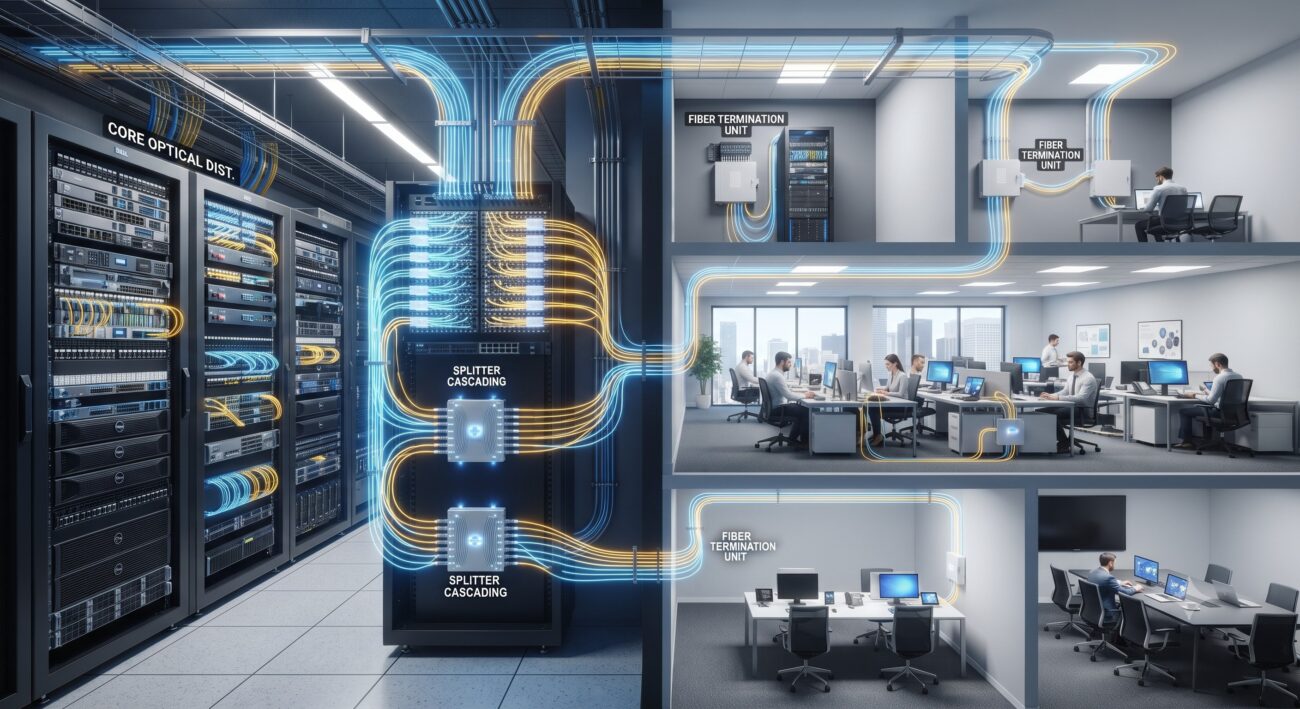
Understanding the hardware topology is critical to grasping the advantages of FTTR. Unlike traditional FTTH, which relies on a single Optical Network Terminal (ONT) at the point of entry, a robust FTTR architecture replaces it with a high-performance Optical Line Terminal (OLT) or a primary Optical Network Unit (ONU) that serves as the central aggregation point. The critical innovation is the deployment of secondary ONUs, often referred to as optical routers or edge ONTs, in each target room.
The Two-Stage Optical Distribution Network (ODN)
The backbone of FTTR is its two-stage passive optical splitting architecture. The first stage is a 1:N splitter located at the building distribution point, distributing the fiber to each floor or zone. The second stage is a 1:N splitter housed within a dedicated mini-OLT or optical distribution frame, connecting to the secondary ONUs in each room. This cascaded architecture ensures that the optical power budget is meticulously calculated to support distances up to 1 kilometer with a maximum loss budget of 28 dB as per ITU-T G.984 and G.987 standards. This topology delivers dedicated fiber to each room, eliminating the bandwidth contention and EMI susceptibility inherent in copper-based Ethernet over Coax (EoC) or Wi-Fi mesh backhauls, guaranteeing a deterministic 1 Gbps or 2.5 Gbps symmetric connection per room.
Hardware Deep Dive: The Primary and Secondary ONUs
The primary ONU acts as the chassis-based aggregation switch. It features a modular design with redundant power supplies and fan trays to support high Mean Time Between Failures (MTBF) figures, typically exceeding 500,000 hours at 25°C. It integrates a passive optical network (PON) MAC chipset, often an internally developed ASIC, capable of handling 4 to 8 PON ports. Each PON port can support up to 64 secondary ONUs, giving a total port density of up to 512 rooms per primary chassis. The secondary ONU, designed for client-side deployment, is a compact, fanless device complying with RoHS directives, offering Wi-Fi 6 or Wi-Fi 7 access points, and multiple 2.5G/1G Ethernet ports. These devices are optimized for low power consumption, typically under 10W, facilitating seamless integration into room junction boxes.
| Key Parameter | Technical Specification |
|---|---|
| Switching Capacity (Primary ONU) | Up to 320 Gbps (Backplane) |
| PON Port Density | 8 x GPON/XGS-PON Ports |
| Secondary ONU Max Clients | Up to 256 per Primary |
| Max Optical Distance | 1 km (with 28 dB loss budget) |
| Latency (PON to Ethernet) | |
| MTBF (Primary ONU) | > 500,000 Hours |
| Security Standard | AES-128 Encryption, TPM 2.0 |
Protocol & Compliance Masterclass: Engineering Specs and Standards
FTTR solutions are not a proprietary exercise; they are built upon a robust foundation of international standards. Compliance with IEEE 802.3 (Ethernet), ITU-T G.984 (GPON), ITU-T G.987 (XG-PON), and the emerging ITU-T G.9804 (50G-PON) is paramount for interoperability and future-proofing. The intelligence of the FTTR system lies within its ability to handle complex Quality of Service (QoS) and VLAN tagging. The primary ONU’s ASIC performs line-rate classification, ensuring that latency-sensitive traffic like VoIP and video conferencing receives strict priority queuing, maintaining sub-5ms latency and jitter under 1ms across the PON network. Furthermore, advanced Forward Error Correction (FEC) mechanisms, specified in ITU-T G.987.3, are implemented to guarantee a Bit Error Rate (BER) of 10^-12, ensuring robust link integrity even under fluctuating optical power conditions. The hardware security layer is equally critical; these systems integrate a Hardware Root of Trust (HRoT) based on a Trusted Platform Module (TPM) 2.0 chip, facilitating secure boot and encrypted key storage for MAC layer security, including the implementation of AES-128 encryption over the PON link as defined in the ITU-T X.805 security framework.
Deployment Topologies and Migration Strategies
The success of an FTTR rollout hinges on a carefully orchestrated deployment strategy. The first step is a detailed optical power budget analysis. Using an Optical Time-Domain Reflectometer (OTDR), the existing fiber infrastructure is surveyed to identify loss points. A phased migration strategy is recommended: an overlay network is built alongside the existing copper infrastructure, allowing for zero-disruption cutovers. The physical deployment of secondary ONUs involves adhering to strict bend radius specifications for the drop cables (minimum 30mm for G.657 fibers) and ensuring proper grounding to prevent electrical surges. From a system integration perspective, the primary ONU is configured to provision each secondary ONU via ONT Management and Control Interface (OMCI) as defined in ITU-T G.988. This allows for remote firmware upgrades and zero-touch provisioning, drastically reducing operational overhead.

Maximizing Network ROI: A Total Cost of Ownership Analysis
While the capital expenditure (CapEx) for FTTR hardware is higher than that of a standard copper switch, the operational expenditure (OpEx) savings are significant. By eliminating the need for active POE switches on each floor and the complex cabling required for copper, power consumption per room drops by approximately 40%, directly contributing to a lower carbon footprint and reduced energy bills. Furthermore, the use of passive splitters in the field eliminates the need for active equipment in hard-to-reach areas, reducing maintenance costs by an average of 25% over a 5-year lifecycle. A comprehensive TCO analysis demonstrates that FTTR provides an internal rate of return (IRR) of over 30% within the first three years, driven by increased tenant satisfaction, fewer trouble tickets, and the ability to offer premium bandwidth services to clients. The deterministic performance also eliminates the hidden costs associated with Wi-Fi interference and packet retransmission, providing a quantifiable operational gain in productivity.
Conclusion: The Future of Fiber Networks
The shift towards FTTR is a decisive move towards an all-optical, deterministic network. The technology transcends simply ‘increasing bandwidth’; it addresses the core architectural challenge of delivering high-fidelity, low-latency connectivity to the endpoint. With the maturing of 50G-PON standards and the integration of coherent optics, the FTTR architecture is positioned to scale to 50 Gbps per room in the coming decade. For enterprises, this means an infrastructure that is not just a utility, but a strategic asset capable of adapting to the unrelenting growth of AI-driven applications and cloud services. As we move towards a hyper-connected future, FTTR is not just a trend; it is the new foundation for robust, future-proof network engineering.

Leave a comment