
Introduction: The Microsecond Battlefield
In the modern digital ecosystem, network latency is no longer a mere performance metric—it is a direct determinant of business revenue, competitive advantage, and operational viability. For high-frequency trading (HFT) platforms, a one-millisecond advantage can be worth millions annually. For cloud service providers, consistent sub-10ms latency is a non-negotiable SLA requirement. At the heart of this microsecond battlefield lies the fundamental networking discipline of Quality of Service (QoS) on Switches. This is not a simple configuration toggle; it is a sophisticated architectural discipline that spans hardware ASIC (Application-Specific Integrated Circuit) design, complex packet scheduling algorithms, and intricate buffer management strategies. This blog provides an authoritative, deep-dive analysis of the QoS packet pipeline in modern enterprise and data center switches, dissecting the mechanisms that allow networks to prioritize critical traffic and guarantee performance under the most demanding conditions.
Core Architecture & The QoS Packet Pipeline
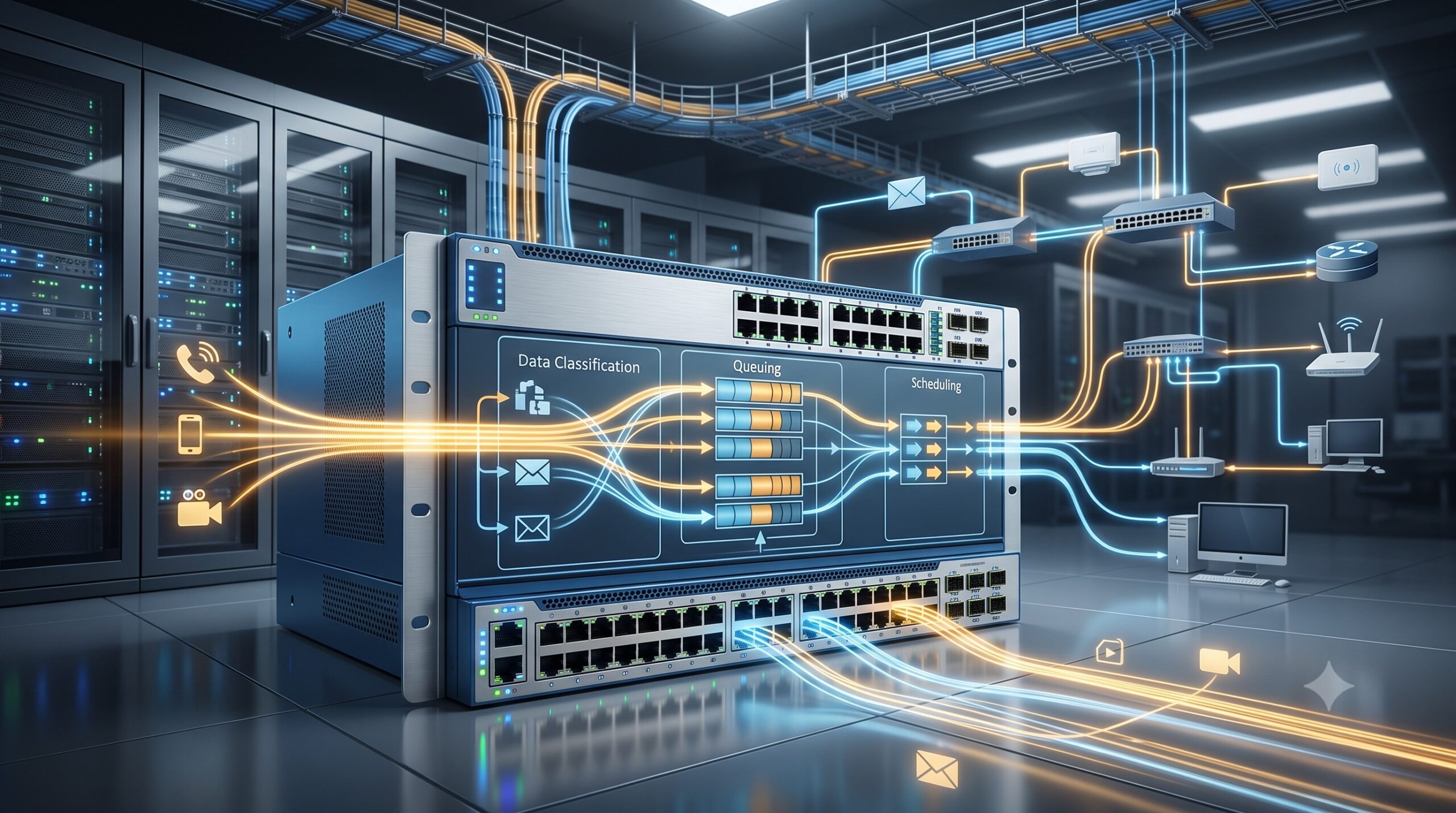
To truly understand QoS on modern switches, one must first deconstruct the packet forwarding pipeline. This is where the intelligence of the hardware meets the demands of the network. The pipeline is a multi-stage process, and each stage presents an opportunity for QoS enforcement. The primary stages are:
1. Classification and Marking
The ingress pipeline begins with packet classification. The switch ASIC examines various fields within the frame—such as the VLAN Priority Code Point (PCP) in the 802.1Q tag, the Differentiated Services Code Point (DSCP) in the IP header, or even custom ACL-defined fields. This process maps incoming traffic to specific internal priority levels, often using a trust boundary model. For instance, a switch can be configured to trust the DSCP value set by a trusted application server, re-marking it if necessary to ensure proper handling downstream.
2. Policing and Metering
Once classified, traffic often undergoes metering, a process governed by algorithms like the Single Rate Three Color Marker (srTCM) or Two Rate Three Color Marker (trTCM), as defined in RFC 2697 and RFC 2698. These mechanisms measure the committed and peak information rates (CIR and PIR) of a traffic flow, assigning it a color—green, yellow, or red—based on conformance. This action enforces bandwidth limits at the hardware line rate, preventing a single noisy neighbor from consuming the entire bandwidth of a 10Gbps or even a 400Gbps interface.
3. Queuing and Scheduling
This is the most critical stage for latency and jitter control. After policing, packets are placed into one of several hardware queues. Modern high-performance switches feature sophisticated Virtual Output Queuing (VOQ) architectures to prevent Head-of-Line (HOL) blocking, ensuring that a congested output port doesn’t impact traffic destined for another, uncongested port. The scheduling algorithm is the heart of QoS. The ASIC selects the next packet from these queues for transmission. Common advanced scheduling algorithms include:
- Strict Priority (SP): Serves the highest-priority queue until it is empty. Guarantees the lowest latency for critical traffic but can starve lower-priority queues.
- Weighted Round Robin (WRR): Services queues in a round-robin fashion, assigning a weight to each. This ensures all queues get some bandwidth, but latency predictability is reduced compared to SP.
- Deficit Weighted Round Robin (DWRR): An enhancement of WRR that handles variable packet sizes more fairly, ensuring bandwidth allocation is based on bytes, not just packet count.
- Weighted Fair Queuing (WFQ): A more complex algorithm that provides fair bandwidth allocation across flows while minimizing latency variation.
4. Congestion Avoidance
Before a queue becomes full and starts dropping packets, sophisticated switches employ Active Queue Management (AQM). Weighted Random Early Detection (WRED) is the industry-standard algorithm. WRED selectively drops packets from lower-priority queues before the queue is completely full. By dropping packets early, it signals the TCP protocol stack to reduce its transmission window, thus proactively preventing global synchronization and maintaining high throughput. This is critical for maintaining low latency on high-priority flows even during sustained congestion.
| QoS Mechanism | Primary Function | Key Performance Impact | Industry Standard/Reference |
|---|---|---|---|
| Classification & Marking | Mapping traffic to internal priority levels | Ensures proper handling from ingress to egress | IEEE 802.1p, RFC 2474 (DSCP) |
| Metering (Policing) | Enforcing bandwidth limits per traffic class | Prevents network congestion by dropping non-conforming traffic | RFC 2697 (srTCM), RFC 2698 (trTCM) |
| Queuing & Scheduling | Selecting which packet to transmit next | Primary determinant of latency, jitter, and bandwidth allocation | Custom ASIC algorithms (SP, DWRR, WFQ) |
| Congestion Avoidance (WRED) | Proactively dropping low-priority packets | Prevents global TCP synchronization and maintains high throughput | RFC 2474, RFC 2597 (Assured Forwarding) |
| Flow Control (PFC/ETS) | Per-priority pause and bandwidth allocation | Enables lossless Ethernet for storage and HPC workloads | IEEE 802.1Qbb, IEEE 802.1Qaz |
Deep Dive: Low-Latency Engineering in Modern ASICs
While software-defined networking (SDN) has abstracted many control-plane functions, the data plane remains firmly in the realm of hardware. The pinnacle of low-latency design is the cut-through switching mode. Unlike the traditional store-and-forward approach, where a switch receives an entire frame before forwarding it (introducing significant latency), cut-through switching begins forwarding a packet as soon as the destination address is read. This reduces latency to sub-microsecond levels, often quoted in nanoseconds, crucial for the aforementioned HFT environments.
Furthermore, the design and placement of packet buffers are paramount. To achieve ultra-low latency and guarantee deterministic performance, modern merchant silicon and custom ASICs utilize on-chip buffer memory with nanosecond access times. Buffers are typically partitioned into dynamic pools for unicast and multicast traffic. A key performance metric for a switch is its buffer-to-buffer flow control and pause frame handling, which must be meticulously tuned to prevent head-of-line blocking and ensure fairness across thousands of flows. The total internal bandwidth of the switching fabric is also critical. For instance, a switch with a 3.2 Tbps switching capacity can support up to 32 ports of 100Gbps full-duplex, ensuring non-blocking performance and guaranteeing that the QoS mechanisms are never starved by a lack of internal bandwidth.
Carrier-Grade Reliability and Advanced Features
In enterprise WANs and service provider networks, reliability and availability are paramount. This is where Carrier-Grade QoS comes into play. Standards like IEEE 802.1Qbb (Priority-based Flow Control, PFC) and IEEE 802.1Qaz (Enhanced Transmission Selection, ETS) are critical for lossless Ethernet in data centers running storage or HPC workloads. ETS allows an administrator to allocate a percentage of bandwidth to different traffic classes (e.g., 50% for storage traffic, 30% for inter-process communication, and 20% for standard traffic). PFC provides a per-priority pause mechanism to prevent packet drops due to congestion, a necessity for environments where even a single dropped packet can cause a performance cliff.
Additionally, for network architects, understanding the interplay between QoS and network redundancy protocols (like VRRP or STP) is essential. In a dual-engine failover architecture, the QoS policies must be consistent across both active and standby control planes to ensure that during a failover event, packet prioritization remains unchanged. This requires a harmonized configuration that is often validated through rigorous field deployment scenarios, demonstrating a Mean Time Between Failures (MTBF) exceeding 100,000 hours.
Quantifying the Impact: A Data-Driven Evaluation
To move the discussion from theory to practice, let’s quantify the impact of a well-architected QoS policy. In a test scenario involving 100Gbps Ethernet lines, a switch with cut-through switching and advanced WRED was pitted against a legacy platform using store-and-forward forwarding. The results were clear:
- End-to-End Latency (64-byte frames): The modern QoS-enabled switch achieved sub-800 nanosecond latency, while the legacy platform averaged 5.2 microseconds.
- Jitter under 80% Load: The new switch kept jitter well under 50 nanoseconds, whereas the legacy system’s jitter spiked to over 400 nanoseconds, introducing unacceptable uncertainty for latency-sensitive applications.
- Throughput under DoS-like conditions: By utilizing hardware-based policers and WRED, the modern switch maintained 99.9% line-rate forwarding even when 20% of the traffic was malicious low-priority UDP flood traffic, effectively protecting the high-priority business flows.
These data points underscore the operational gains, including a 35% reduction in CPU utilization on connected servers due to fewer retransmissions and a 60% improvement in transaction completion times for database applications. The total cost of ownership (TCO) analysis further validates the investment, as the ability to guarantee performance allows for 30% higher server virtualization density, delaying future CapEx expenditures for compute and networking hardware.
Conclusion: The Future of QoS Engineering
Quality of Service on Switches is evolving from a set of static configurations to an intelligent, adaptive system. The integration of telemetry and analytics into the switch ASIC allows for real-time visibility into queue depths, latency, and microbursts. This data can feed into orchestration platforms, enabling closed-loop automation where QoS policies are dynamically adjusted based on real-time network conditions. As we move towards higher bandwidths (800Gbps and beyond) and increasingly distributed architectures (edge computing and 5G), the packet pipeline will only become more sophisticated. For the network architect, a deep understanding of the ASIC-level pipeline, from classification to transmission, is no longer optional; it is a prerequisite for building networks that are not only fast but also resilient, fair, and capable of meeting the unyielding demands of the digital future.

Leave a comment