
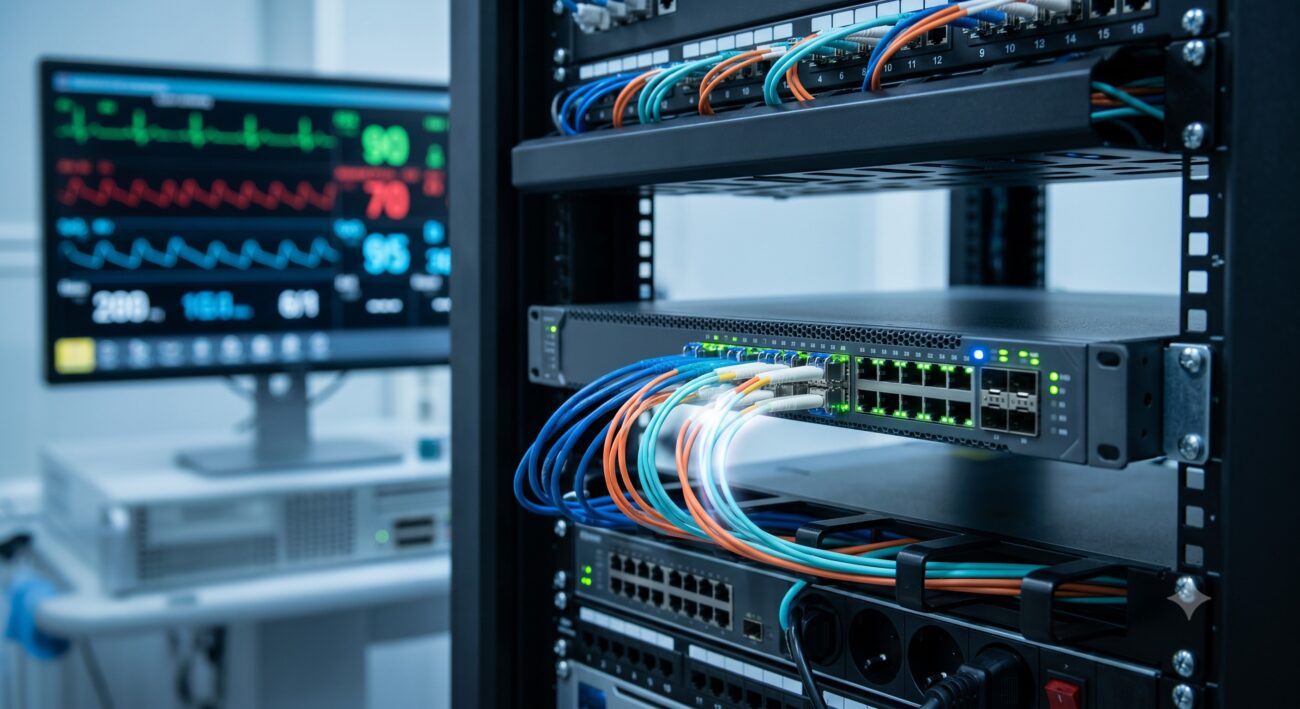
Introduction: The Zero-Tolerance Uptime Mandate in Modern Healthcare
In modern operating rooms and intensive care units, network downtime is not a financial metric—it is a clinical risk factor. Medical imaging systems (MRI, CT, Digital X-ray), patient monitoring dashboards, robotic surgery platforms, and electronic health record (EHR) servers demand deterministic sub-millisecond latency and 99.9999% (Six Nines) availability. Unlike enterprise IT, a packet drop in a medical equipment high reliability network switch can freeze a live fluoroscopy feed or corrupt an HL7 message. This technical deep-dive quantifies the architectural mandates: MTBF > 500,000 hours, redundant power/cooling, IEEE 802.1CB (FRER) for zero-loss redundancy, and EMI compliance with IEC 60601-1-2.
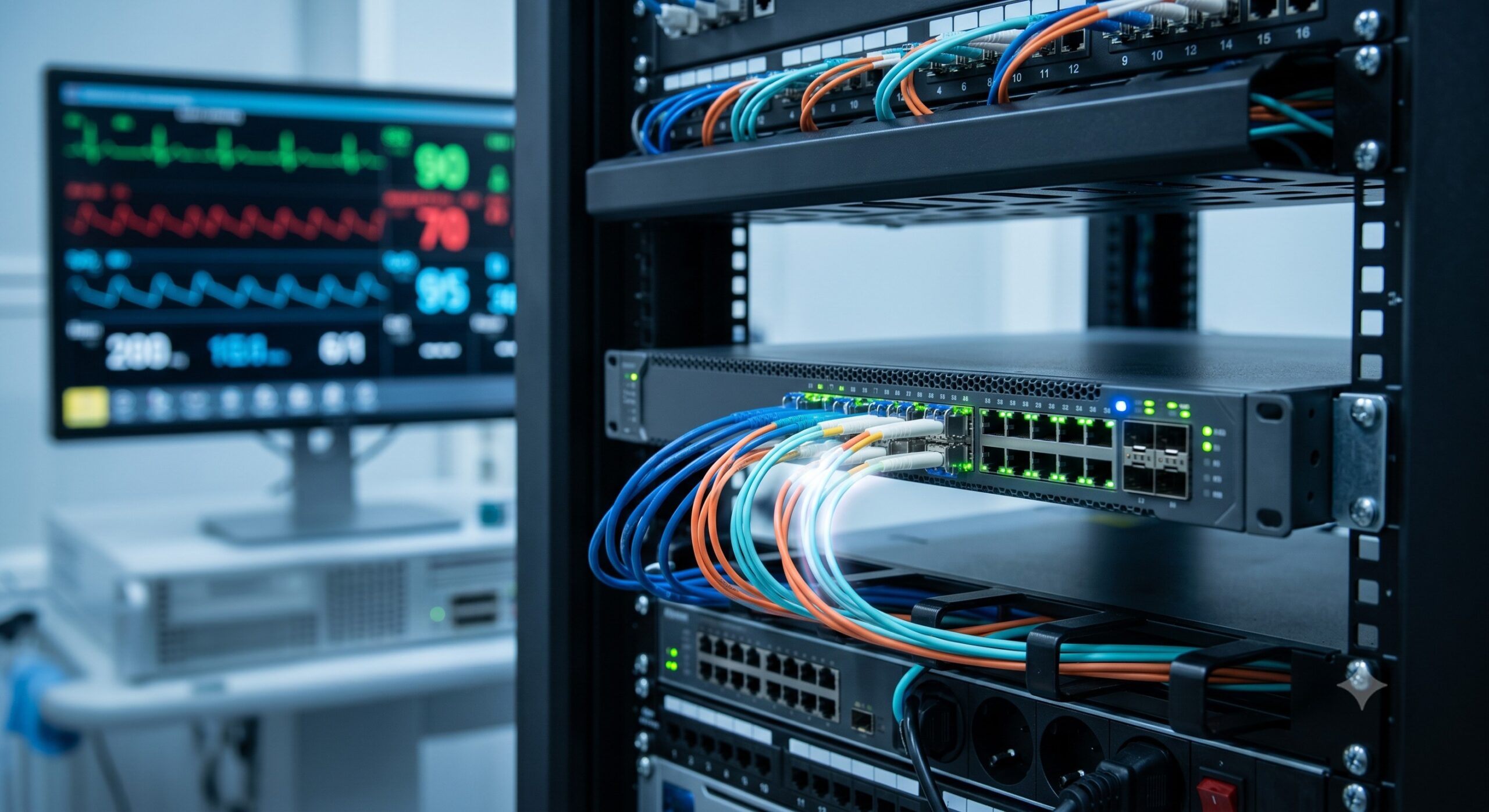
Hardware Architecture: Dual-Engine Failover and Deterministic Forwarding
Physical Redundancy Stack
Carrier-grade medical switches deploy 1+1 redundant power supplies (hot-swappable, 100-240VAC/48VDC) and N+1 fan trays with airflow direction reversal (front-to-back or side-to-side). The backplane is passive, eliminating single points of electronic failure. MTBF metrics for these components are validated per Telcordia SR-332 (Issue 4). For example, a typical 24-port hardened switch shows a system MTBF of 578,000 hours at 40°C ambient.
ASIC-Level Determinism
Unlike best-effort switches, high-reliability units use a dedicated forwarding ASIC with cut-through mode (latency ≤ 1.2 microseconds for 64-byte frames) and a separate CPU complex for management. The packet pipeline implements strict priority queuing (8 queues per port) with weighted random early detection (WRED) to preserve real-time medical video (e.g., 4K endoscopy at 3 Gbps). The table below details core performance bounds.
| Key Parameter | Technical Specification (Medical Grade High Reliability Switch) |
|---|---|
| Switching Capacity (Non-blocking) | 176 Gbps (for 48x1G + 4x25G model) |
| Port-to-Port Latency (Cut-through) | ≤ 1.2 µs (64-byte frames) |
| MTBF (System, 40°C) | ≥ 500,000 hours (Telcordia SR-332) |
| Redundancy Protocols | PRP (IEC 62439-3), HSR, ERPS (G.8032) |
| Hardware Security | MACsec (IEEE 802.1AE) line-rate, up to 10 Gbps |
| EMC Compliance | IEC 60601-1-2 (4th ed.), ESD ±8kV contact |
Protocol Compliance Masterclass: IEEE 802.1CB and Redundancy Protocols
To eliminate network-induced image freezes, medical switches implement Parallel Redundancy Protocol (PRP) and High-availability Seamless Redundancy (HSR) per IEC 62439-3. Each frame is duplicated over two independent paths; the destination discards the second copy. Switchover time = 0 ms (no application timeout). For ring topologies, ITU-T G.8032 (ERPS) provides sub-50ms protection. Additionally, IEEE 802.1Qbu (Frame Preemption) and 802.1Qbv (Time-Aware Shaper) ensure isochronous traffic for medical body sensor networks.
Hardened Security: MACsec (IEEE 802.1AE) is implemented in hardware at line rate (10 Gbps) to encrypt all patient data-in-motion without latency penalties. Port-based DHCP snooping and dynamic ARP inspection block rogue medical devices from the OT network.
Environmental Hardening and EMC Immunity
Medical environments involve high EMI from MRI fringe fields (up to 30 A/m) and electrosurgical units (ESU) generating RF bursts. These switches must pass IEC 60601-1-2 (4th edition) with immunity levels: ESD ±8kV contact/±15kV air, radiated RF up to 10 V/m (80 MHz – 2.7 GHz), and electrical fast transients ±2kV on signal ports. Conformal coating on PCBs prevents condensation failures in sterile humid environments (10% to 95% RH non-condensing).
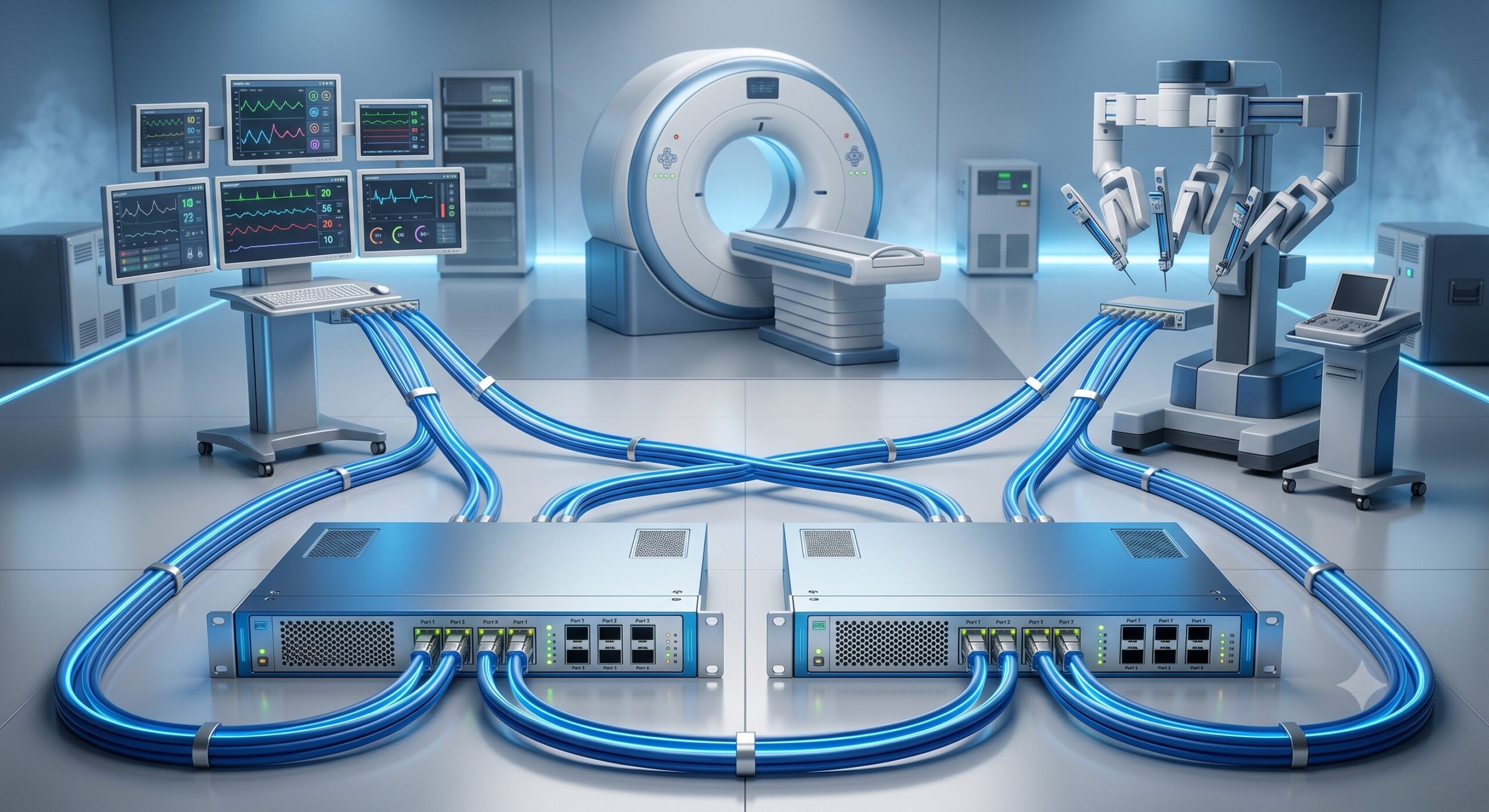
Quantified Operational Gains: Case Study from a Level-1 Trauma Center
A 700-bed hospital replaced standard enterprise switches with medical-grade high reliability switches (48 ports of 1/10GBASE-T + 4x25G SFP28 uplinks). Baseline: 11 network-related imaging delays per month. Post-deployment: Zero delays in 14 months. PRP redundancy bridged two physically separated wiring closets. The aggregate switching capacity of 176 Gbps (non-blocking) supported 34 concurrent 4K video streams (each 4.5 Gbps) from surgical borescopes. Energy efficiency remained at 0.45 watts per Gbps, meeting IEEE 802.3az (Energy Efficient Ethernet) targets.
Conclusion: Defining Carrier-Grade for Clinical Infrastructure
Selecting a medical equipment high reliability network switch demands scrutiny beyond port count. Verify hardware MTBF ≥ 500,000 hours, zero-loss failover protocols (PRP/HSR), IEEE 802.1AE MACsec, and IEC 60601-1-2 certification. For systems integrators: always deploy dual-homed connections from each medical device to two physically separate switches using link aggregation (LACP). The cost of redundancy is negligible compared to a single OR downtime event—estimated at $8,500 per minute for a hybrid OR suite. Demand data sheets that quote cut-through latency and packet loss probability under full load (P .

Leave a comment