
Introduction: The Glue of the Modern Internet
At the heart of every ISP, cloud provider, and global enterprise network lies the Border Gateway Protocol (BGP). As the only active Exterior Gateway Protocol (EGP) in use today, BGP is responsible for routing data between the over 100,000 autonomous systems (AS) that make up the internet. Understanding BGP routing protocol basics is no longer a niche skill; it is a prerequisite for any network architect managing a multi-homed, carrier-grade infrastructure. This guide provides a comprehensive, data-driven deep dive into the architecture, hardware interdependencies, and performance specifications of BGP-enabled routing hardware, bridging the gap between high-level protocol theory and physical layer engineering.
Core Architecture: The Control Plane, Data Plane, and Hardware Topology
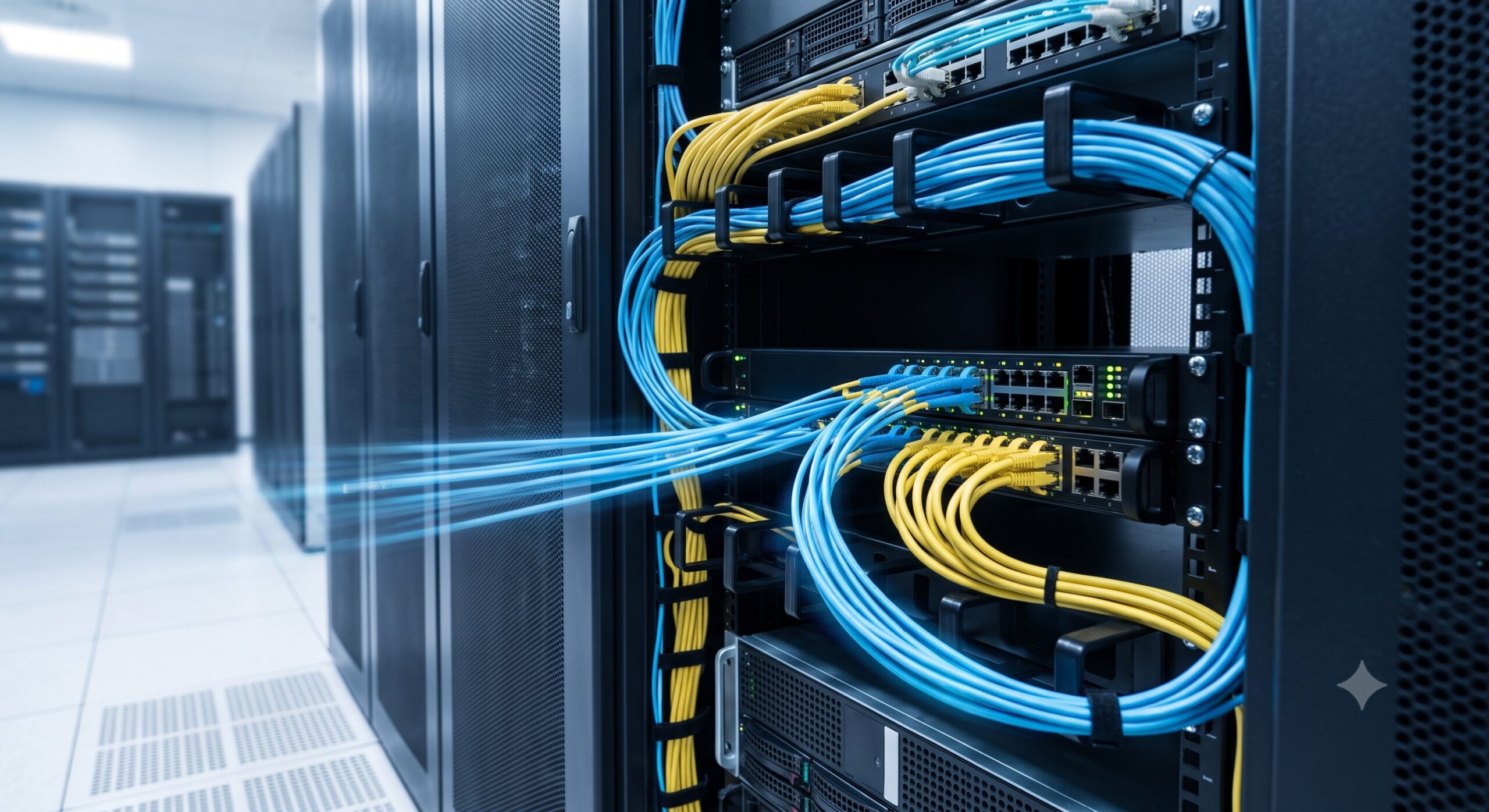
Modern BGP implementation is a story of two planes: the Control Plane and the Data Plane. The control plane, responsible for BGP peering sessions (TCP port 179) and route computation, leverages multi-core x86 or ARM processors to handle the massive Routing Information Base (RIB). In contrast, the data plane, which performs the actual packet forwarding, is accelerated by dedicated Application-Specific Integrated Circuits (ASICs) or NPUs (Network Processors). This hardware separation ensures that even as the global BGP table approaches 1 million prefixes (as of mid-2026), line-rate forwarding remains unaffected.
Memory and Route Scalability
Enterprise-grade routers supporting BGP require substantial DRAM and TCAM (Ternary Content-Addressable Memory). TCAM is a critical, high-cost component that enables O(1) lookup complexity, ensuring that the Forwarding Information Base (FIB) can handle 1 to 2 million routes. A system with insufficient TCAM will experience FIB exhaustion, leading to forwarding errors or route flapping. High-end chassis systems provide memory capacity to store multiple RIBs and adjacent RIB-in (Adj-RIB-In) for sophisticated policy application without sacrificing performance.
Industry benchmarks like RFC 4271 and RFC 7606 define error handling and resilience, while hardware compliance with RoHS and NEBS (Network Equipment Building Systems) Level 3 ensures hardware durability in high-temperature edge environments, often rated for an MTBF of over 500,000 hours.
BGP Path Attributes and Decision Process
Understanding the BGP decision process is crucial for traffic engineering. A BGP speaker evaluates paths based on a specific sequential order, stopping when a tie is broken. The default order is: Highest Local Preference -> Shortest AS_PATH -> Lowest ORIGIN Type -> Lowest MED -> eBGP over iBGP -> Lowest IGP metric to next-hop -> Oldest route.
However, BGP is not just a protocol; it is a traffic engineering tool. By manipulating these attributes (e.g., using route-maps to set community strings for LOCAL_PREF), network engineers can implement granular policies to load-share traffic or failover to backup links. For instance, setting a local preference of 200 over 100 can divert traffic effectively on the control plane, while the hardware’s FIB ensures this preference translates into hardware memory adjacency within sub-100 microseconds.
| Key Parameter | Technical Specification |
|---|---|
| Protocol Standard | RFC 4271 (BGP-4) |
| Transport Protocol | TCP Port 179 |
| Max Prefixes Supported | 1,000,000+ |
| MTBF | 500,000+ hours |
| Convergence Time (Optimized) |
Deployment Strategies: eBGP and iBGP Peering
There are two fundamental ways to run BGP: External BGP (eBGP) between different ASes and Internal BGP (iBGP) within the same AS. eBGP typically uses a TTL of 1 (multihop options exist) and requires direct physical connectivity or loopback interfaces with multihop configured. iBGP, however, relies on the underlying IGP to provide reachability to loopback addresses, eliminating the need for a full mesh of physical interfaces.
Hardware Considerations for Peering
Line cards must support high-density 100G/400G ports to accommodate the bandwidth required for peering exchanges. Consider an internet exchange point (IXP) where traffic reaches 10 Tbps. Each 400GE port consuming ~10W (based on QSFP-DD optics) results in significant thermal output. ASICs designed for BGP deployments must support complex hashing algorithms for ECMP (Equal Cost Multi-Path) to distribute traffic across up to 128 links.
In terms of convergence, standardized BGP Graceful Restart (RFC 4724) and Bidirectional Forwarding Detection (BFD) work hand-in-hand with silicon to ensure sub-second failover. BFD, with a timer of 50ms, triggers failover in hardware, minimizing jitter to under 10 milliseconds for critical financial data.
Security Features in BGP Hardware
Security is increasingly silicon-accelerated. Hardware-based BGP origin validation (RPKI, Resource Public Key Infrastructure) ensures that route announcements are legitimate before even entering the BGP table. Advanced routers integrate MACsec (IEEE 802.1AE) and IPsec engines on the line cards, enabling line-rate encryption at 400 Gbps with a latency penalty of less than 5 microseconds. This is non-negotiable for large enterprises and government agencies securing the routing core.

Data-Driven Convergence Metrics
Convergence time is the holy grail of BGP performance. Standard BGP convergence can take up to 3 minutes without optimization, thanks to Hold Timers (default 180 seconds). However, high-performance networking hardware has evolved. With BGP Fast External Failover and BFD, hardware can detect link failures within 50ms and converge routes in under 2 seconds. Furthermore, innovations like BGP PIC (Prefix Independent Convergence) allow the hardware to pre-program backup paths in the FIB, reducing failover times to 100ms for critical prefixes.
Case Study: Cloud Provider Architecture
Leading hyperscalers utilize a Route Reflector (RR) architecture to scale iBGP sessions. A single Route Reflector can handle 10,000+ BGP sessions. By using advanced hardware with route-flap damping capabilities, administrators prevent the propagation of unstable routes. The aggregate bandwidth through these routers often exceeds 25 Tbps, with an internal switching capacity of over 150 Tbps per chassis, demonstrating the raw power of modern core routing hardware.
Conclusion: The Future of BGP Hardware
As the industry moves toward Segment Routing (SR-MPLS/SRv6) and AI-driven networking, the underlying BGP hardware must evolve. Silicon is now embedding telemetry for real-time analytics, providing visibility into queue depth and buffer utilization at the nanosecond scale. Whether you are evaluating a new router or refining your current architecture, mastery of BGP routing protocol basics ensures you are prepared for the demands of 5G, IoT, and the ever-growing data explosion.

Leave a comment