

EXECUTIVE SUMMARY
The ZXR10 5250 Series is a carrier-grade, 1RU Gigabit Ethernet access switch platform engineered for high-density subscriber and enterprise edge deployments. Central to its multicast service delivery capability is the IGMP Snooping subsystem, which constrains multicast flooding at the Layer 2 boundary and directs IPv4 multicast traffic only to ports with active receivers. This document establishes the authoritative technical baseline for IGMP Snooping operational limits, configuration boundaries, and hardware co-dependencies on the ZXR10 5250 platform. Network architects should reference these parameters when designing IPTV, OTT video, and enterprise multicast distribution topologies where predictable group capacity and VLAN scaling are mandatory.

ARCHITECTURE & CHASSIS DESIGN
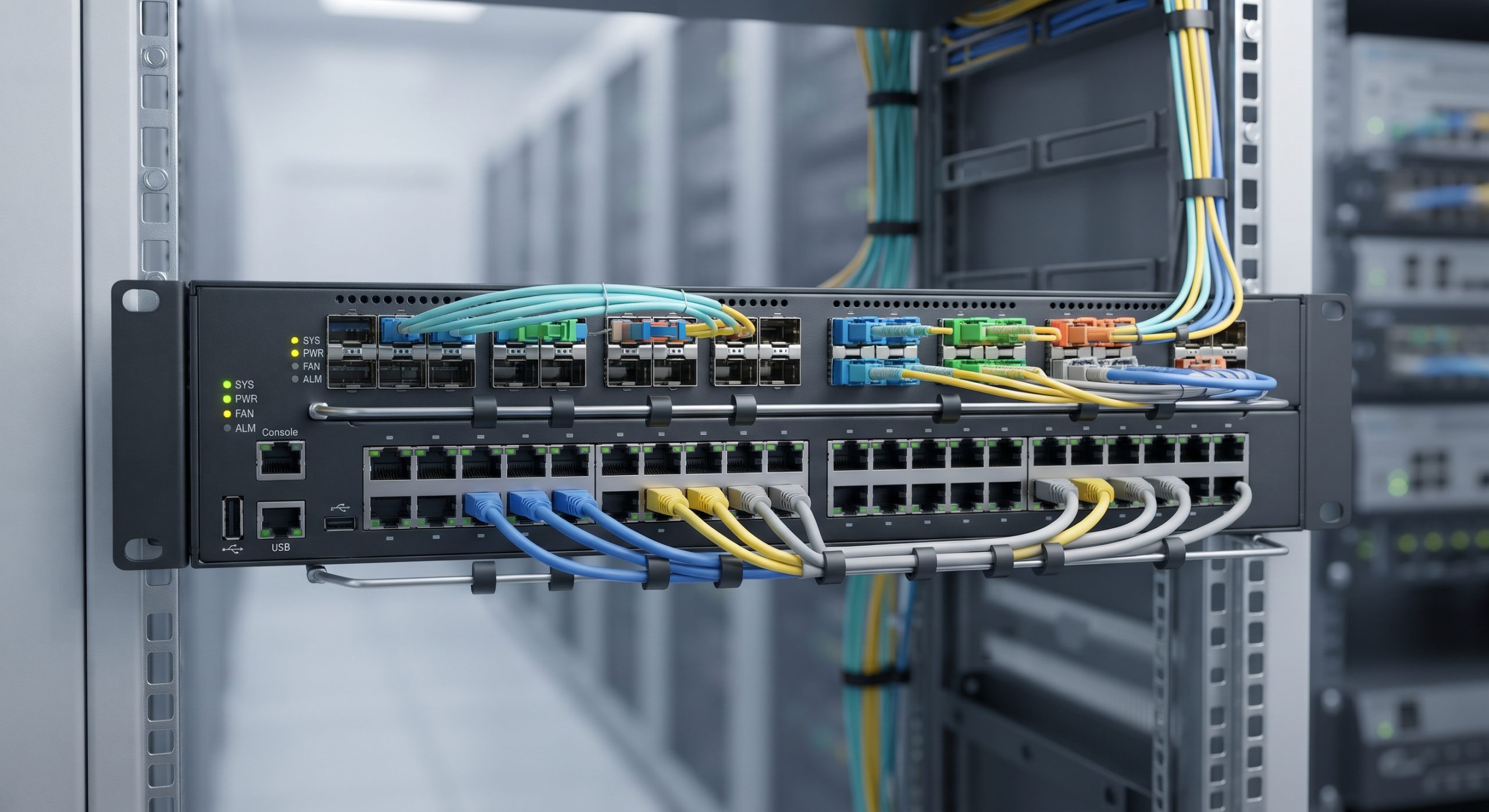
The ZXR10 5250 Series employs a non-blocking store-and-forward architecture built around a high-speed ASIC forwarding engine. The platform is available in multiple port configurations, with the flagship 5250-52TS-L model delivering 48 × 10/100/1000BASE-T RJ45 ports plus 4 × Gigabit SFP interfaces within a 1RU chassis . Backplane bandwidth reaches 256 Gbps with a packet forwarding rate of 42 Mpps for the 52-port configuration, while the MAC address table supports 16K entries . The IGMP Snooping function operates as a Layer 2 optimization mechanism within this forwarding pipeline, snooping IGMP membership reports and leave messages to maintain a per-VLAN multicast forwarding table. Without IGMP Snooping enabled, multicast frames are flooded to all ports in the VLAN, consuming unnecessary bandwidth and degrading overall switch utilization .
HARDWARE FEATURES
The multicast control plane on the ZXR10 5250 Series is tightly coupled with the platform’s VLAN and QoS capabilities. Key IGMP Snooping functional attributes include:
– IGMP Snooping version support: V1, V2, and V3, enabling compatibility with legacy and current multicast receiver signaling .
– Per-VLAN IGMP Snooping activation and deactivation, allowing selective multicast optimization across discrete service domains.
– Maximum multicast group limit configuration per VLAN or per port, with a replace keyword that permits replacement of the longest-unresponsive query group when the limit is reached .
– Static multicast group entry support based on VLAN, for deterministic forwarding of known multicast streams without reliance on dynamic membership learning .
– Multicast VLAN Registration (MVR) capability, facilitating shared multicast stream distribution across multiple subscriber VLANs without replication at the source .
– Controllable multicast and CAC channel access control, providing operator-enforced subscriber admission policies for multicast content .
– IGMP ring monitoring, a protective function for ring-based access topologies that prevents stale multicast forwarding states .
COMPLIANCE & STANDARDS
The ZXR10 5250 Series conforms to IEEE 802.3, 802.3u, 802.3ab, and 802.3z Ethernet standards. IGMP Snooping behavior aligns with IGMPv1 (RFC 1112), IGMPv2 (RFC 2236), and IGMPv3 (RFC 3376) protocol specifications for membership reporting and query processing. Power over Ethernet models additionally comply with IEEE 802.3af and 802.3at for powered device delivery . Environmental operating parameters specify a temperature range of -5°C to 50°C and humidity of 20% to 90% non-condensing for standard models .
TECHNICAL SPECIFICATIONS
The following table consolidates the principal hardware and IGMP Snooping parameters for the ZXR10 5250 Series. Parameters reflect the 5250-52TS-L configuration unless otherwise noted; IGMP Snooping limits are enforced at the software configuration layer within the constraints of the ASIC forwarding table resources.
| Parameter | Specification |
|---|---|
| Form Factor | 1RU fixed-configuration chassis |
| Switching Capacity | 256 Gbps (52-port models) |
| Packet Forwarding Rate | 42 Mpps (52-port models) |
| MAC Address Table | 16K entries |
| IGMP Snooping Versions | IGMPv1, IGMPv2, IGMPv3 |
| IGMP Snooping Scope | Per-VLAN enable/disable; per-VLAN/per-port max group limit; static group entries; MVR; ring monitoring |
| Max Multicast Group Limit | Configurable per VLAN/port (ASIC table resource-dependent; replace option available at limit) |
| VLAN Support | 4K VLANs (IEEE 802.1Q); Voice VLAN, PVLAN, GVRP |
| Multicast VLAN Registration | Supported (MVR) |
| Controllable Multicast | Supported with CAC channel access control and user access logging |
| Power Supply | AC 100–240V, 50–60Hz (non-PoE models: 27W typical; PoE models: up to 1020W with full PoE load) |
| Operating Temperature | -5°C to 50°C |
| Operating Humidity | 20% to 90% (non-condensing) |
| Dimensions (H × W × D) | 43.6 × 442 × 220 mm (typical 52-port non-PoE) |
| Weight | Approximately 3 kg (non-PoE 52-port) |
ORDERING OPTIONS
ZXR10 5250 Series ordering options span multiple port configurations to address varied access densities and PoE requirements. The 5250-52TS-L provides 48 GE electrical ports with 4 SFP uplinks for non-PoE access scenarios. The 5250-52PM variant adds full IEEE 802.3af/at PoE+ support across 48 ports with a dedicated expansion slot for 10GE uplink modules, suitable for IP surveillance and wireless access point aggregation . PoE-capable models deliver up to 840W of PoE budget in the 52PM configuration, with system power consumption rated at 180W exclusive of PoE load . All models in the series support the IGMP Snooping feature set described in this document, with maximum group limits governed by available ASIC table resources and the configured per-VLAN or per-port thresholds.
📥 Download Technical Specification
Click the button below to view or download the full official PDF datasheet.
Leave a comment