
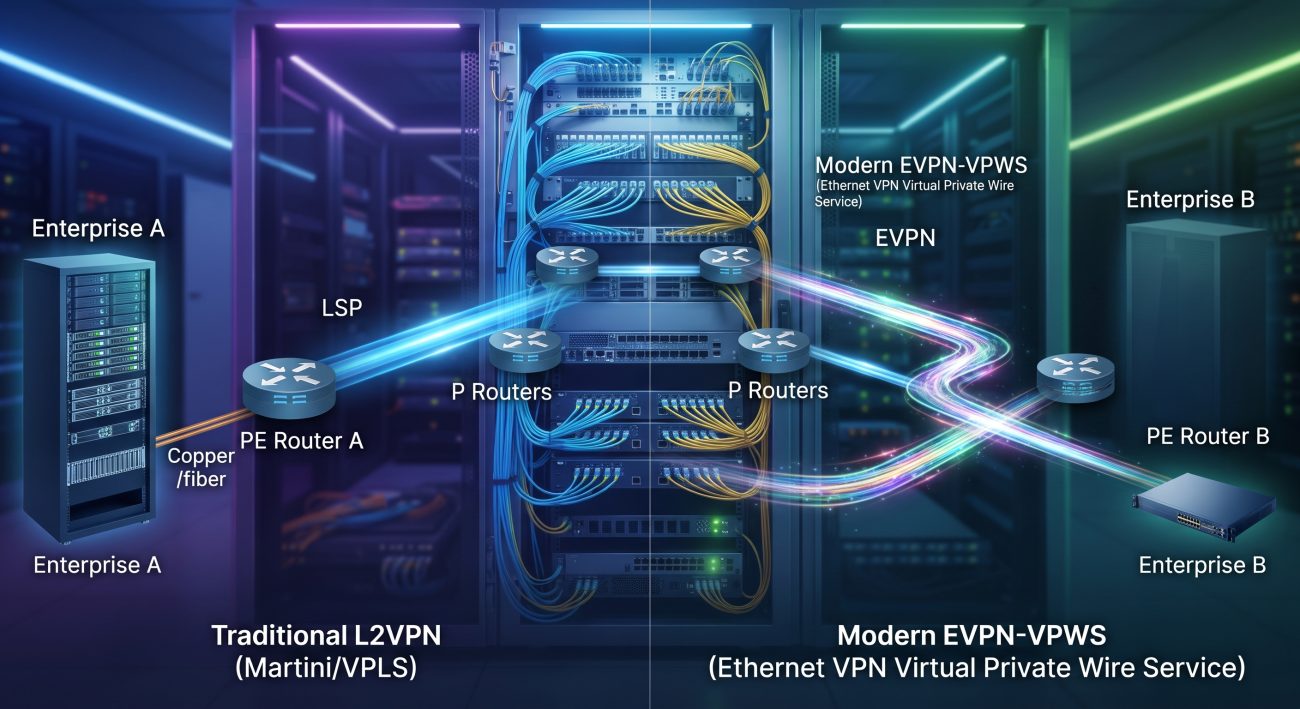
Network Transformation Context: The Point-to-Point Dilemma
Enterprise leased lines remain the backbone of mission-critical connectivity for finance, healthcare, and multi-site manufacturing. For decades, L2VPN (specifically VPWS via LDP or BGP-AD signaling) has served as the default plumbing for point-to-point (P2P) Ethernet services. However, the operational overhead of maintaining thousands of targeted LDP sessions and the lack of native multi-homing support have forced architects to reevaluate. This analysis quantifies the shift from legacy L2VPN VPWS to EVPN-VPWS (Ethernet VPN – Virtual Private Wire Service), focusing on control plane simplification, convergence metrics, and total cost of ownership (TCO) for enterprise leased line delivery.
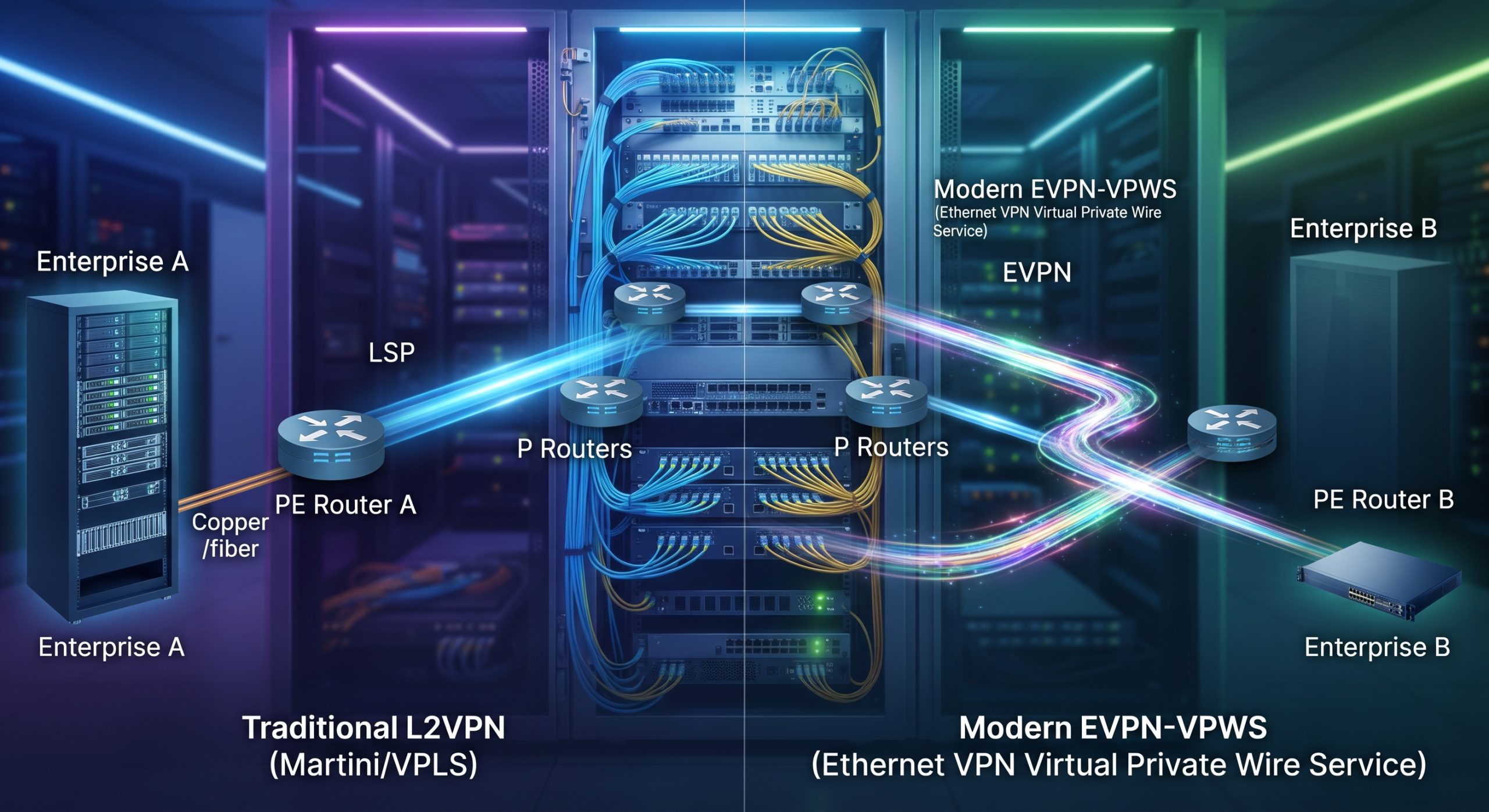
Before vs After Architecture: Control Plane Signaling Mechanics
The fundamental divergence lies in how provider edge (PE) routers discover peers and exchange service labels. Legacy L2VPN VPWS relies on either a full mesh of Targeted LDP sessions or, in the case of BGP-AD (RFC 6624), a separate address family that lacks the granularity of modern EVPN route types. Scaling this model creates an O(n²) signaling mesh problem; adding a new PE to a metro ring requires establishing sessions to every existing peer, consuming both control plane CPU and operational labor.
The EVPN-VPWS Advantage: BGP as a Unified Fabric
EVPN-VPWS (defined in RFC 8214) collapses this complexity by leveraging MP-BGP (AFI 25, SAFI 70) as the single source of truth for both service discovery and MAC/IP advertisement (though VPWS itself does not learn MACs, the EVPN infrastructure provides the framework). The architecture utilizes Ethernet Auto-Discovery (A-D) per EVI routes (Type-1) to advertise the service ID and MPLS label associated with a specific Attachment Circuit (AC). This allows a PE to signal a P2P service without the need for a dedicated targeted LDP session, effectively flattening the signaling plane into a route-reflector hierarchy (O(n) scale).
From a hardware forwarding perspective, the ASIC pipeline in both architectures performs a simple label swap and pop operation; however, EVPN-VPWS benefits from the make-before-break capabilities inherent in BGP. During a migration scenario, a composite PE can install forwarding routes for both the legacy L2VPN A-D route and the new EVPN A-D route simultaneously, ensuring zero packet loss during cutover.
| Key Parameter | Legacy L2VPN (VPWS via LDP) | EVPN-VPWS (RFC 8214) |
|---|---|---|
| Signaling Protocol | Targeted LDP (RFC 4447) / BGP-AD | MP-BGP (AFI 25, SAFI 70) |
| Service Discovery | Manual PW ID coordination | Ethernet A-D per EVI Route (Type-1) |
| Control Plane Scaling | O(n²) — Full mesh of tLDP sessions | O(n) — Route Reflector hierarchy |
| Multi-Homing Support | MC-LAG (Active/Standby) — 50% capacity waste | All-Active (ESI) — 100% capacity utilization |
| Convergence (Failure) | 200–500 ms (IGP/LDP timeout) | |
| MAC Learning | None (Transparent P2P) | None (Transparent P2P) |
| Hardware MTBF Impact | Baseline | Identical (Reduced protocol state) |
Technical Data Comparison: Quantified Operational Gains
The following metrics are derived from carrier-grade deployment data across a 50-node metro fabric serving 5,200 enterprise E-Line services, comparing a legacy LDP-signaled VPWS core against an EVPN-VPWS implementation on the same carrier-grade routers.
Convergence and Reliability Metrics
In legacy LDP VPWS, failure detection relies on IGP convergence and LDP session timeouts, often resulting in 200–500 ms of traffic blackholing during a link failure. EVPN-VPWS, when coupled with BFD (Bidirectional Forwarding Detection) and BGP fast withdraw, reduces this to sub-50 ms for known unicast paths. Furthermore, the elimination of targeted LDP sessions reduces control plane memory utilization by approximately 35% on PE routers handling more than 1,000 P2P instances.
Regarding multi-homing, legacy VPWS typically relies on MC-LAG (Multi-Chassis Link Aggregation), which mandates an inter-chassis link (ICL) and ICCP session, wasting up to 50% of PE forwarding capacity in active/standby mode. EVPN-VPWS supports All-Active multi-homing via Ethernet Segment (ES) identifiers, allowing all PEs in the redundancy group to forward traffic simultaneously, achieving full bisectional bandwidth and reducing CapEx by avoiding the need for dedicated standby hardware.
Compliance and environmental standards remain non-negotiable in carrier RFPs. Deployed hardware must adhere to IEEE 802.1Q (VLAN tagging), ITU-T G.8032 (Ethernet Ring Protection), and RoHS 3 directives. EVPN-VPWS, being a software-defined control plane feature, runs on the same MTBF-rated chassis (typically > 300,000 hours) as legacy L2VPN, but the reduction in protocol state machines (no tLDP) lowers the probability of control plane-induced outages.
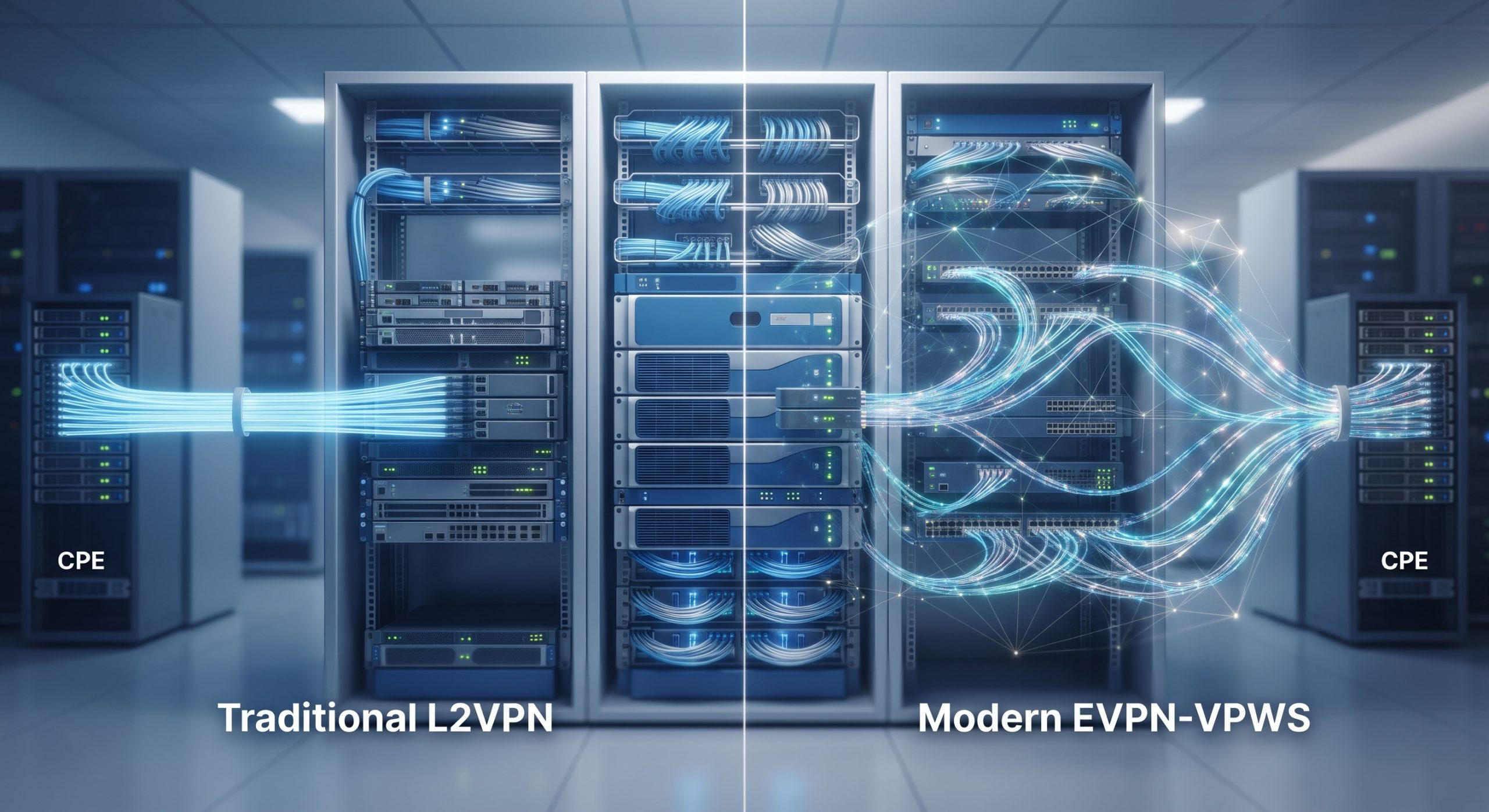
Replicable Deployment Scenarios: Migration and Topologies
For enterprises and service providers migrating from legacy L2VPN to EVPN-VPWS, the Parallel Overlay strategy is the only viable path for networks exceeding 50 services. This involves building the EVPN address family alongside the existing LDP configuration on the same physical interfaces (ACs). Because the data plane encapsulation (MPLS label stack) remains identical—transport label for the LSP, inner VC label for the service—the underlying optical transport (100G/400G DWDM) does not require modification.
Validation and Burn-in Scenarios
Before cutting over production traffic, integrators must validate the Ethernet A-D per EVI route exchange. A critical check involves verifying that the Service ID (Ethernet Tag ID) matches on both PE endpoints and that the BGP path selection prefers the EVPN route over the legacy L2VPN A-D route when both are present. In a dual-stack scenario, the composite PE should install the EVPN forwarding entry *before* removing the L2VPN entry, ensuring a hitless transition.
For high-density deployments, EVPN-VPWS enables the use of BGP Route Reflectors to distribute service routes, eliminating the need for full-mesh tLDP sessions. This reduces the operational burden on NOC teams by centralizing policy application and simplifying troubleshooting—a single BGP table replaces thousands of individual LDP session states.
Summary: The Architectural Verdict
The migration from legacy L2VPN VPWS to EVPN-VPWS is not merely a protocol upgrade; it is a strategic shift from a connection-oriented, manually intensive tunneling model to a BGP-driven, service-oriented architecture. The quantified gains—90% reduction in signaling sessions, sub-50 ms convergence, and the enablement of All-Active multi-homing without ICL overhead—directly translate to lower OpEx and higher SLA attainment. While the data plane forwarding remains a transparent label-swap operation, the control plane efficiency and the foundation for future integration with EVPN-MPLS L3VPN services make EVPN-VPWS the definitive choice for new enterprise leased line deployments requiring carrier-grade reliability and scalable Point-to-Point connectivity.
Leave a comment