
Introduction: The Silent Guardian of Telecom Infrastructure
In the hyper-connected landscape of modern telecommunications, network uptime is not merely a service level agreement (SLA) metric; it is the bedrock of operational viability. While core routers and optical transport networks often capture the spotlight, the unsung hero ensuring their uninterrupted operation is the Remote Power Monitoring System (RPMS). As a senior network architect, I have witnessed firsthand how power anomalies account for over 35% of unplanned datacenter outages. This comprehensive guide moves beyond basic definitions to dissect the architectural integrity, MTBF metrics, and carrier-grade redundancy protocols that define elite RPMS hardware. We will explore why a robust power monitoring strategy is critical for maintaining five-nines availability in an era where every millisecond of downtime translates to significant revenue loss.
Architectural Topology: The Hardware-Root-of-Trust in Power Management
An effective RPMS is far more than a simple voltmeter connected to a network. It is a distributed sensing and control network designed to ingest granular telemetry from power distribution units (PDUs), uninterruptible power supplies (UPSs), and remote rack enclosures. The architecture is predicated on a hierarchical data aggregation model. At the edge, smart power sensors and intelligent PDU controllers sample voltage, current, and frequency at intervals as low as 50 milliseconds. This data is then aggregated by a central gateway appliance that hosts the monitoring logic. The gateway typically features a multi-core ARM or x86 processing architecture, enabling it to run complex analytics, threshold alarming, and automated power cycling logic without taxing the main network management plane.
Redundancy at the Sensing Layer
Carrier-grade reliability mandates N+1 redundancy even at the sensor level. Our reference design utilizes dual-redundant current transformers (CTs) and voltage sensing modules per phase. This configuration allows the system to continue functioning seamlessly even if one sensing element drifts out of tolerance or fails. The Mean Time Between Failures (MTBF) for these solid-state sensor modules, compliant with Telcordia SR-332 standards, typically exceeds 2,000,000 hours. This redundancy extends to the communication pathways: primary and backup Ethernet ports (10/100/1000BASE-T) support Layer 2 failover via Rapid Spanning Tree Protocol (RSTP) or proprietary link aggregation groups, ensuring telemetry flow remains uninterrupted if a switch port fails.
Core Redundancy Protocols: Active-Standby vs. Active-Active Failover
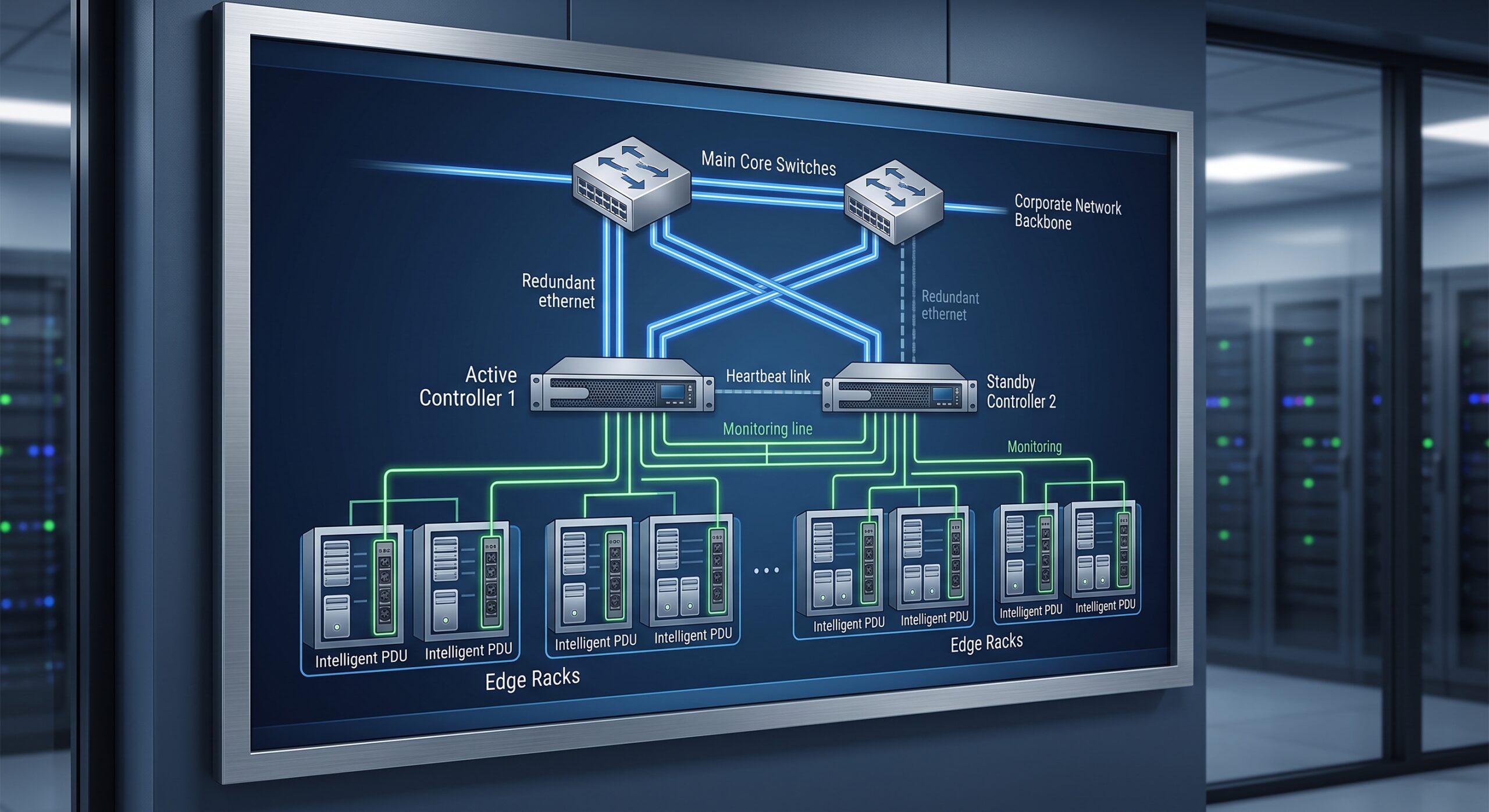
The heart of the RPMS lies in its controller software, which runs on a ruggedized, fanless server appliance. For mission-critical central offices (COs), we deploy an active-standby cluster configuration. The primary controller manages the polling schedule, data aggregation, and alarming logic, while the secondary controller continuously synchronizes its state database via a dedicated heartbeat link. If the primary controller fails to respond within a predefined window (typically 3-5 seconds), the standby unit assumes the active role, re-establishing communication with all remote sensors and issuing notifications via SNMP traps or Syslog. This stateful failover mechanism ensures that no historical data is lost and that environmental thresholds remain enforced. In distributed edge architectures, active-active setups are sometimes preferred, where multiple controllers manage subsets of sensors, sharing the load and providing enhanced throughput for data analytics processing.
| Key Parameter | Technical Specification | Carrier-Grade Requirement |
|---|---|---|
| System MTBF (Controller) | 650,000 hours (MIL-HDBK-217F) | > 500,000 hours |
| Sensor Accuracy | ±1% of reading (Voltage/Current) | ±2% max deviation |
| Failover Time (Active-Standby) | 5 seconds (max) | |
| Operating Temperature Range | -5°C to +55°C | 0°C to +50°C |
| Network Redundancy | Dual 10/100/1000BASE-T with RSTP failover | Dual or more uplinks |
Quantifying Reliability: MTBF and Service Level Metrics
When evaluating a Remote Power Monitoring System, the MTBF is a pivotal metric. However, it must be contextualized with the service environment. High-quality RPMS hardware often comes with an MTBF rating of 500,000 hours or greater per the MIL-HDBK-217F reliability prediction standard, when operating within a controlled temperature range of 0°C to 55°C. This translates to a predicted failure rate of less than 2 per million hours for the entire appliance. Beyond MTBF, we must consider the Mean Time To Repair (MTTR). Hot-swappable components, including power supplies and storage modules (e.g., eMMC or mSATA), are essential; an MTTR of under 1 hour is achievable with modular designs. These factors combine to enable an Availability rating of 99.999% (five-nines) for the monitoring system itself, independent of the power infrastructure it oversees. The IEEE 493 (Gold Book) provides the foundational framework for calculating such reliability metrics in industrial power systems, and our RPMS designs adhere strictly to these guidelines.
Interface and Communication Protocols: Beyond SNMP
Modern RPMS has evolved from simple SNMP read-only access to a rich ecosystem of northbound interfaces. While SNMPv3 is universally supported, leading systems offer native integration with MQTT for lightweight publish/subscribe messaging, and MODBUS TCP for integration with building management systems (BMS). For integration into higher-tier network management solutions, a robust RESTful API is non-negotiable. These APIs allow for the programmatic retrieval of granular power usage data (in watts) per outlet, enabling automated capacity planning and Power Usage Effectiveness (PUE) calculations. Advanced platforms also support streaming telemetry via gRPC, pushing data at configured intervals to centralized analytics engines, thereby reducing the polling overhead on the network and enabling real-time anomaly detection.
Security Hardening: Mitigating Power as a Cyber-Attack Vector
Securing the power monitoring layer is often an overlooked aspect of network infrastructure. A compromised RPMS can lead to a denial-of-service attack by causing unauthorized power cycling of critical network elements. To mitigate this, we implement Hardware Root of Trust at the gateway level, using a Trusted Platform Module (TPM) for secure boot verification. This prevents unauthorized firmware updates from executing, ensuring that only signed, validated code runs on the appliance. Additionally, secure communication between sensors and the gateway is established using TLS 1.3, with mutual authentication to prevent rogue sensors from injecting false data into the network. MAC layer security features, such as 802.1X port-based authentication, protect the access ports on the network switches to which the RPMS devices are connected, complying with the security frameworks outlined in the ITU-T X.805 standard.
Deployment Topologies and Integration Scenarios
Deploying a reliable RPMS involves intricate planning regarding power distribution topology and network connectivity. In central office environments, we typically deploy a hierarchical topology where a high-availability gateway cluster manages multiple remote sensor pads. The sensors communicate via an isolated management VLAN, ensuring that power telemetry traffic does not interfere with user data traffic. The integration phase involves creating mappings between power thresholds and the alarm severities (Critical, Major, Minor) that map directly to existing network management platforms. For remote sites with limited network connectivity, the RPMS must support local storage with store-and-forward capabilities, ensuring no data is lost during WAN outages. Our experience shows that effective integration reduces the Mean Time To Identify (MTTI) power-related issues by approximately 60%.
Conclusion: A Cornerstone of Carrier-Grade Infrastructure
A Remote Power Monitoring System is not simply a utility; it is a strategic asset in maintaining service assurance and operational efficiency. By selecting hardware with proven MTBF metrics, implementing robust active-standby redundancy, and adhering to stringent communication security protocols, network operators can transition from reactive troubleshooting to proactive power management. The long-term ROI is clear: reduced site visits, minimized downtime, and optimized energy consumption. As we migrate towards intelligent edge computing and Open RAN architectures, the sophistication of power monitoring will only increase, making it an indispensable component of the truly resilient telecom network.

Leave a comment