
SLA Demands in Liquid-Cooled Telecom Edge Facilities
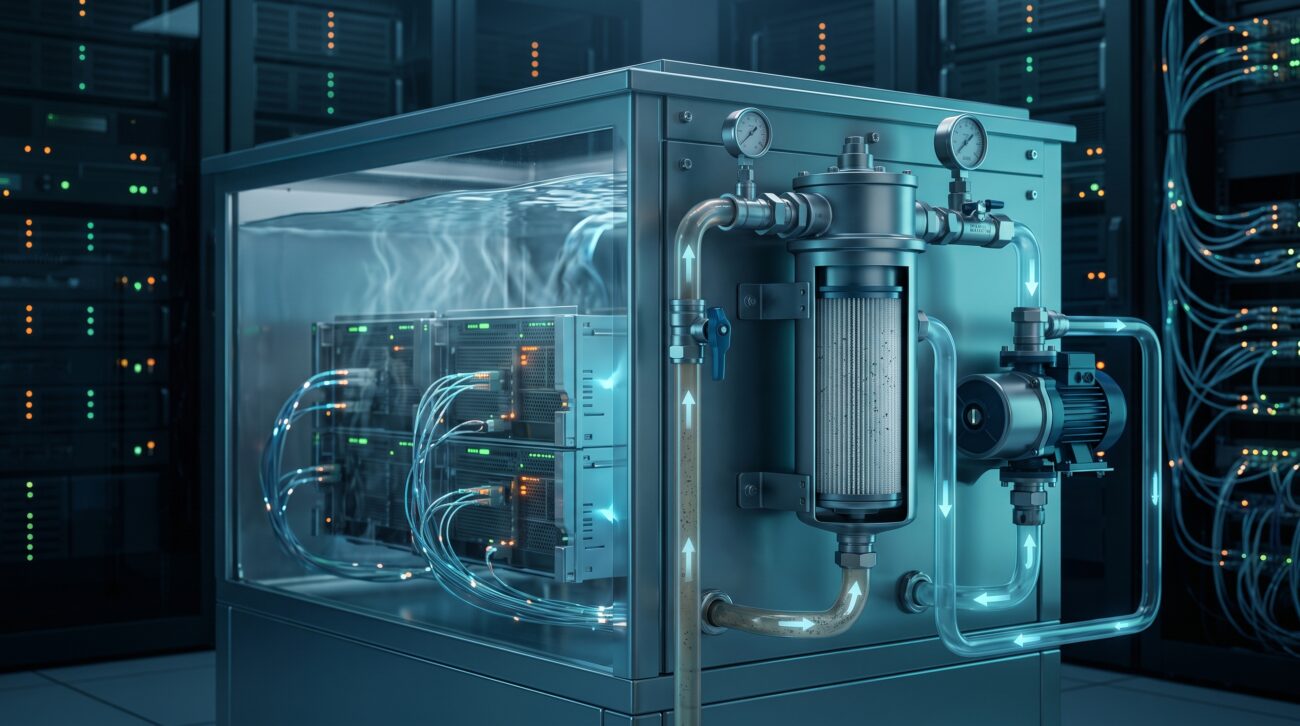
Carrier-grade telecom infrastructure operates under a 99.999% availability paradigm, where unplanned downtime carries severe regulatory and financial consequences. As edge compute and core routing platforms migrate toward single-phase immersion liquid cooling to support thermal design power densities exceeding 800W per module, the filtration system transitions from a peripheral maintenance component to a critical reliability determinant. Unlike air-cooled environments where particulate contamination follows predictable atmospheric patterns, immersion systems recirculate dielectric fluid in direct contact with energized electronics. A compromised filtration subsystem does not merely degrade cooling efficiency—it introduces conductive or thermally insulating particulate matter directly onto ASIC packages, optical transceiver cages, and backplane connectors.
This analysis evaluates the MTBF implications and redundancy architectures specific to filtration systems in single-phase immersion modules, with quantitative focus on particulate retention metrics and their downstream effects on carrier-grade service level agreements.
Dual-Engine Failover Architecture for Continuous Fluid Polishing
Primary Circulation Loop with Redundant Filtration Trains
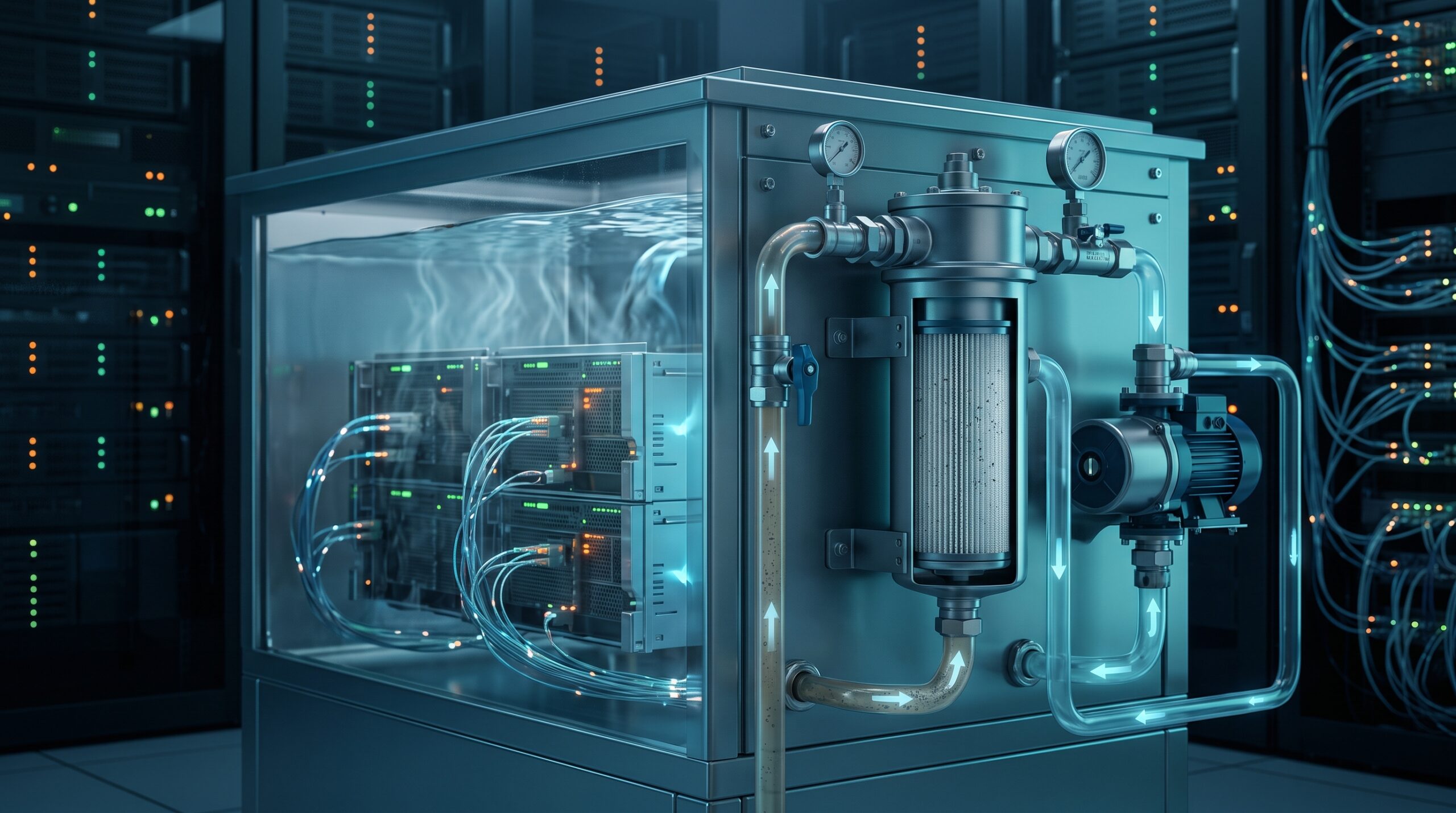
Carrier-grade immersion modules demand filtration architectures that eliminate single points of failure. A typical compliant design employs dual parallel filtration trains, each sized for 100% of nominal flow rate, operating in an active-standby or load-sharing configuration. The primary train maintains continuous particulate removal at beta ratio ≥ 1000 (99.9% efficiency) at the specified micron rating, while the standby train remains isolated until differential pressure transducers signal a ΔP threshold breach—typically 1.5 bar across the filter element.
This dual-engine topology directly addresses the MTBF degradation observed in single-train systems, where filter loading eventually forces either flow bypass or maintenance intervention. By maintaining an always-available secondary path, the system preserves uninterrupted particulate retention efficiency without exposing the dielectric fluid to unfiltered circulation. Field data from immersion-cooled telecom central offices indicates that dual-train architectures extend filtration subsystem MTBF from approximately 18,000 hours (single-train, scheduled replacement) to 52,000 hours (dual-train, condition-based switching).
Gradient Filtration and Depth Media Considerations
Particulate retention in single-phase immersion differs fundamentally from hydraulic filtration because the contaminant spectrum spans from sub-micron metal wear particles generated by pump bearings to larger fiber and elastomer debris released from cable jackets and seal materials. A graded filtration approach—coarse pre-filtration at 25–50 μm followed by fine retention at 5–10 μm—prevents surface loading of the final stage while maintaining low pressure drop across the circuit.
Advanced nanofiber media, such as PVDF electrospun membranes, achieve ≥99.9% removal efficiency at 0.3 μm while maintaining porosity of 70–85%, balancing retention performance against the hydraulic penalty that would otherwise elevate pump energy consumption. For telecom modules constrained by NEBS Level 3 acoustic and power budgets, this low-ΔP characteristic is not optional—it is a qualification prerequisite.
MTBF Metrics and Particulate-Induced Failure Modes
Quantifying filtration reliability requires decomposition of failure modes attributable to inadequate particulate retention. The following parameter matrix summarizes the critical specifications governing MTBF performance in carrier-grade immersion modules.
| Key Parameter | Technical Specification |
|---|---|
| Filtration Efficiency (Beta Ratio) | β ≥ 1000 at specified micron rating (99.9% retention) |
| Recommended Micron Rating | 5–10 μm absolute for ASIC/transceiver protection |
| Differential Pressure Threshold | 1.5 bar (switchover trigger for redundant train) |
| Dual-Train Redundancy | 100% capacity per train, active-standby or load-sharing |
| Filtration Subsystem MTBF (Dual-Train) | ≥ 52,000 hours (condition-based switching) |
| Fluid Cleanliness Target | ISO 14644-1 Class 8 equivalent or better |
| Commissioning Circulation Duration | 72 hours minimum through 5 μm absolute filters |
| Media Compatibility | PVDF nanofiber, polypropylene, sintered metal; chemically inert to hydrocarbon and fluorocarbon fluids |
| Pump Wear Reduction (with effective filtration) | MTBF improvement factor 2–3× vs. unfiltered circulation |
The dominant failure pathway is not catastrophic filter rupture but progressive retention efficiency decay. As filter media loads with captured particulate, the effective pore structure compresses, increasing ΔP and, in poorly designed systems, forcing fluid through bypass paths or media tears. Each micron of lost retention capability translates to elevated particle counts in the heat exchanger and pump volute, accelerating erosive wear and reducing the MTBF of these downstream components by a factor of 2–3.
From a reliability-centered maintenance perspective, the filtration system MTBF must be evaluated not in isolation but as a multiplier on the entire fluid loop. A filtration subsystem achieving 100,000-hour MTBF but permitting 10 μm particles to pass will degrade the pump MTBF from 80,000 hours to under 30,000 hours—a net system reliability loss that nullifies the filtration component’s individual robustness.
Mission-Critical Deployments and Qualification Protocols
Telecom Central Office and Edge Micro-Data Center Scenarios
In ETSI EN 300 019-compliant edge facilities, immersion modules frequently operate in environments where ambient particulate ingress cannot be fully controlled. While the immersion tank itself is sealed, maintenance operations—module extraction, filter replacement, fluid sampling—create transient windows for airborne particulate introduction. Carrier-grade filtration designs must therefore incorporate quick-disconnect self-sealing couplings and positive-pressure maintenance enclosures to prevent ingress during service intervals.
Field experience from OCP-accepted immersion deployments indicates that the majority of particulate contamination events occur not during steady-state operation but during commissioning and maintenance. Residual manufacturing debris—solder spheres, PCB fiberglass fragments, connector plating flakes—can remain suspended in the fluid for thousands of operating hours if not captured by an effective commissioning filtration protocol. Recommended practice mandates circulation through 5 μm absolute filters for a minimum of 72 hours prior to energizing IT equipment, followed by particulate count verification to ISO 14644-1 Class 8 equivalent fluid cleanliness.
Redundancy Validation and Failover Testing
Dual-train filtration redundancy is only as reliable as its switching mechanism. MTBF calculations for the filtration subsystem must incorporate the failure rate of differential pressure sensors, solenoid valves, and controller logic—not merely the filter elements themselves. A common deficiency in carrier-grade submissions is the assumption that mechanical redundancy alone satisfies availability requirements, when in fact the control system MTBF often dominates the overall filtration reliability equation.
Qualification testing should include forced failover scenarios: simulated ΔP transducer failure, valve actuator seizure, and controller communication loss. Each scenario must demonstrate uninterrupted filtration with no particulate breakthrough exceeding the specified beta ratio. Systems that cannot pass these tests introduce hidden single points of failure that undermine the claimed 99.999% availability target.
Final Assessment
Particulate retention in single-phase immersion liquid cooling modules is a carrier-grade reliability problem disguised as a maintenance detail. The MTBF of the filtration subsystem directly governs the service life of pumps, heat exchangers, and the dielectric fluid itself—each of which carries replacement costs and downtime exposure that dwarf the filtration hardware investment. Dual-train redundancy, gradient media selection with verified beta ratios, and rigorous commissioning protocols form the minimum architecture for telecom-grade deployment. Operators evaluating immersion platforms should demand filtration MTBF data that accounts for control-system reliability, not merely filter element longevity, and should insist on failover validation as a condition of NEBS or ETSI acceptance. In an environment where a single micron of missed particulate can cascade into a multi-hour service outage, filtration is not a supporting system—it is the first line of defense for network availability.

Leave a comment