
1. Introduction: AI Is More Than Computing Power
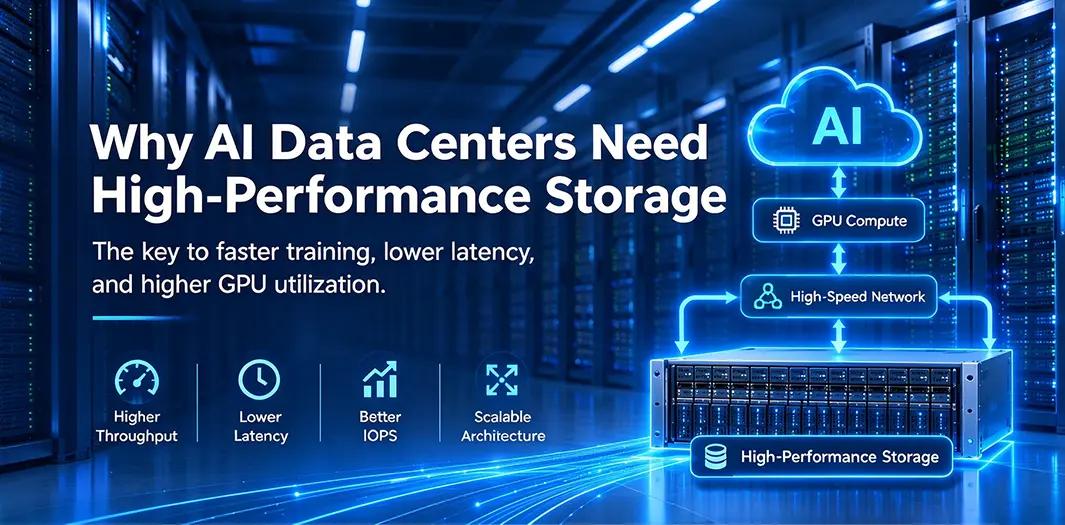
Artificial intelligence is transforming data centers, driving demand for powerful GPUs, high-speed networks, and increasingly sophisticated storage infrastructure. As AI models grow in size and complexity, the amount of data required for training and inference continues to increase.
However, computing power alone does not determine AI performance. GPUs need a continuous supply of data to operate efficiently. If the storage system cannot deliver data quickly enough, computing resources may spend valuable time waiting for data instead of processing it.
This is why high-performance storage has become an important component of modern AI infrastructure. A well-designed storage system helps reduce data-loading delays, support large-scale workloads, and improve the overall efficiency of AI computing environments.
2. How Storage Affects AI Workloads
AI workloads place different demands on storage systems depending on whether they involve model training or inference.
AI Model Training
Training an AI model involves processing large datasets through repeated computational operations. The storage system must supply training data, model parameters, and intermediate files to the computing infrastructure.
If data cannot be delivered at the required rate, GPUs may remain idle while waiting for the next batch. This can increase training time and reduce infrastructure utilization.
Storage also plays an important role in checkpointing. During training, models periodically save their parameters and training states so that interrupted jobs can resume without restarting from the beginning. Fast and reliable write performance helps minimize the time spent saving checkpoints.
AI Inference
Inference occurs when a trained model generates predictions, answers questions, or processes new information.
Unlike training, inference often places greater emphasis on response time, predictable latency, and the ability to support multiple concurrent requests. Storage may be needed to load model weights, retrieve supporting data, and access other application resources.
For large language models, frequently accessed model weights are generally loaded into GPU memory or other memory tiers during execution. Storage performance is particularly important when loading models, switching between models, or managing workloads that exceed available memory capacity.
The storage requirements therefore depend on the application. Training often emphasizes sustained throughput and checkpoint performance, while inference may place greater emphasis on model-loading time, latency, and concurrency.
3. Key Performance Metrics of AI Storage
Evaluating storage for AI requires more than looking at capacity or the maximum advertised transfer speed. Several performance indicators must be considered together.
Throughput
Throughput measures how much data a storage system can transfer within a given period, commonly expressed in MB/s or GB/s.
High throughput is important when loading large datasets, feeding multiple GPU servers, or saving large model checkpoints. In distributed AI environments, the aggregate throughput of the storage system must keep pace with the combined demand of multiple compute nodes.
IOPS
Input/output operations per second (IOPS) measures how many read and write operations a storage system can complete each second.
High IOPS can benefit workloads involving many small or random data accesses. However, IOPS alone does not determine performance. The size of each I/O operation, its read/write ratio, queue depth, and access pattern all influence actual throughput.
Latency
Latency refers to the time required to complete an I/O operation.
Low latency is valuable for applications that depend on rapid data access. Consistent latency is also important: a system that performs well on average but experiences frequent latency spikes may still cause unpredictable application performance.
For AI infrastructure, engineers should consider both average latency and higher-percentile measurements, such as p95 and p99, under realistic workloads.
Scalability
As AI models, datasets, and user demand grow, storage infrastructure must expand without becoming a bottleneck.
Scalable architectures allow organizations to increase capacity and performance as needed. However, adding storage devices does not automatically guarantee proportional performance gains. Controllers, network bandwidth, metadata operations, and software architecture can limit scaling.
4. Technologies Behind High-Performance AI Storage
Several technologies help address the performance and scalability requirements of AI workloads.
NVMe SSDs
NVMe (Non-Volatile Memory Express) is a storage interface and protocol designed for non-volatile memory devices, commonly using PCIe connectivity.
Compared with traditional SATA-based SSDs, NVMe SSDs can support higher bandwidth, lower protocol overhead, and greater parallelism. These characteristics make them suitable for demanding workloads involving large datasets, frequent data access, and high-performance computing.
Nevertheless, actual performance depends on the SSD itself, the PCIe generation, the server platform, the workload, and the storage software.
All-Flash Storage Arrays
All-flash storage systems use solid-state drives as their primary storage media.
By combining flash performance with enterprise storage capabilities, these systems can provide high throughput, low latency, data protection, and centralized management. They are useful when multiple applications or compute nodes require reliable access to shared datasets.
For AI deployments, the appropriate design depends on the required performance, usable capacity, data protection policies, and budget.
Distributed Storage and Parallel File Systems
Large AI clusters may involve many GPU servers accessing shared data simultaneously. A single storage server may not provide sufficient capacity or bandwidth for these environments.
Distributed storage systems can spread data across multiple nodes, while parallel file systems are designed to support concurrent access to data across a cluster. Depending on their implementation, these architectures can increase aggregate throughput and capacity as additional nodes are deployed.
They also introduce design considerations such as data placement, metadata performance, fault tolerance, network congestion, and operational complexity.
5. Storage and Networking: Working Together
High-performance storage cannot operate effectively in isolation. Data must travel through a complete path that may include SSDs, storage controllers, PCIe interfaces, network adapters, switches, and the compute server before reaching GPU memory.
If any part of this path has insufficient bandwidth or excessive latency, it can limit the performance of the entire system.
For example, a storage array capable of delivering high aggregate throughput may not achieve that performance if its network uplinks are undersized or multiple servers compete for limited bandwidth.
High-speed Ethernet, suitable network architectures, and technologies such as RDMA can help improve data movement in appropriate environments. RDMA allows data to be transferred between system memories with reduced CPU involvement, while GPUDirect Storage can enable a more direct data path between supported storage systems and GPU memory.
These technologies require compatible hardware, software, drivers, and configurations. They are not automatic performance upgrades for every deployment.
The key principle is that storage, networking, and computing resources must be designed as a coordinated system. Optimizing one component while ignoring the others may deliver limited improvements.
6. Choosing the Right Storage Architecture for AI
There is no single storage architecture that fits every AI workload. Organizations should evaluate their requirements before selecting hardware or designing a storage environment.
Important considerations include:
- Workload characteristics: Determine whether the application is primarily training, inference, data preparation, or a combination of these activities.
- Performance requirements: Evaluate sustained throughput, IOPS, latency, concurrency, and checkpointing needs rather than relying solely on peak benchmark results.
- Capacity and growth: Estimate current data requirements and future growth in datasets, model versions, and application outputs.
- Scalability: Assess whether capacity and performance can be expanded independently or together as workloads increase.
- Reliability and data protection: Consider redundancy, snapshots, backup policies, recovery procedures, and the impact of storage failures.
- Total cost of ownership: Account for hardware, networking, power consumption, cooling, software licensing, maintenance, and future expansion.
For example, an AI research environment working with large datasets may prioritize high-throughput shared storage and parallel data access. An enterprise inference platform may place greater emphasis on rapid model loading, predictable response times, and reliable service availability.
In some cases, a tiered architecture is appropriate. Frequently accessed data can reside on high-performance flash storage, while less frequently accessed datasets and historical records can be stored on more cost-efficient capacity-oriented systems.
This approach helps balance performance, capacity, and cost without requiring every piece of data to reside on the fastest available storage.
7. Conclusion: Building a Balanced AI Infrastructure
As AI workloads continue to evolve, storage is becoming an increasingly important part of data center design.
High-performance storage helps deliver training data efficiently, reduce checkpointing delays, support rapid model loading, and accommodate growing datasets. Technologies such as NVMe SSDs, all-flash arrays, distributed storage, and high-speed networking provide different ways to address these requirements.
However, the goal is not simply to select the fastest storage device. Effective AI infrastructure requires a balanced architecture in which storage, networking, memory, and computing resources work together.
By understanding workload characteristics and evaluating performance across the complete data path, organizations can build AI environments that are more scalable, reliable, and cost-effective.


Leave a comment