
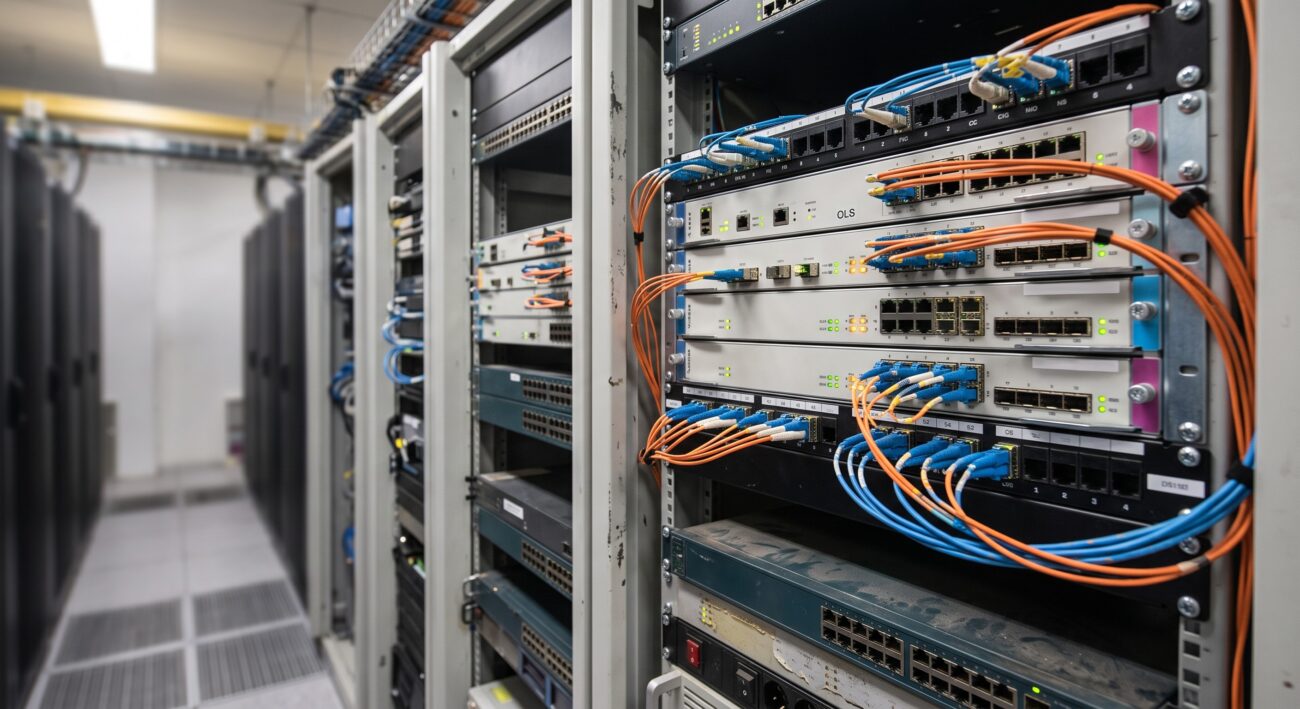
Introduction: The Strategic Imperative of Pre-Owned Optical Infrastructure
In an era of relentless bandwidth expansion—driven by 5G backhaul, hyperscale datacenter interconnect, and AI training clusters—the demand for Wavelength Division Multiplexing (WDM) equipment has never been more acute. However, the CapEx burden of procuring brand-new DWDM and CWDM systems often strains network budgets, forcing engineers and procurement officers to explore the burgeoning market for used WDM equipment. This guide, authored by a Senior Network Architect with 15 years of hands-on deployment experience, delivers a comprehensive, data-driven roadmap for sourcing pre-owned optical transport gear without compromising carrier-grade reliability or future-proofing your fiber plant.
According to a 2025 Dell’Oro Group report, the global optical transport equipment market grew 4% year-over-year, but the secondary market expanded at nearly double that rate as enterprises seek to maximize fiber efficiency with coherent optics and ROADM architectures at a fraction of the original cost. This guide cuts through the noise, offering a structured methodology—from ITU-T grid compliance to MTBF calculations—ensuring your sourced hardware delivers tangible operational gains.
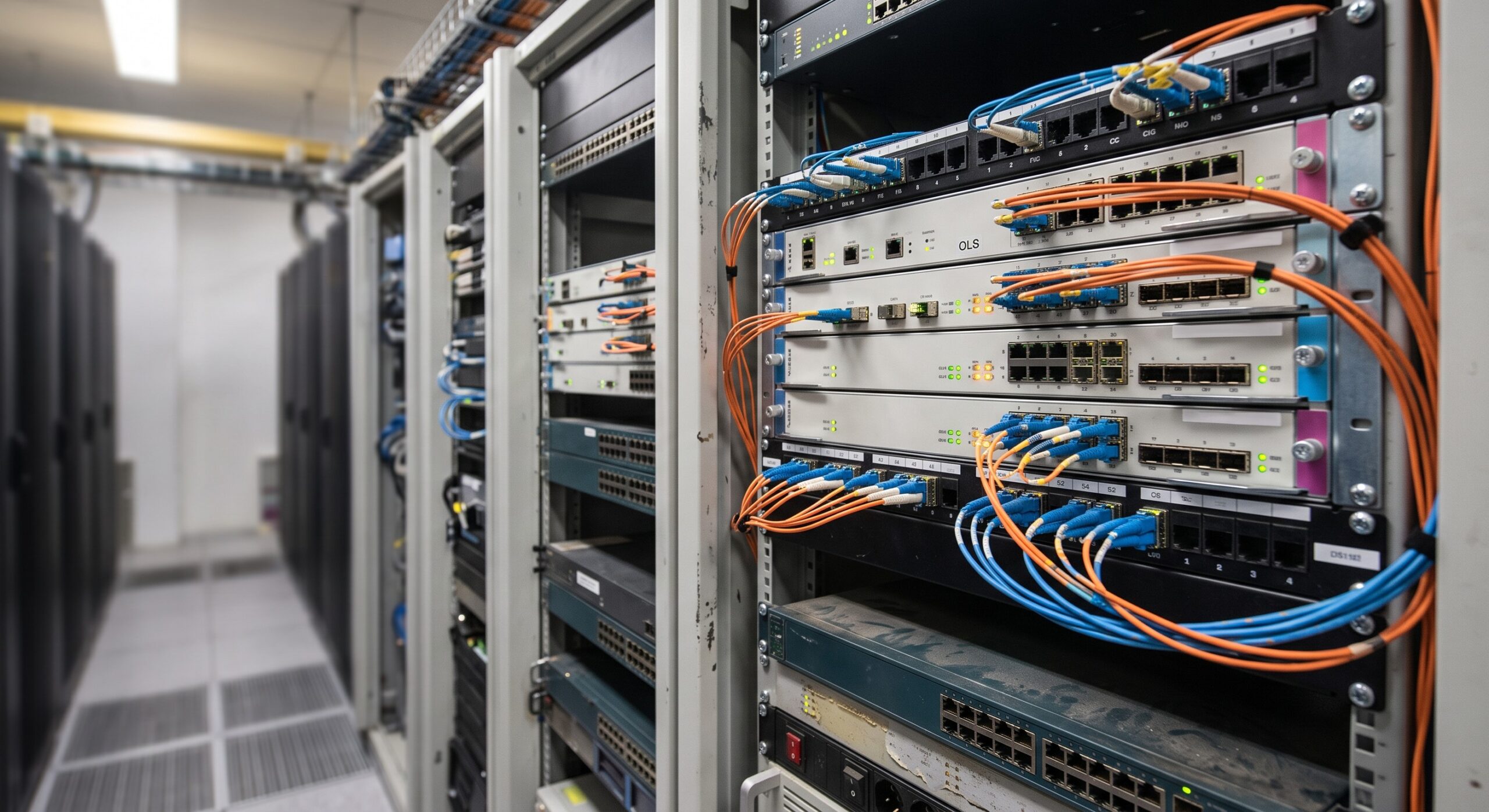
Core Architecture & Hardware Topology of Second-Hand WDM Systems
Deciphering the Optical Layer: Mux/Demux, Transponders, and Amplifiers
At its heart, a WDM system combines multiple optical carriers onto a single fiber pair. In the used market, you will encounter two primary flavors: Coarse WDM (CWDM), with channel spacings of 20 nm per the ITU-T G.694.2 standard, and Dense WDM (DWDM), adhering to the rigid 100 GHz (0.8 nm) or 50 GHz grid (ITU-T G.694.1). When sourcing used WDM equipment, the first architectural decision is the OSNR (Optical Signal-to-Noise Ratio) budget. Legacy systems may support only 8 channels at 10 Gbps, whereas modern used units (post-2020) routinely handle 96 channels at 200 Gbps using QPSK or 16-QAM modulation.
- Transponders & Muxponders: These convert client-side signals (e.g., 100G Ethernet, 32G FC) to DWDM wavelengths. When evaluating used units, scrutinize the supported FEC (Forward Error Correction) gain—typically 9-12 dB for standard G.709, rising to 15 dB with enhanced algorithms.
- Optical Amplifiers (EDFA/Raman): Pre-owned amplifiers must be verified for their gain flatness (NF (Noise Figure) (
- ROADMs (Reconfigurable Add-Drop Multiplexers): These enable dynamic wavelength routing. Used WSS (Wavelength Selective Switch) based ROADMs offer flexibility but check the insertion loss (typically 6-9 dB) and PDL (Polarization Dependent Loss) (
Backplane and Fabric Interconnect Speeds
Many used WDM equipment shelves rely on a centralized switch fabric for OADM (Optical Add-Drop Multiplexing). The switching capacity of this backplane—ranging from 1.2 Tbps to 25.6 Tbps in high-end units—dictates the system’s non-blocking performance. Ensure the latency through the fabric stays below 50 microseconds for financial trading applications, a metric often overlooked in second-hand listings.
Technical Specifications, Compliance, and Performance Metrics
To objectively assess used WDM equipment, you must treat the acquisition like an engineering audition. Do not rely solely on ‘good condition’ labels. Insist on a test report showing BER (Bit Error Rate) across all channels at 2.4 Gbps (for legacy SDH) up to 400 Gbps (for modern coherent modules). Here is the minimum specification matrix every evaluator should demand:
| Key Parameter | Technical Specification |
|---|---|
| Channel Spacing (ITU-T G.694.1) | 50 GHz / 100 GHz (DWDM) or 20 nm (CWDM) |
| Max Channel Count | 96 (50 GHz grid) / 48 (100 GHz grid) |
| Max Per-Channel Bit Rate | 200 Gbps (DP-QPSK) to 400 Gbps (16-QAM) depending on coherent engine |
| System Optical Loss Budget | Typically 22-35 dB (including amplifier spans) |
| OSNR Tolerance (FEC Off) | Minimum 18 dB @ 200 Gbps (BER 1e-15) |
| Latency (Transponder + Fabric) | |
| MTBF (Mean Time Between Failures) | > 200,000 hours for line cards; > 500,000 hours for passive Mux/Demux |
| Redundancy (Carrier Grade) | 1+1 Power, Fan, and Fabric redundancy typical |
| Compliance | IEEE 802.3, ITU-T G.709, RoHS, NEBS Level 3 |
Industry Standards and Environmental Compliance
IEEE 802.3 compliance for Ethernet over WDM is non-negotiable. Additionally, check for RoHS certification, particularly for European import. The ITU-T G.709 digital wrapper standard ensures interoperability for OTN (Optical Transport Network) signals. When sourcing used DWDM line cards, verify their support for FlexO (Flexible OTN) interfaces, which offer up to 400 Gbps client mapping.
Benchmarking Used WDM Against Legacy and New Systems
Let’s address the elephant in the room: does used WDM equipment truly outperform legacy telecom hardware? The answer is nuanced. A legacy STM-64/OC-192 system from the pre-2010 era might aggregate only 10 Gbps per fiber pair. A used DWDM system from 2021, leveraging 100G coherent technology, can push 48 channels at 200 Gbps, achieving 9.6 Tbps over the same fiber. The spectral efficiency jumps from 0.2 bps/Hz to over 5 bps/Hz with probabilistic constellation shaping.
- CapEx Advantage: Used equipment typically runs 50-70% less than list price. A 40-channel, 100G capable platform that cost $500,000 new can be sourced for $150,000-$180,000 from certified remarketers.
- OpEx Considerations: Power consumption is critical. A new 400G ZR pluggable may draw 12-15W, while an older used CFP2-DCO module could draw 18-22W. Over 5 years, this power delta adds significant HVAC costs—factor this into your TCO model.
Real-World Deployment: ISP Metro Core Expansion Case Study
A regional ISP in the Midwest needed to upgrade their 100G backbone to 400G capacity to support streaming and cloud aggregation. With a budget of $250,000, new equipment was out of reach. They sourced used Nokia 1830 PSS chassis and Ciena Waveserver platforms, both supporting CFP2-DCO modules. The deployment involved replacing legacy 10G transponders with used 200G/400G capable cards. The ROADM degree was expanded from 2 to 4 using refurbished WSS modules.
Post-deployment, the network saw a 300% increase in throughput (from 960 Gbps to 3.84 Tbps) with a latency penalty of just 8 microseconds due to the coherent DSP processing. The ISP achieved a ROI of 18 months, paying back the CapEx via new enterprise circuit sales.

Conclusion: Engineering a Sound Sourcing Strategy
The market for used WDM equipment is a treasure trove for the knowledgeable engineer, but it demands rigorous due diligence. Focus on coherent generation (look for 100G+ per lambda), verify MTBF (> 200,000 hours for line cards), and always demand a 30-day burn-in test with spectral analysis. The era of ‘buy new by default’ is ending. With the guidelines laid out in this ultimate guide, you can architect a high-performance, cost-optimized optical layer that meets the demands of 5G and the AI-driven datacenter, all while keeping your network budget firmly in the black.

Leave a comment