

RUGGEDIZED DESIGN PHILOSOPHY
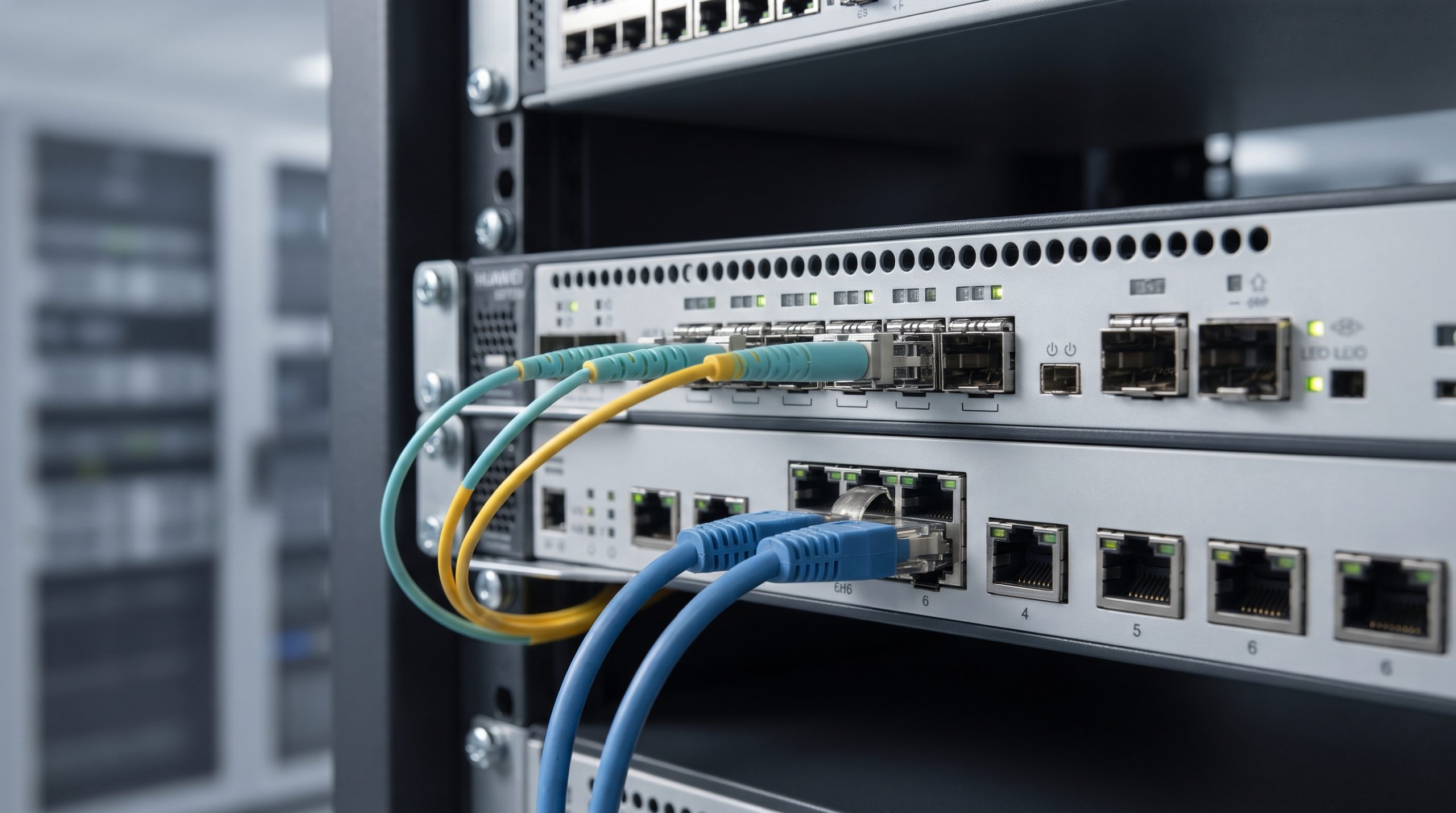
Deploying access switches in outdoor cabinets, industrial enclosures, or semi-exposed telecom sites exposes Ethernet infrastructure to transient overvoltage events that originate from direct or indirect lightning strikes, inductive coupling on long cable runs, and ground potential rise between distributed network nodes. The Huawei S5735-L Series integrates dedicated port-level lightning protection circuitry directly into the front-end interface design, eliminating the need for external surge suppression dongles in space-constrained or maintenance-sensitive deployments. This application note documents the electrical tolerance, circuit topology, and field deployment considerations for the S5735-L port protection subsystem, with emphasis on models bearing the IA1 ruggedized designation and standard V2 variants offering common-mode surge immunity.

THERMAL & ELECTRICAL TOLERANCE
The S5735-L series employs a multi-stage transient voltage suppression network at each copper Ethernet port. The first stage utilizes a gas discharge tube or high-energy varistor array to shunt the bulk of a lightning-induced surge to chassis ground. A second stage, comprising transient voltage suppressor diodes and series impedance elements, clamps residual voltage to levels safe for the PHY transceiver. This staged approach balances surge-handling capacity against parasitic capacitance that could otherwise degrade signal integrity at 1000BASE-T and 2.5GBASE-T rates. For the standard S5735-L48T4XE-A-V2 and comparable V2 models, Huawei specifies common-mode surge immunity of ±7 kV on service ports, while the power inlet is rated for ±6 kV differential-mode and ±6 kV common-mode. The ruggedized S5735-L-I series, designed for outdoor cabinet environments, elevates service-port protection to ±10 kV common-mode, addressing the higher exposure profile of pole-mounted or cabinet-based access nodes.
OPERATIONAL ADVANTAGES
The integration of port-level protection yields three operational benefits for carrier and enterprise deployments. First, it reduces truck-roll frequency in remote sites where a lightning event might otherwise disable access connectivity for an entire cluster of subscribers or devices. Second, because the protection is embedded on the main board rather than added as an external inline module, the switch maintains its 1U form factor and does not require additional rack space or cabling strain relief. Third, the protection circuitry is transparent to autonegotiation and PoE delivery; S5735-L PoE models can continue to supply power to connected devices while maintaining surge immunity, a critical consideration for outdoor surveillance or wireless access point deployments. The standard S5735-L48T4XE-A-V2 carries an MTBF rating of 40.01 years and availability exceeding 0.99999, figures that reflect the reliability contribution of robust front-end protection in addition to component derating and thermal design.
CERTIFICATIONS MATRIX
The S5735-L series complies with EMC and safety certification regimes applicable to enterprise and carrier access equipment, including EN 55032 Class A, EN 55035, and IEC 61000-4-5 surge immunity testing. The port protection circuitry contributes directly to compliance with the 1.2/50 µs and 8/20 µs combination wave test profiles specified in IEC 61000-4-5. For deployments requiring demonstrated surge tolerance, Huawei publishes per-model specifications for both service-port and power-port protection, allowing network architects to match the switch variant to the site exposure class. The S5735-L-I series extends operating temperature range to -40°C to +70°C for certain models, pairing thermal ruggedization with electrical ruggedization for harsh outdoor environments.
EXACT SPECS
The following table consolidates port lightning protection parameters for representative S5735-L series models. Values reflect Huawei published specifications at time of document preparation; designers should verify against the latest datasheet for the specific SKU under evaluation.
| Parameter | Specification |
|---|---|
| Service Port Surge Immunity (Standard V2 Models) | Common-mode ±7 kV |
| Service Port Surge Immunity (Ruggedized IA1 Models) | Common-mode ±10 kV |
| Power Port Surge Immunity | Differential-mode ±6 kV, Common-mode ±6 kV |
| Applicable Standards | IEC 61000-4-5, EN 55032 Class A, EN 55035 |
| Grounding Requirement | Chassis bonding to rack/cabinet ground busbar via dedicated grounding screw |
| MTBF (S5735-L48T4XE-A-V2) | 40.01 years |
| Availability | > 0.99999 |
FIELD DEPLOYMENT SCHEMATIC
For field deployment, Huawei recommends bonding the switch chassis to the cabinet or rack grounding busbar using the provided grounding screw and a conductor sized per local electrical code. The grounding path should present low impedance at surge frequencies; braided conductors or short, wide straps are preferred over long, thin wire runs. When the S5735-L is deployed in an outdoor cabinet, the Ethernet cables exiting the cabinet should be routed through a dedicated cable entry with a drip loop, and shielded cabling should have its shield bonded to the cabinet ground at the entry point. The integrated port protection is designed to absorb residual transient energy after the primary building or cabinet-level surge protective device has operated; it is not a substitute for a coordinated lightning protection system that includes air terminations, down conductors, and equipotential bonding. For sites with a history of frequent lightning activity or exposed cable runs exceeding 100 meters, an external Category 6 surge protector at the cabinet boundary remains a recommended supplementary measure.
📥 Download Technical Specification
Click the button below to view or download the full official PDF datasheet.
Leave a comment