
Executive Pain Points: The Megawatt Rack Thermal Wall
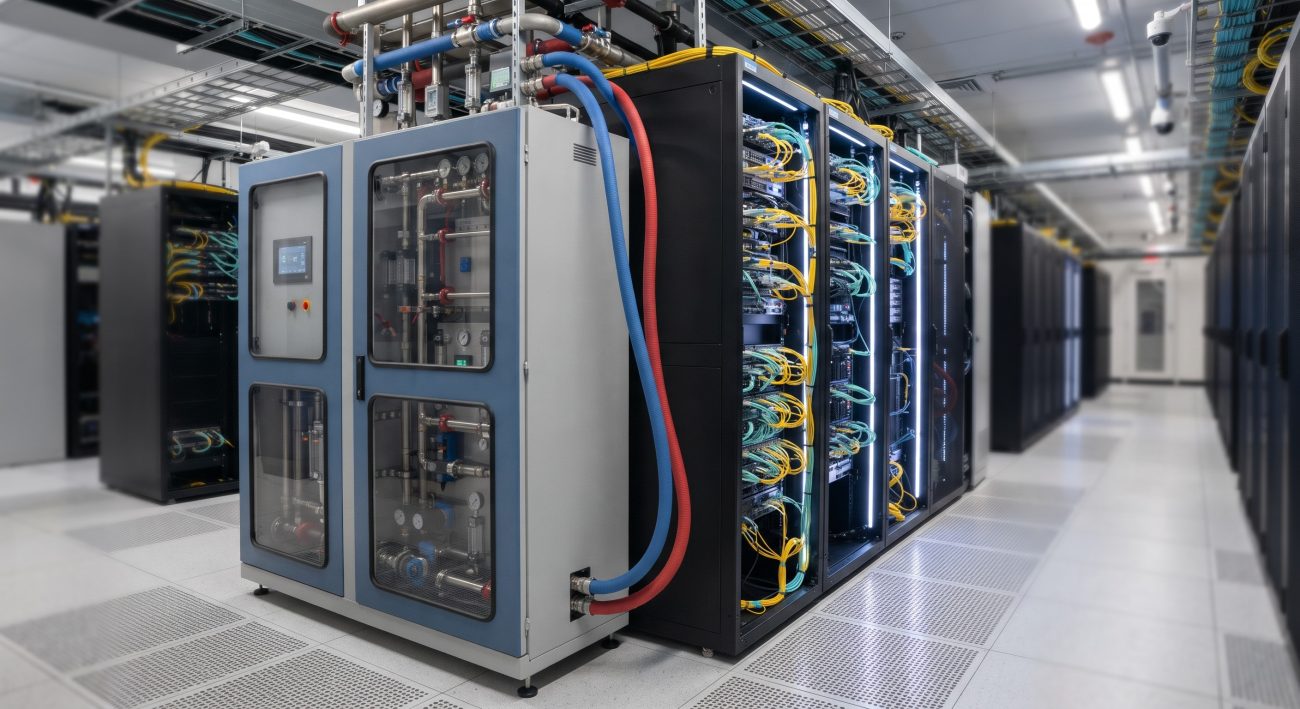
The proliferation of AI accelerator racks has fundamentally broken the traditional data center cooling calculus. Where a standard enterprise rack once hovered at 5-15 kW, next-generation GPU-dense architectures are surging past 1 MW per rack, with roadmaps pointing toward even higher densities . At these thresholds, air cooling becomes thermodynamically and economically unviable. The Coolant Distribution Unit (CDU) emerges not as a peripheral HVAC accessory, but as the critical hydraulic and thermal bridge between the facility water system (FWS) and the technology cooling system (TCS) . For network architects and infrastructure strategists, the challenge is no longer whether to deploy liquid cooling, but how to size CDU modules to maximize capital efficiency while ensuring carrier-grade reliability and PUE optimization.
CapEx vs. OpEx Analysis: The 2.5 MW Modular Threshold
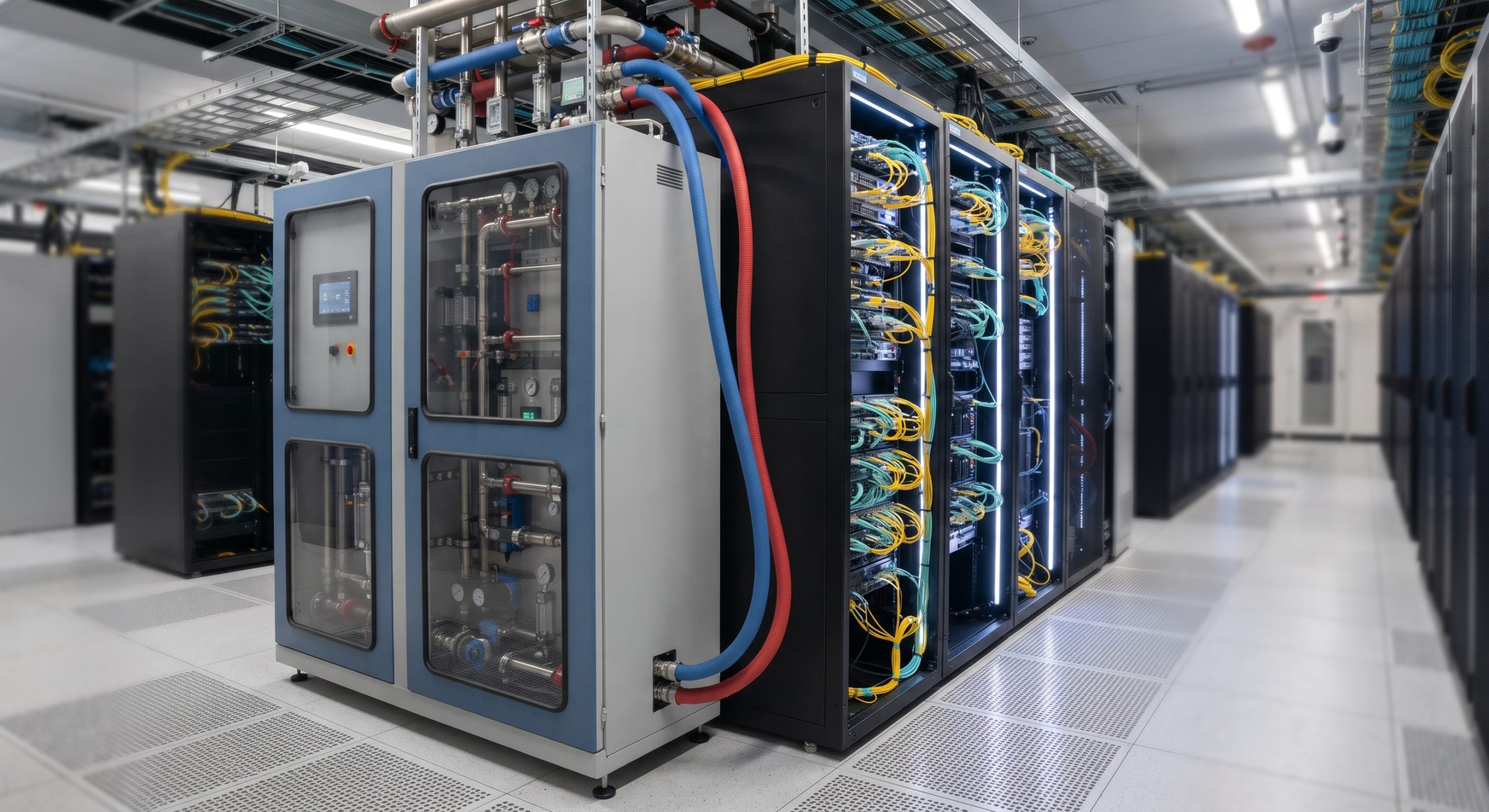
The financial architecture of a megawatt-scale AI facility is dictated by the granularity of its cooling modules. Sizing a CDU too small introduces N+1 pump redundancy constraints and excessive manifold complexity; sizing too large creates stranded capacity and inefficient part-load operation. The industry benchmark has crystallized around a 2.5 MW single-CDU capacity . This specific module size enables a mathematically clean 4+2 redundancy configuration for a 10 MW hall: six 2.5 MW units provide 10 MW of active cooling with two full units on standby, satisfying Tier III/IV concurrent maintainability requirements without over-provisioning the facility loop .
From a CapEx perspective, modular 2.5 MW CDUs allow phased capital deployment—infrastructure teams can populate cooling capacity in lockstep with GPU cluster delivery, avoiding the interest carry costs of over-building central plants. On the OpEx side, the hydraulic efficiency of the CDU directly impacts the facility-level PUE. Experimental data indicates that while air-cooled facilities exhibit PUE fluctuations between 1.16 and 1.61 due to compressor cycling, liquid-cooled architectures leveraging CDUs maintain a stable PUE within the 1.25–1.29 range, representing a 15.3% improvement in total energy consumption .
Hardware Efficiency: Hydraulic and Thermal Performance Metrics
Pump Redundancy and Variable Frequency Drives
The operational heart of the CDU is its variable speed pump module. Unlike constant-speed legacy pumps, modern CDU modules utilize Variable Frequency Drives (VFDs) to modulate flow based on real-time ΔT (delta temperature) across the secondary loop . In a megawatt rack, the hydraulic resistance of cold plates and manifolds is significant; the CDU must deliver high flow rates at stable differential pressures to prevent flow starvation in the furthest rack manifolds. Sizing calculations must account for the pump curve degradation during 1+1 or 2+1 internal redundancy failover events. When a primary pump trips, the standby unit must ramp to full speed within to prevent a thermal transient that could trigger GPU throttle or shutdown.
Heat Exchanger Approach Temperature
The plate-and-frame heat exchanger (BPHE) separates facility water (often laden with treatment chemicals) from the dielectric or treated water loop servicing the servers . The approach temperature—the difference between the leaving secondary supply temperature and the entering primary water temperature—is a critical sizing variable. A tighter approach (e.g., 1°C to 2°C) increases CapEx due to larger exchanger surface area, but it lowers the required facility water temperature, enabling waterside economizer hours and reducing chiller plant energy. For megawatt AI racks, where ASHRAE W45 or W40 facility water classes are increasingly common, the CDU must be selected to guarantee secondary supply temperatures within the IT manufacturer’s S-class envelope (typically 15–25°C) even at peak facility water temperatures .
| Key Parameter | Technical Specification |
|---|---|
| Module Cooling Capacity | 2.5 MW (scalable to 10 MW+ via 4+2 redundancy) |
| Redundancy Configuration | N+1 internal pumps; 4+2 at facility level for 10 MW halls |
| Pump Failover Response Time | |
| Heat Exchanger Approach Temperature | 1°C – 2°C (tight approach for economizer hours) |
| Secondary Loop Supply Temperature | 15°C – 25°C (ASHRAE S-class compliant) |
| Facility Water Class Compatibility | ASHRAE W40 / W45 (warm water cooling) |
| Monitoring & Control Protocols | Modbus TCP, SNMP, BACnet (BMS integration) |
| Compliance Standard | IEEE P4126 (CDU for Server Liquid Cooling Systems) |
Datacenter Integration: Manifold Topologies and Leak Mitigation
Integrating a 2.5 MW CDU into a data hall requires careful attention to primary/secondary piping topology. The CDU is typically placed adjacent to the rack rows, feeding a vertical manifold or overhead header system. For megawatt racks, the supply and return manifolds must be sized for low fluid velocity (typically ) to minimize erosion and pressure drop, yet large enough to avoid excessive material costs. The use of quick-disconnect (QD) fittings at the rack level is mandatory for serviceability, but each QD introduces a potential leak point and a minor pressure penalty .
Modern CDU modules incorporate integrated leak detection at the base of the cabinet and within the manifold enclosures. Upon detecting moisture, the control system can isolate the affected secondary loop via motorized isolation valves while maintaining flow to the remaining healthy racks, preserving fault tolerance at the row level. This capability is essential for mission-critical AI training clusters where a single unplanned thermal event can invalidate weeks of checkpointing progress.

Lifecycle Verdict: Sizing for the Next GPU Generation
The lifecycle economics of a CDU investment hinge on future-proofing against GPU roadmap transitions. NVIDIA’s trajectory from 700W to >1000W TDP accelerators means that a CDU sized perfectly for today’s rack may be hydraulically inadequate for the next refresh cycle . The 2.5 MW modular threshold provides a practical hedge: it allows operators to swap individual CDU modules as higher-capacity units become available (e.g., 3 MW+ class) without re-piping the facility loop, provided the primary-side piping and valves are sized with 20% headroom.
Furthermore, compliance with emerging standards such as IEEE P4126 (Standard for Coolant Distribution Unit of Server Liquid Cooling Systems) ensures that the selected CDU meets baseline requirements for reliability, environmental adaptability, and safety testing . For B2B infrastructure buyers, the lowest-cost per kW CDU is rarely the optimal choice; the total cost of ownership is minimized when the unit delivers high hydraulic efficiency, seamless BMS integration (via protocols like Modbus TCP or SNMP), and modular scalability that defers CapEx until compute capacity is actually monetized. In the megawatt era, the CDU is not a commodity—it is the thermodynamic control plane of the AI factory.

Leave a comment