
EXECUTIVE SUMMARY
The Cisco Catalyst 9300 Series represents the industry benchmark for stackable enterprise access switching, engineered to meet the escalating power demands of modern campus and branch environments. This document provides a definitive technical overview of the platform’s 90W Cisco UPOE+ (Universal Power Over Ethernet) delivery capabilities, specifically focusing on the power budgets, allocation mechanisms, and deployment architectures required to support high-density Internet of Things (IoT) endpoints, Wi-Fi 6/6E access points, and USB-C powered devices.
As enterprise networks converge operational technology (OT) and information technology (IT), the requirement for standards-compliant, high-wattage Power over Ethernet has transitioned from a convenience to a critical infrastructure mandate. The Catalyst 9300, powered by the Cisco Unified Access Data Plane (UADP) 2.0 ASIC and managed via Cisco IOS XE, delivers a robust, scalable, and intelligent power delivery framework . This datasheet delineates the specific power budgets achievable per model, the role of Cisco StackPower in pooling redundant capacity, and the operational parameters necessary for designing resilient 90W PoE infrastructures.
ARCHITECTURE & CHASSIS DESIGN
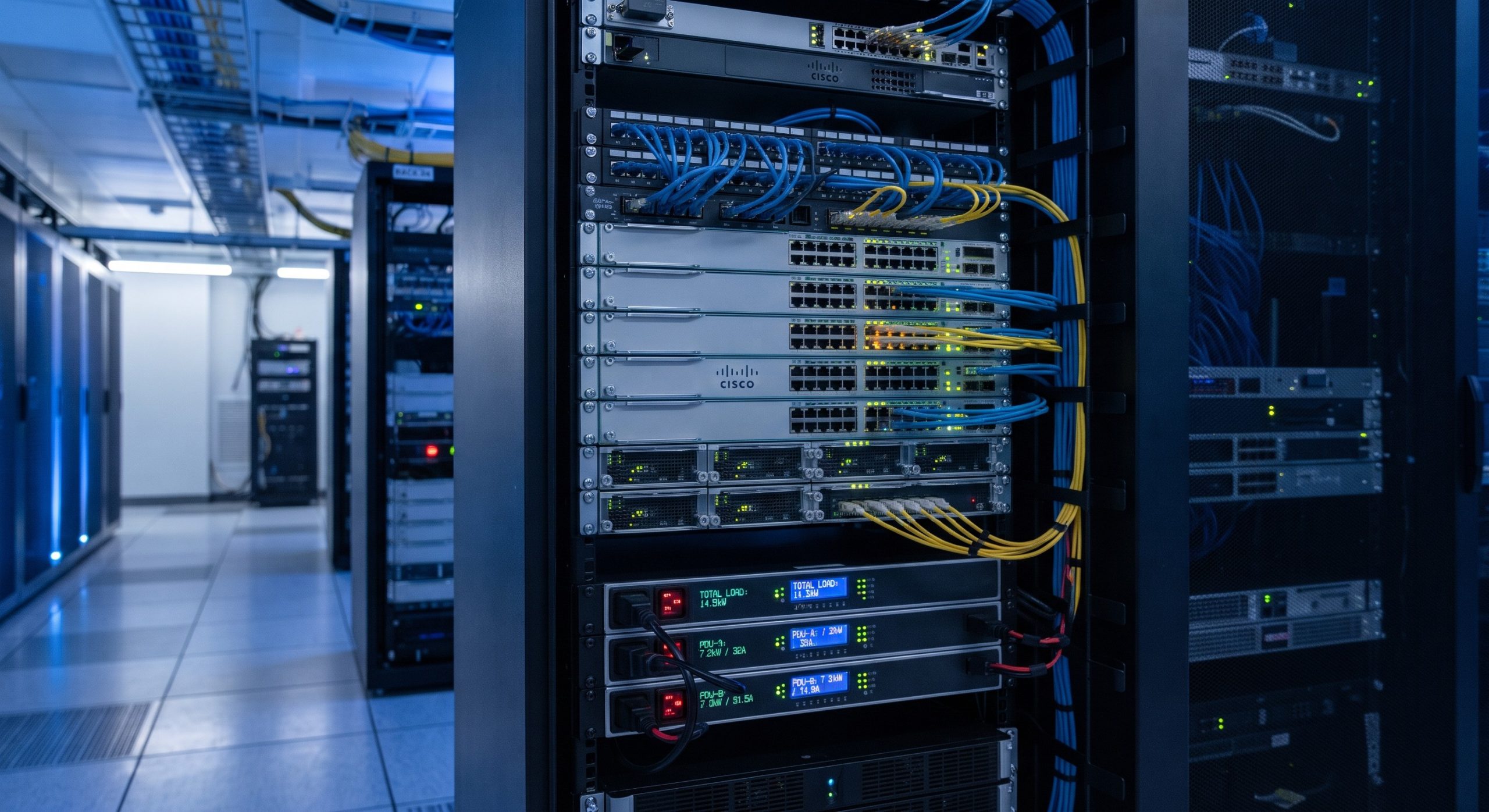
The Catalyst 9300 Series is architected around a modular and fixed uplink philosophy, ensuring that power delivery does not compromise data throughput or chassis scalability. The power subsystem is a critical component of the chassis design, featuring hot-swappable, redundant power supplies and a dedicated power backplane that isolates PoE delivery from the data switching fabric.
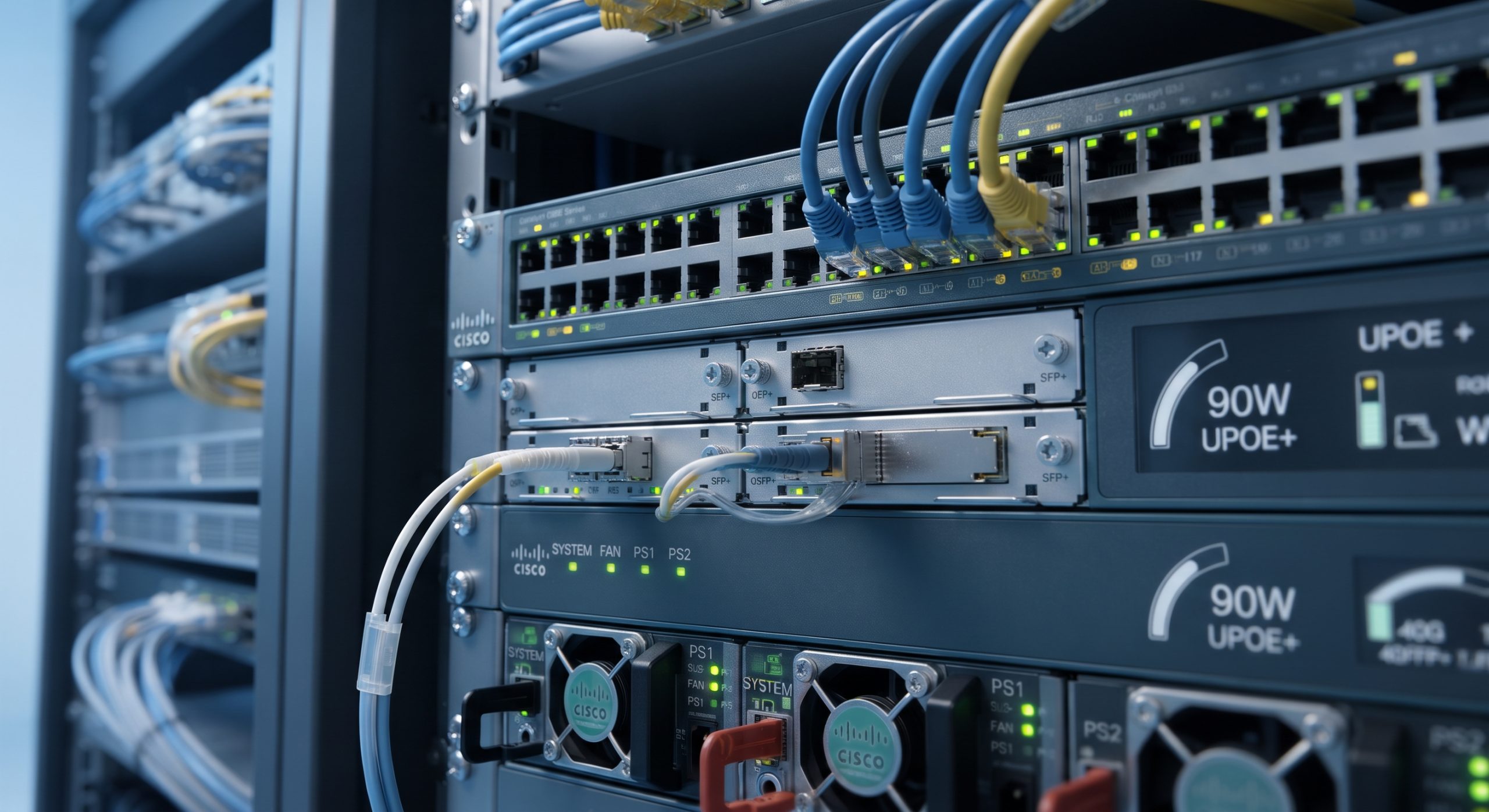
Central to the platform’s high-density 90W capability is the support for IEEE 802.3bt Type 4 (Class 8) power sourcing. This allows the switch to negotiate and deliver up to 90W per port over four pairs of standard copper cabling, ensuring backward compatibility with legacy PoE (802.3af) and PoE+ (802.3at) devices while providing the headroom required for next-generation endpoints . The architecture prioritizes intelligent power management, utilizing Cisco StackPower technology to pool power supplies across the stack. This design allows for the aggregation of power resources, enabling higher port densities of 90W UPOE+ than would be possible with standalone chassis, while also providing N+N power redundancy without the need for dedicated redundant supplies in every unit .
HARDWARE FEATURES
• 90W UPOE+ Density: The platform supports varying densities of 90W ports depending on the model and power supply configuration. Standalone chassis can deliver substantial 90W port counts, while an 8-member stack utilizing StackPower can aggregate power to support up to 288 ports of 90W UPOE+ .
• Intelligent Power Allocation: The system employs dynamic power budgeting. Administrators can configure per-port power limits (e.g., capping a port at 60W or 90W) based on endpoint requirements, ensuring that the total power draw never exceeds the available budget under normal or failover conditions .
• StackPower Redundancy: This feature creates a shared power domain across the stack. If one power supply fails, the remaining supplies in the stack automatically assume the load for all powered devices, ensuring uninterrupted operation of critical IoT and lighting endpoints.
• Perpetual PoE and Fast PoE: These features ensure that powered devices maintain power during switch reboots or software upgrades, minimizing downtime for critical services like security cameras and access control systems.
COMPLIANCE & STANDARDS
The Catalyst 9300 90W UPOE+ implementation strictly adheres to the following industry standards, ensuring multi-vendor interoperability and operational safety:
• IEEE 802.3bt (Type 4, Class 8): Full compliance for 90W delivery over 4-pair cabling.
• IEEE 802.3at (PoE+): Backward compatibility for 30W devices.
• IEEE 802.3af (PoE): Backward compatibility for 15.4W devices.
• Cisco UPOE (60W): Legacy support for Cisco proprietary 60W devices.
• Safety Certifications: UL 60950-1, IEC 60950-1, EN 60950-1, and RoHS compliance for environmental sustainability .
TECHNICAL SPECIFICATIONS
The following table details the power delivery budgets and operational parameters for key Catalyst 9300 models configured for 90W UPOE+ deployment. Actual available port counts are contingent upon the installed power supply capacity (e.g., 1100W or 1900W configurations) and the enablement of StackPower.
| Parameter | Specification |
|---|---|
| PoE Standard Compliance | IEEE 802.3bt Type 4 (Class 8), 90W per port |
| Max 90W UPOE+ Ports (Standalone) | Up to 48 ports (model dependent, e.g., C9300X-48HX) |
| Max 90W UPOE+ Ports (8-Member Stack) | Up to 288 ports with StackPower |
| Power Supply Options | 715W, 1100W, or 1900W AC (Hot-swappable, 1+1 Redundant) |
| Stacking Bandwidth | Up to 1 Tbps (StackWise-1T) with Catalyst 9300X models |
| Forwarding Capacity | Up to 1 Tbps local stackable switching bandwidth |
| ASIC Architecture | UADP 2.0 / UADP 2.0sec (for IPsec models) |
| Operating System | Cisco IOS XE |
ORDERING OPTIONS
To deploy a 90W UPOE+ capable Catalyst 9300 solution, the following SKU categories must be selected based on port count, speed, and power supply requirements:
• Chassis Models: Select models ending in “H” (e.g., C9300-24H, C9300-48H) for 1G 90W UPOE+ density, or “HX” (e.g., C9300X-48HX) for Multigigabit 90W UPOE+ capability .
• Power Supplies: For maximum 90W port density, 1900W AC power supplies are recommended, particularly in StackPower configurations, to ensure sufficient headroom for peak Class 8 loads.
• StackPower Cables: Required for pooling power across multiple chassis in a stack.
📥 Download Technical Specification
Click the button below to view or download the full official PDF datasheet.

Leave a comment