
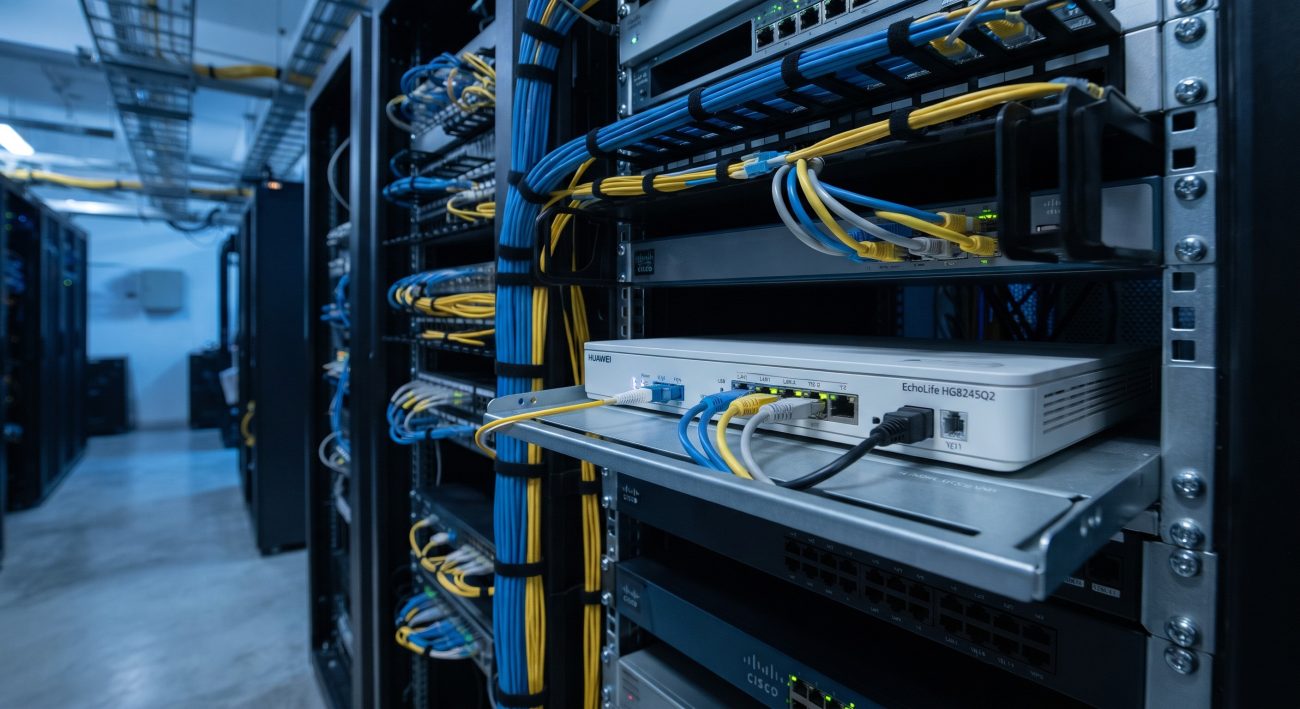
TECHNOLOGY OVERVIEW
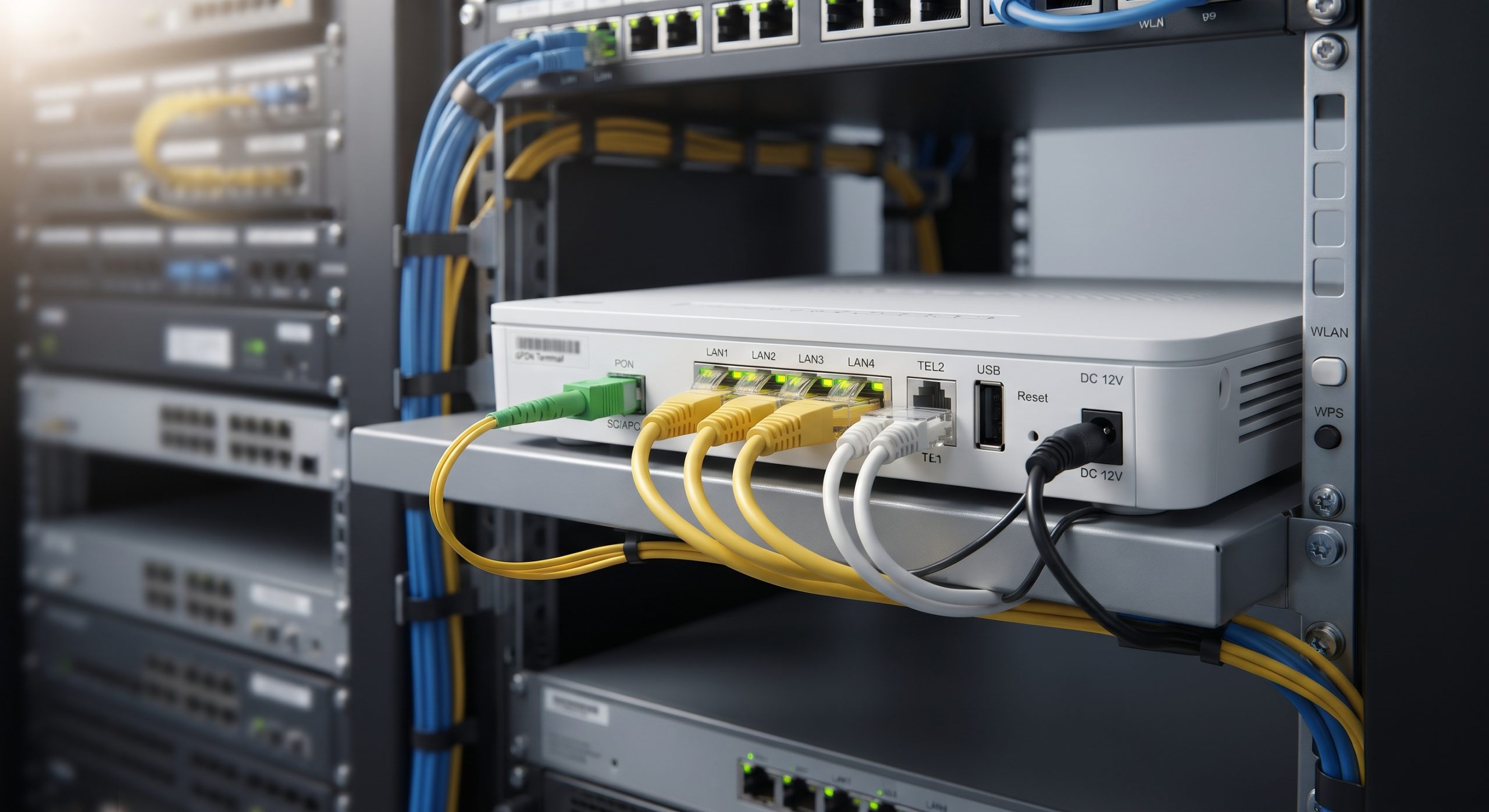
The Huawei EchoLife HG8245Q2 is a routing-type Optical Network Terminal (ONT) engineered for deployment within Huawei’s end-to-end all-optical access architecture. It leverages GPON technology to deliver ultra-broadband access, integrating voice, data, and high-definition video services into a single compact subscriber premises device . The unit provides four Gigabit Ethernet ports, two POTS ports for VoIP telephony, one USB interface, and concurrent dual-band Wi-Fi operation on 2.4 GHz and 5 GHz frequencies . This document serves as a technical reference for the physical interface layout, pinout assignments, and electrical characteristics of the HG8245Q2 hardware platform.

OPTICAL TRANSCEIVER INTERFACES
The optical interface constitutes the primary WAN uplink of the HG8245Q2. The device employs a GPON Class B+ optical module with an SC/APC connector, supporting upstream transmission at 1310 nm and downstream reception at 1490 nm . The optical port is designed for single-mode fiber (SMF) termination. Physical layer diagnostics, including transmit optical power, receive optical power, and LOS (Loss of Signal) status, are accessible via the embedded web management interface under the Optical Information status page . The LOS indicator LED provides immediate visual feedback: a steady off state indicates normal optical reception, while a blinking condition signifies loss of signal or an unconnected fiber pigtail .
REDUNDANT SUBSYSTEMS
While the HG8245Q2 is a subscriber-grade premises device and does not incorporate carrier-class 1+1 redundancy for its power or uplink paths, the platform supports service-level resiliency through dual POTS ports for voice fallback and multiple Gigabit Ethernet ports for LAN-side distribution. The device operates on a single external power adapter input rated at 11–14 V DC . The power barrel connector accepts the included AC/DC adapter (100–240 V AC input). For persistent voice service availability during mains power interruption, the ONT is compatible with external battery backup units via the power interface, though the internal battery management status is reported through the web interface .
CAPABILITY METRICS
The HG8245Q2 delivers Layer 2 and Layer 3 forwarding performance suitable for residential and small office environments. Downstream and upstream Layer 2 forwarding rates are specified at 200 Mbit/s, while IPv4 Layer 3 forwarding reaches up to 2 Gbit/s downstream and 1 Gbit/s upstream . The device supports a maximum of 1024 MAC addresses. Wireless capability includes 2×2 MIMO on the 2.4 GHz band (802.11b/g/n) and 3×3 MIMO on the 5 GHz band (802.11a/n/ac), with antenna gain specified at 2 dBi . Voice services are supported via SIP or H.248 protocols over the two RJ-11 POTS interfaces .
TECHNICAL SPECIFICATIONS
The following table consolidates the physical, electrical, and interface parameters of the Huawei EchoLife HG8245Q2 ONT platform.
| Parameter | Specification |
|---|---|
| Form Factor | Desktop subscriber premises ONT, passive cooling |
| Dimensions (W x D x H) | Approximately 265 mm x 176 mm x 82 mm (varies by source) |
| Weight | Approximately 0.5 kg (unit, varies by configuration) |
| Optical Interface | 1 x GPON Class B+, SC/APC connector, 1310 nm TX / 1490 nm RX |
| Ethernet Ports | 4 x RJ-45 10/100/1000BASE-T Gigabit Ethernet |
| POTS Ports | 2 x RJ-11 FXS for VoIP (SIP / H.248) |
| USB Ports | 1 x USB 2.0 Type-A |
| Wi-Fi Interfaces | 2.4 GHz: 802.11b/g/n 2×2 MIMO; 5 GHz: 802.11a/n/ac 3×3 MIMO |
| Power Input (Adapter) | 100–240 V AC, 50/60 Hz |
| Power Input (Device) | 11–14 V DC, 1.5 A (barrel connector) |
| Operating Temperature | 0°C to 40°C |
| Operating Humidity | 5% to 95% RH (non-condensing) |
| Maximum Power Consumption | Approximately 14 V / 2 A (adapter rating) |
| L2 Forwarding | 200 Mbit/s downstream / 200 Mbit/s upstream |
| IPv4 L3 Forwarding | 2 Gbit/s downstream / 1 Gbit/s upstream |
| MAC Address Table | 1024 entries maximum |
| Management | Web UI, NMS, TR-069 |
| Certifications | FCC (QISHG8245Q2), CE, RoHS |
COMPLIANCE AUDIT
The HG8245Q2 has been certified to applicable international standards for electromagnetic compatibility, safety, and environmental compliance. The device carries FCC approval (FCC ID: QISHG8245Q2) with an approval date of April 14, 2017 . Regional certifications including CE, ISO, and RoHS are documented for commercial distribution . Operating temperature is specified from 0°C to 40°C with relative humidity tolerance of 5% to 95% non-condensing, suitable for controlled indoor subscriber premises environments . The equipment is designed for passive cooling, eliminating active fan components and associated acoustic noise or mechanical wear .
SCALING STRATEGY
The HG8245Q2 is positioned as a fixed-configuration ONT within the Huawei EchoLife portfolio, with no modular expansion slots or line card upgrade paths. Capacity scaling is achieved through the four onboard Gigabit Ethernet ports and dual-band Wi-Fi radios rather than hardware modularity. For network operators, the platform supports remote management via NMS, Web UI, or TR-069, enabling zero-touch provisioning and mass firmware update workflows . The USB port (USB 2.0 Type-A) provides a local storage or diagnostics interface, though its primary documented use is for technical support data collection rather than end-user expansion . Deployment scaling within an ISP topology is therefore achieved through unit density rather than per-device hardware expansion.
📥 Download Technical Specification
Click the button below to view or download the full official PDF datasheet.

Leave a comment