
SLA Demands: The Unforgiving Reliability Requirements of 5G Fronthaul
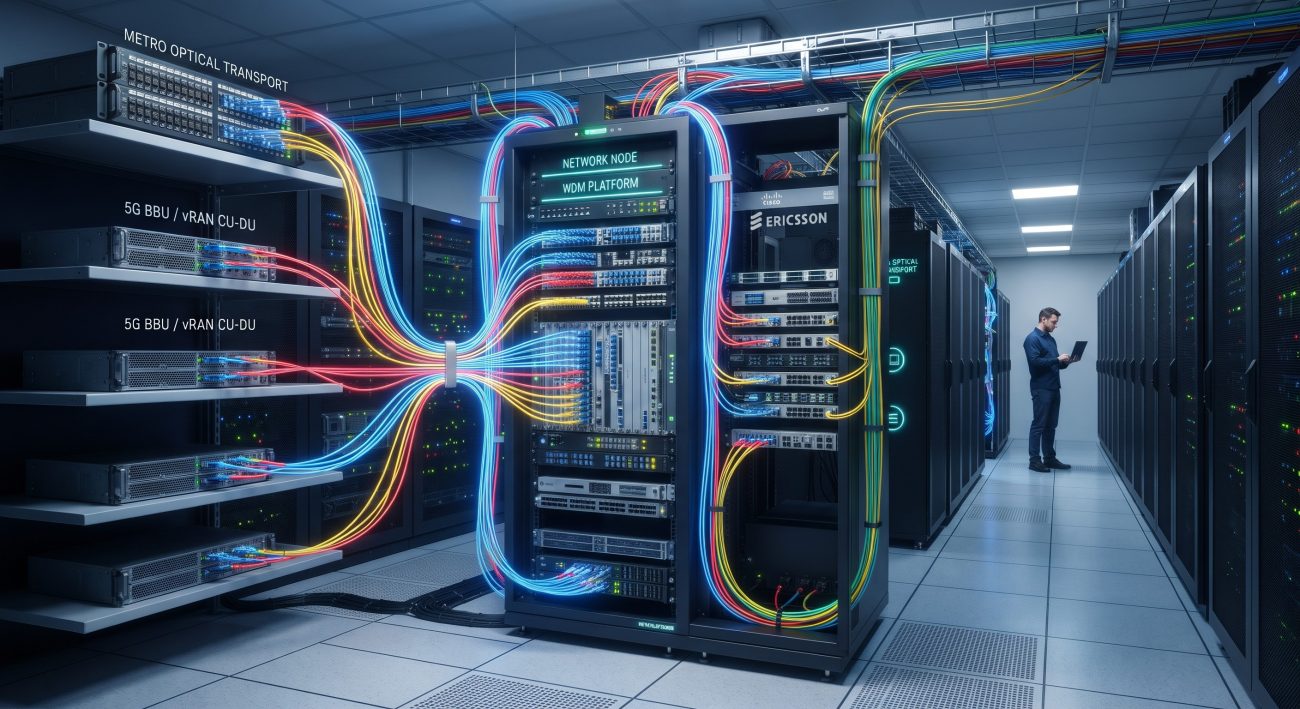
The migration to Cloud RAN architecture fundamentally alters the fault domain of a mobile network. By centralizing Baseband Units (BBUs) into Distributed Units (DUs) and Centralized Units (CUs), the transport network must deliver not only capacity but carrier-grade availability. Unlike traditional backhaul, 5G Fronthaul and Midhaul carry latency-sensitive, jitter-intolerant traffic between Remote Radio Units (RRUs/AAUs) and DU/CU sites. A single fiber cut or optical transceiver failure in a centralized C-RAN hub can disrupt service for dozens of cell sites simultaneously.
Industry standards, notably ITU-T G.698.2, define the physical layer optical interface parameters for metro DWDM applications, ensuring interoperability and baseline performance for amplified multichannel systems . Concurrently, the IEEE 802.1CM standard establishes Time-Sensitive Networking (TSN) profiles for fronthaul, mandating strict bounds on latency, packet delay variation (PDV), and frame loss ratio to prevent radio interface resets . For network architects, the evaluation of Metro WDM reliability is no longer a passive optical budget calculation; it is an active assessment of MTBF (Mean Time Between Failures) across active line cards, redundancy switching times, and protection architectures.
Dual-Engine Failover Architecture: Designing for Sub-50ms Recovery
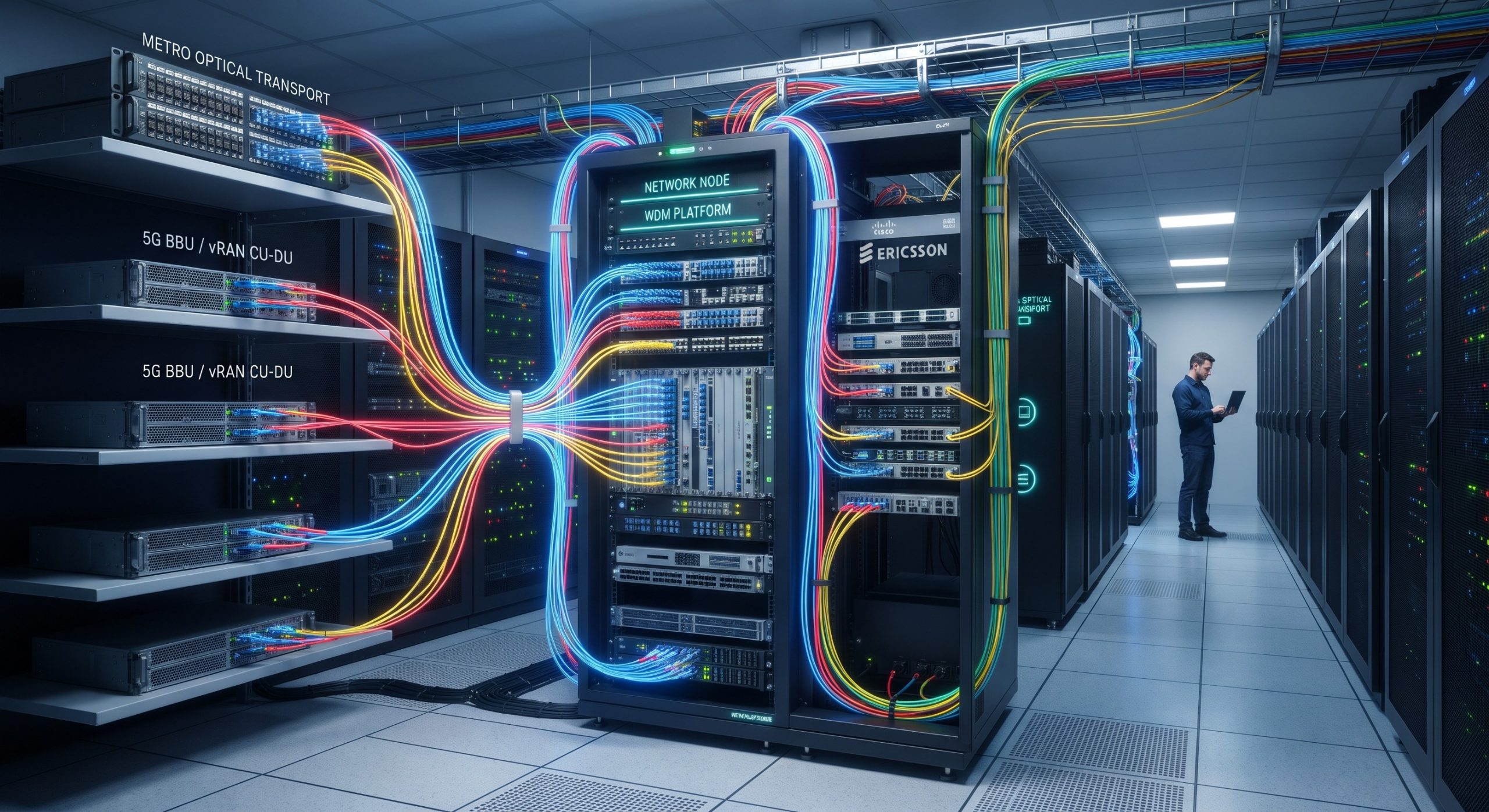
Carrier-grade Metro WDM platforms for 5G transport must eliminate single points of failure. The architectural imperative shifts from simple point-to-point connectivity to a resilient ring or meshed topology utilizing Reconfigurable Optical Add-Drop Multiplexers (ROADMs) and redundant control planes.
Optical Layer Protection Schemes
At the photonic layer, Optical Channel Protection (OCP) and Optical Multiplex Section Protection (OMSP) provide the first line of defense. In a typical metro ring deployment, dedicated protection wavelengths or a 1+1 protection scheme ensure that traffic is bridged to both the working and protection fiber paths. Should a fiber cut occur, the receiving end detects Loss of Signal (LOS) and switches to the protection path. The critical metric here is switching time. For 5G fronthaul carrying eCPRI or CPRI streams, restoration must occur within 50 milliseconds to avoid triggering radio link failure procedures or causing HARQ retransmission storms.
Equipment Redundancy and Active/Standby Logic
Within the WDM terminal equipment itself, reliability is engineered through redundancy. Key components such as the Control Plane CPU, Cross-Connect Matrix, and Power Supply Units (PSUs) are deployed in 1+1 active/standby configurations. The system must support hot-swappable fan trays and load-sharing PSUs to maintain operation during maintenance or single-unit failure. The MTBF for a carrier-grade WDM chassis is typically calculated to exceed 200,000 hours (approximately 22.8 years), assuming a 40°C operating environment. This calculation aggregates the failure rates of all field-replaceable units (FRUs), adhering to Telcordia GR-63-CORE and RoHS compliance standards for environmental durability and material safety.
| Key Parameter | Technical Specification |
|---|---|
| Protection Switching Time | |
| System MTBF | > 200,000 hours (Telcordia GR-63-CORE compliant) |
| Intrinsic Latency | |
| Channel Spacing (ITU-T) | 50 GHz / 100 GHz per G.698.2 |
| Per-Wavelength Capacity | 10G / 25G / 100G / 400G (Scalable) |
| Operating Temperature Range | -5°C to +55°C (Extended range) |
MTBF Metrics and Operational Parameters: Quantifying Reliability
Evaluating the true reliability of a Metro WDM system requires drilling into the component-level specifications and the operational limits that govern thermal and electrical stress. The table below outlines benchmark parameters for a carrier-grade WDM platform designed for 5G Cloud RAN xHaul.
- Protection Switching Time: The interval from fault detection to traffic restoration on the protection path. For 5G latency-critical services, this must be strictly < 50 ms, with leading platforms achieving < 10 ms.
- MTBF (System): The calculated mean time between failures for the fully populated chassis. Values > 200,000 hours indicate a mature, telco-grade design.
- Latency Contribution: The intrinsic forwarding latency added by the WDM transponder/muxponder. For transparent transport, this should be < 10 microseconds to preserve the fronthaul latency budget.
- Channel Spacing & Capacity: Supporting 100 GHz and 50 GHz spacing per ITU-T G.698.2, with per-wavelength rates scalable from 10 Gbps to 400 Gbps (using PAM4 or coherent optics) to accommodate massive MIMO antenna data .
The thermal design is equally critical. Operating within -5°C to 55°C in outdoor cabinets or uncontrolled central office environments requires advanced thermal dissipation. Excessive heat directly degrades laser performance and reduces MTBF. Therefore, fan speed control algorithms and temperature monitoring are essential for predictive maintenance.
Mission-Critical Deployments: Redundancy in Action
Consider a regional Cloud RAN deployment where a Central Office (CO) hosts the DU pool for 50 macro cell sites within a 10 km radius. The fronthaul network utilizes a semi-active WDM system to conserve fiber resources . In this scenario, the AAU side is passive, while the DU side is active and managed via a centralized controller. To meet the five-nines (99.999%) availability target, the network implements a dual-homed ring topology.
If the primary fiber trunk between the CO and a remote aggregation node fails, the ROADM at the aggregation node detects the LOS and triggers an optical protection switch. Within 10 ms, the eCPRI user plane traffic is rerouted over the alternate path around the ring. Simultaneously, the Synchronization plane (IEEE 1588v2 / SyncE) must reconverge to maintain phase alignment; otherwise, the radio frames will misalign, causing inter-cell interference and throughput degradation. This dual-plane recovery—optical and synchronization—is the hallmark of a resilient Metro WDM architecture for 5G.
Final Assessment: Reliability as a Competitive Differentiator
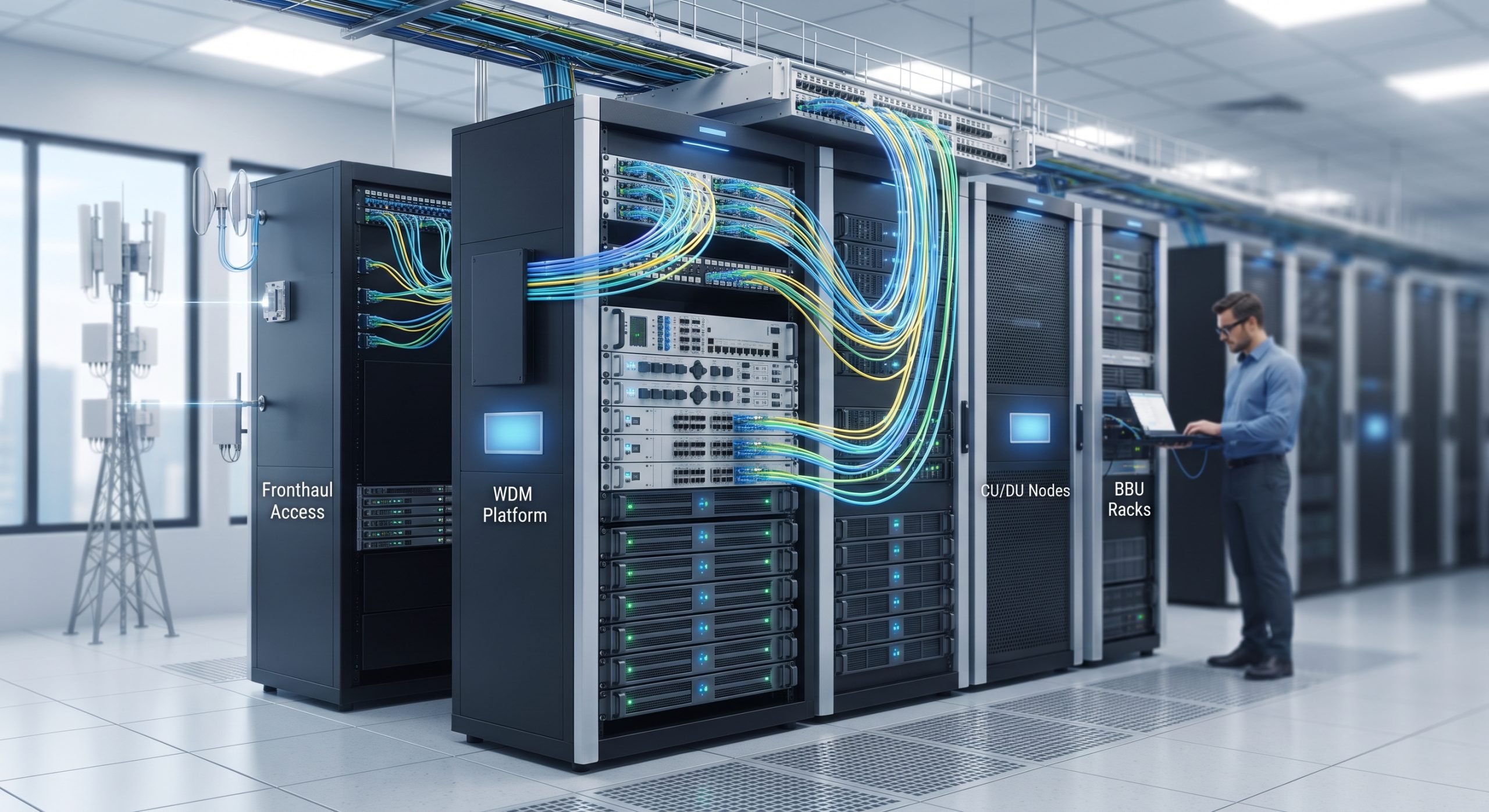
For B2B telecom operators and systems integrators, the selection of Metro WDM equipment for 5G Cloud RAN is a long-term strategic decision. The architecture must be evaluated not just on port density or raw line rate, but on the rigorous engineering of its redundancy mechanisms and the transparency of its reliability data. A platform with a proven MTBF exceeding 200,000 hours, sub-50ms protection switching, and compliance with ITU-T and IEEE fronthaul standards provides the foundational assurance required for mission-critical 5G services. As networks evolve toward 6G and higher densities, the tolerance for downtime approaches zero; investing in a carrier-grade WDM foundation today ensures the transport network remains a strategic asset rather than a bottleneck.
Leave a comment