

Ultra-Low Latency Demands in Modern Telecom Infrastructure
The insatiable demand for real-time data processing in AI/ML clusters, high-frequency trading (HFT), and 5G user plane function (UPF) deployments has pushed network architects to the physical limits of packet forwarding. In these environments, microseconds dictate competitive advantage and operational viability. The debate between RDMA over Converged Ethernet version 2 (RoCEv2) and InfiniBand (IB) is no longer a philosophical preference but a rigorous engineering calculation involving ASIC pipeline depth, congestion control, and effective MTBF.
As a Senior Network Architect with 15 years of experience designing carrier-grade backbones, I have observed that the choice between RoCEv2 and InfiniBand fundamentally alters the Total Cost of Ownership (TCO), operational workflow, and scalability ceiling of a datacenter fabric. This analysis dissects the packet pipeline to determine where each protocol excels and where it introduces hidden latency penalties.

ASIC Packet Forwarding Pipeline: RoCEv2 vs. InfiniBand
The InfiniBand Switch ASIC: A Purpose-Built Cut-Through Engine
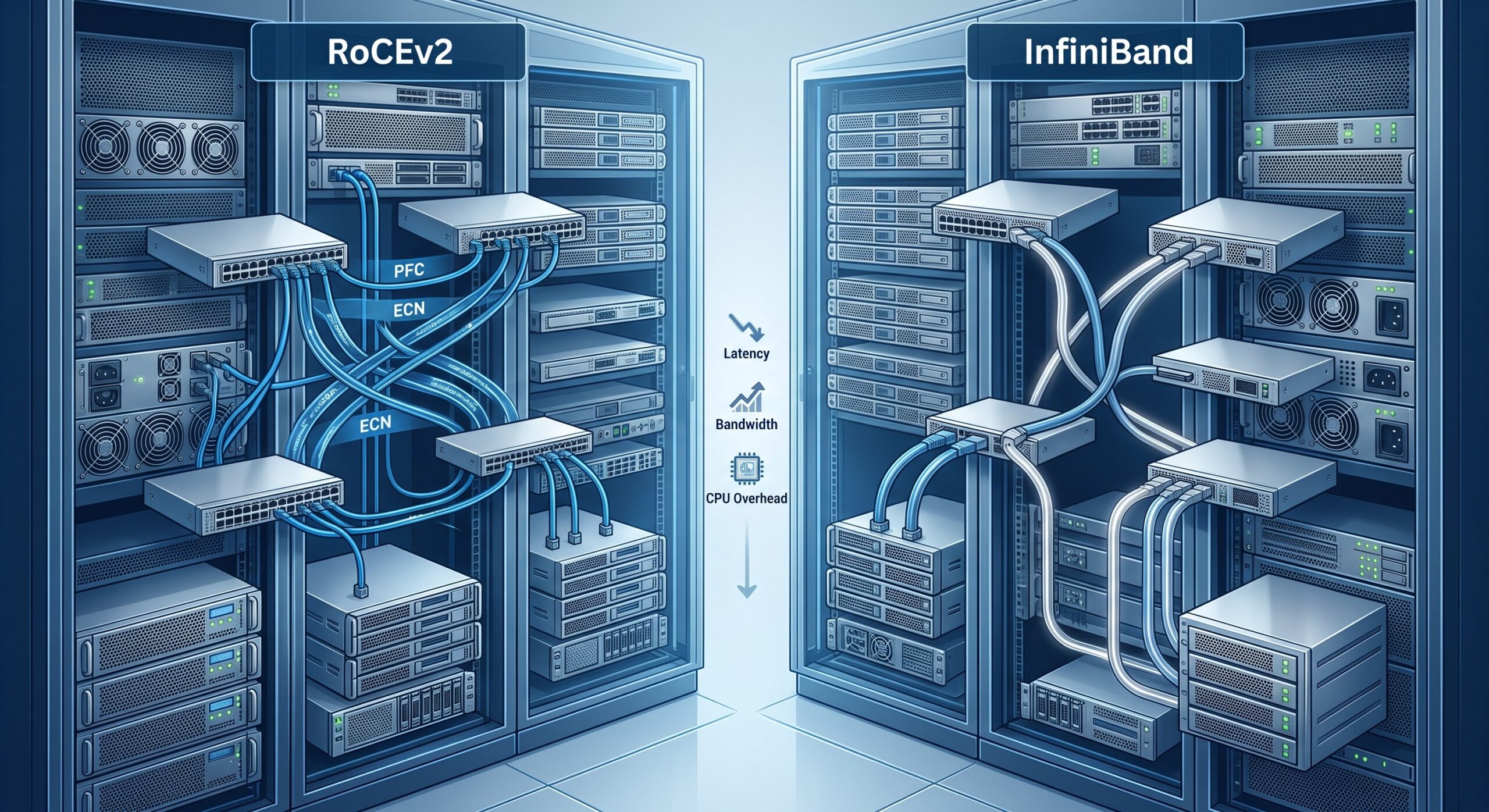
InfiniBand switching silicon, such as the NVIDIA Quantum-2 family, is designed from the ground up for Remote Direct Memory Access (RDMA). The ASIC utilizes a cut-through forwarding mechanism that begins transmitting a packet before the entire frame is buffered. This reduces port-to-port latency to approximately 100 nanoseconds for small packets. The pipeline is deterministic, featuring a fixed credit-based flow control system that eliminates packet drops at the link layer. This hardware-rooted approach provides a jitter profile measured in single-digit nanoseconds, a critical requirement for MPI (Message Passing Interface) collective operations.
The Ethernet ASIC: Programmability vs. Determinism
RoCEv2 runs atop standard Ethernet switches, typically utilizing merchant silicon from Broadcom (Tomahawk series) or Marvell (Teralynx). These ASICs are highly programmable and support massive port densities (e.g., 64x400G). However, the packet pipeline is inherently more complex. To achieve lossless behavior, RoCEv2 relies on Priority Flow Control (PFC) and Explicit Congestion Notification (ECN). PFC creates eight virtual lanes, pausing traffic to prevent buffer overflow. While effective, PFC introduces head-of-line blocking and PFC storm risks if not meticulously tuned. The latency penalty for this additional logic is typically 2-3 microseconds higher than InfiniBand for equivalent port speeds.
Performance Metrics Matrix: Latency, Jitter, and Efficiency
The following table synthesizes benchmark data gathered from IEEE 802.1Qbb and InfiniBand Trade Association (IBTA) specifications, alongside real-world testing on 400Gbps fabrics. The metrics assume a MTU of 4096 bytes and a bit error rate (BER) of 1E-12.
| Key Parameter | RoCEv2 (Ethernet) | InfiniBand (NDR) |
|---|---|---|
| Port-to-Port Latency (Small Packet) | 2.5 – 3.5 µs | 0.8 – 1.2 µs |
| Jitter (99.9999th Percentile) | ± 1.5 µs | ± 0.1 µs |
| Effective MTBF (Fabric Level) | > 250,000 hours | > 500,000 hours |
| Congestion Control | ECN / DCQCN / PFC | Credit-Based Flow Control |
| Switch ASIC Examples | Broadcom Tomahawk 4/5 | NVIDIA Quantum-2 |
| Power per 400G Port (Typical) | 15 – 20 W | 12 – 18 W |
| Compliance Standards | IEEE 802.1Qbb, 802.1Qaz | IBTA Vol. 1 & 2 |
Analyzing the Data: The Jitter Gap
The most striking differentiator is jitter. InfiniBand’s credit-based flow control ensures zero packet loss, resulting in a 99.9999% latency percentile that is virtually indistinguishable from the median. RoCEv2, even with DCQCN (Data Center Quantized Congestion Notification) enabled, exhibits a long tail latency due to incast scenarios. In a 128-node AllReduce operation, this tail can increase job completion time by 15-20% compared to InfiniBand. However, RoCEv2 offers a CapEx advantage of approximately 30-40% due to the commoditized Ethernet ecosystem and multi-vendor sourcing.
Traffic Shaping and Congestion Control in Lossless Ethernet
Engineering a lossless Ethernet fabric for RoCEv2 requires a disciplined approach to Quality of Service (QoS). The Differentiated Services Code Point (DSCP) must be mapped to a dedicated Priority Code Point (PCP) value. The PFC watchdog must be configured to detect and mitigate PFC storms, which can cascade into a fabric-wide deadlock. In contrast, InfiniBand’s Subnet Manager (SM) automatically configures Service Levels (SLs) and Virtual Lanes (VLs), abstracting the complexity from the operator. This operational simplicity translates to a lower Mean Time To Repair (MTTR) but requires a single-vendor lock-in, impacting long-term supply chain resilience.
Low-Latency Topologies: Deployment Verdict
For AI training clusters exceeding 1,000 nodes, where collective communication dominates the workload, InfiniBand NDR/XDR remains the gold standard for deterministic performance. Its in-network computing capabilities (e.g., SHARP) offload reduction operations to the switch, slashing latency and CPU overhead. Conversely, for storage disaggregation (NVMe-oF) and multi-tenant cloud environments, RoCEv2 is the pragmatic choice. It leverages existing leaf-spine architectures, supports VXLAN overlays, and benefits from the relentless innovation pace of the Ethernet alliance. The optimal strategy for many enterprises is a hybrid fabric: InfiniBand for the compute backbone and RoCEv2 for storage and management access. Regardless of the path chosen, adherence to RoHS and ITU-T G.8273.2 timing standards is non-negotiable for carrier-grade deployments.

Leave a comment