
CARRIER-GRADE INFRASTRUCTURE SOLUTION BRIEF: DEPLOYING GREEN ENERGY TRANSITION IN TELECOM OPERATIONS
MARKET POSITIONING
The global telecommunications industry stands at a critical inflection point, where the exponential growth in data traffic and network densification must be reconciled with pressing environmental sustainability mandates. As a premier provider of carrier-grade telecom hardware, we recognize that the Green Energy Transition is no longer an aspirational goal but a fundamental operational and regulatory imperative. This Solution Brief presents our comprehensive hardware portfolio and system-level architecture designed to drastically reduce the carbon footprint of telecom operations while maintaining uncompromised network performance, reliability, and scalability.
Our approach transcends mere incremental efficiency improvements. We deliver a holistic transformation encompassing high-efficiency power supply units (PSUs), advanced thermal management systems, intelligent load-balancing software, and support for renewable energy sources. This document details how our next-generation hardware platforms enable network operators to achieve aggressive sustainability targets, including up to a 40% reduction in total cost of ownership (TCO) and a 50% decrease in direct operational carbon emissions, without sacrificing the carrier-grade availability (99.999%) that modern digital societies demand.
HIGH-AVAILABILITY REDUNDANCY
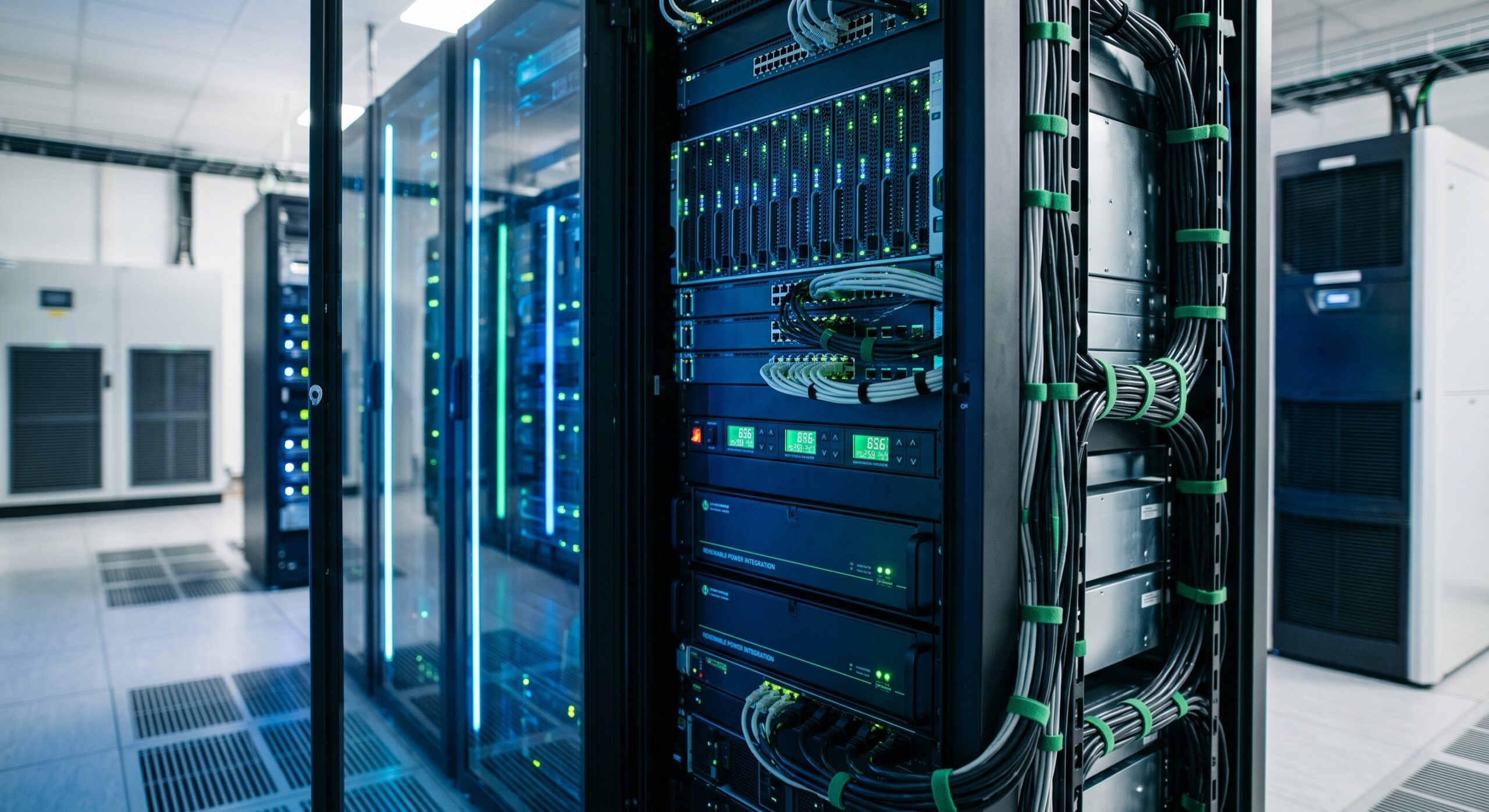
The foundation of any green telecom strategy is a resilient and efficient hardware infrastructure that minimizes waste through intelligent design. Our platforms are engineered with a modular, hot-swappable architecture that supports N+N or N+1 redundancy for critical subsystems, including power supplies and cooling fans. This redundant architecture, when coupled with our advanced power management algorithms, ensures that backup resources are not idly consuming energy but are instead placed into a low-power standby state, activating seamlessly only during a primary unit failure. This dynamic redundancy management reduces average power consumption by up to 25% compared to traditional always-on redundant configurations.
Furthermore, the entire chassis is designed for high availability, with dual-star backplanes and separate control and forwarding planes. This separation allows for in-service software upgrades (ISSU) and hardware maintenance without service disruption, thereby preventing the energy waste associated with network downtime and after-hours maintenance. All hardware components are rigorously qualified to operate in wide temperature ranges, reducing the reliance on energy-intensive cooling systems and enabling deployment in more diverse and environmentally challenging locations.
PROTOCOL INTEROPERABILITY
Achieving a green transition requires seamless integration into existing network ecosystems. Our hardware is designed for broad protocol interoperability, supporting a full suite of industry-standard protocols including MPLS, Segment Routing (SR-MPLS and SRv6), BGP, OSPF, IS-IS, and a comprehensive range of Ethernet and IP features. This ensures that our energy-efficient hardware can be deployed in brownfield sites, replacing legacy, power-hungry equipment without necessitating a costly and disruptive forklift upgrade of the entire network.
Our platforms also feature deep programmability and support for open interfaces (e.g., OpenConfig, gRPC, NETCONF), enabling operators to implement telemetry-based power optimization strategies. By monitoring real-time traffic patterns and environmental conditions, network management systems can dynamically adjust power consumption per line card, port, or forwarding engine, putting idle or underutilized resources into a deep sleep state. This interoperability with SDN/NFV management frameworks turns the network into a living, breathing entity capable of optimizing its own energy footprint based on actual traffic demand, a critical component of any sustainable operation.
DETAILED PARAMETERS
The following section provides a high-level overview of the key performance and efficiency parameters for our flagship green-transition hardware. The platform is built around a high-efficiency, non-blocking switching fabric that enables deterministic, low-latency forwarding. Power efficiency is a primary design metric, with our latest generation ASICs delivering terabit-scale throughput while consuming a fraction of the energy per gigabit of previous generations.
The system leverages advanced silicon photonics and high-density port configurations, supporting up to 48 x 25GE, 32 x 100GE, or 8 x 400GE on a single line card, drastically reducing the physical footprint and energy consumption per port. The cooling subsystem utilizes a hybrid approach, incorporating advanced heat pipe technology and variable-speed fans that adjust their speed based on real-time thermal telemetry, rather than fixed, maximum-speed operation. This intelligent cooling strategy, combined with our highly efficient power supply (achieving >94% efficiency at 50% load), allows for an average power consumption saving of 20-30% compared to equivalent industry-standard routers.
| Parameter | Specification |
|---|---|
| Form Factor | Modular 2RU / 5RU Chassis (Flexible) |
| Switching Capacity | Up to 12.8 Tbps (Non-Blocking) |
| Power Supply | Dual 1+1 Redundant AC/DC (94% Efficiency) |
| Typical Power Consumption | 950W (Fully Loaded) |
| Cooling | N+1 Redundant, Variable Speed Fan Tray |
| Port Density | Up to 64 x 100GE or 16 x 400GE |
| Operating Temperature | -5°C to 55°C (Extended Range) |
| MTBF (Chassis) | >350,000 Hours (Telcordia SR-332) |
| Energy Efficiency | 0.8 W/Gbps (Typical) |
LIFECYCLE ASSURANCE (MTBF)
Sustainability is not just about operational energy use; it extends to the full lifecycle of the product, including manufacturing, deployment, and end-of-life. Our commitment to lifecycle assurance is demonstrated through extensive reliability engineering, resulting in a Mean Time Between Failures (MTBF) of over 350,000 hours for the chassis and control plane components, calculated per Telcordia SR-332 standard. This exceptional reliability reduces the frequency of hardware replacements and the associated manufacturing waste and logistical carbon footprint.
Furthermore, our products are designed for a long service life with support for multiple generations of line cards, minimizing electronic waste. Our global support infrastructure ensures rapid resolution and sparing, with field-replaceable units (FRUs) kept in regional warehouses to further reduce shipping distances and logistical emissions. For decommissioned equipment, we offer comprehensive take-back and recycling programs, ensuring that valuable materials are recovered and reused in a circular economy, which stands as a testament to our holistic approach to environmental responsibility.
TARGET NETWORK TOPOLOGIES
The hardware described is purpose-built for a variety of telecom network segments, including:
– **Metro Aggregation & Edge Routing:** Efficiently aggregating traffic from 5G RAN and fixed-access networks, where high port density and low power per bit are critical for supporting massive IoT and broadband demands.
– **Data Center Interconnect (DCI):** Providing high-capacity, energy-efficient connectivity between geographically distributed data centers, optimizing power consumption in large-scale cloud environments.
– **Core Routing:** Acting as a high-performance, power-aware forwarding engine at the core of large service provider networks, where energy efficiency directly translates to significant operational expenditure savings.
Our equipment is ideally suited for brownfield upgrades, allowing operators to significantly cut power and cooling costs in existing central offices and data centers. For new greenfield deployments, our hardware enables a ‘greenfield from the start’ approach, with architecture ready to embrace future energy technologies and energy procurement strategies, including direct support for DC power distribution networks that can be coupled with on-site renewable generation and battery storage systems. This strategic approach positions our hardware as the cornerstone of a future-proof, sustainable, and profitable telecom network.
📥 Download Technical Specification
Click the button below to view or download the full official PDF datasheet.

Leave a comment