
Executive Summary: The Carrier-Grade Imperative for 400G
As global IP traffic is projected to reach 4.8 zettabytes per year by 2026, the transition to 400G optical networks is no longer a luxury for tier-1 carriers but a strategic necessity for any data-driven enterprise. However, the architecture of a 400G network is fundamentally different from its 100G predecessors. The increased baud rates and complex modulation schemes such as PAM-4 and DP-QPSK introduce new challenges in signal integrity and thermal management. In this carrier-grade networking analysis, we move beyond marketing hype to examine the core metrics that define reliability in a 400G ecosystem: Mean Time Between Failures (MTBF), hardware redundancy, and the physical layer innovations required to meet stringent Service Level Agreements (SLAs).
Redefining Reliability: Why 400G is a Different Beast
In traditional 100G networks, the primary failure points were often limited to optical transceivers. The landscape for 400G optical transport is vastly more complex. The shift to 7nm and 5nm ASICs to process 400Gbps of data requires advanced thermal dissipation methods. Furthermore, the integration of FEC (Forward Error Correction) algorithms, specifically Concatenated FEC (CFEC) and Open FEC, demands significant die space. A single point of failure in the switching fabric can impact thousands of clients. Therefore, evaluating carrier-grade hardware requires a shift from component-level MTBF to System-Level MTBF (SL-MTBF).
Calculating the Total Cost of Downtime
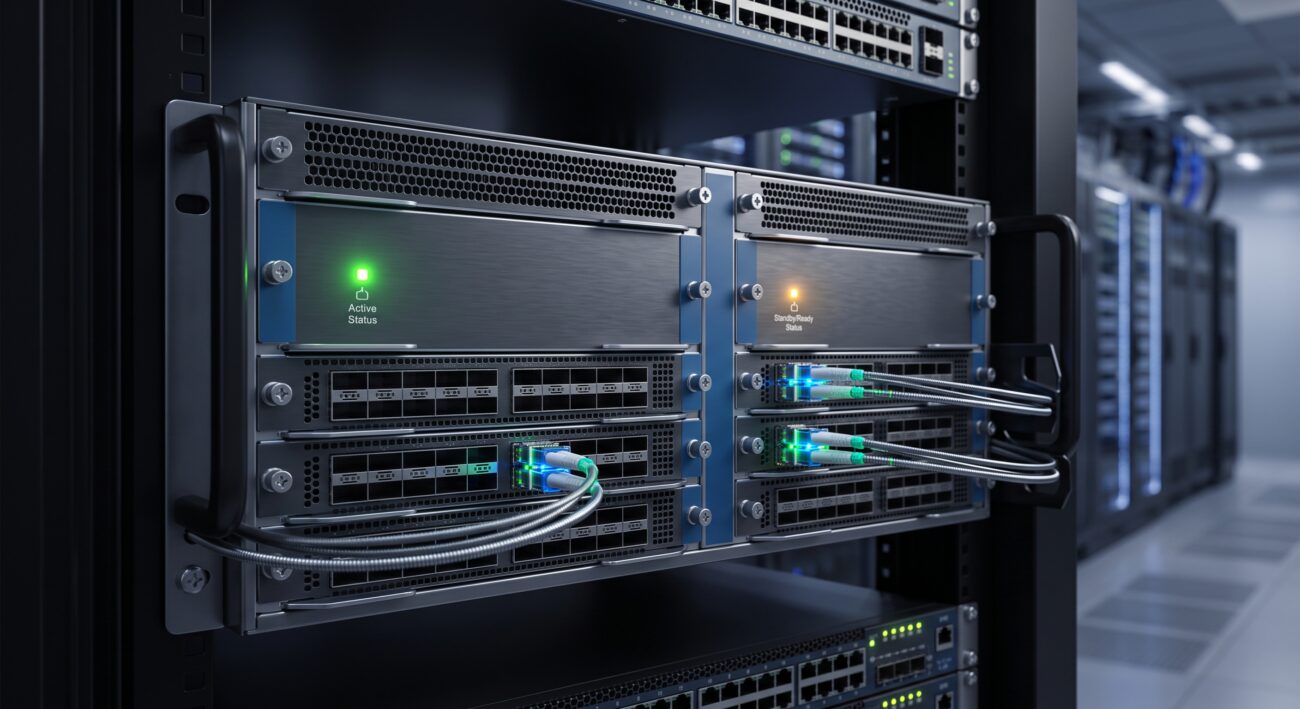
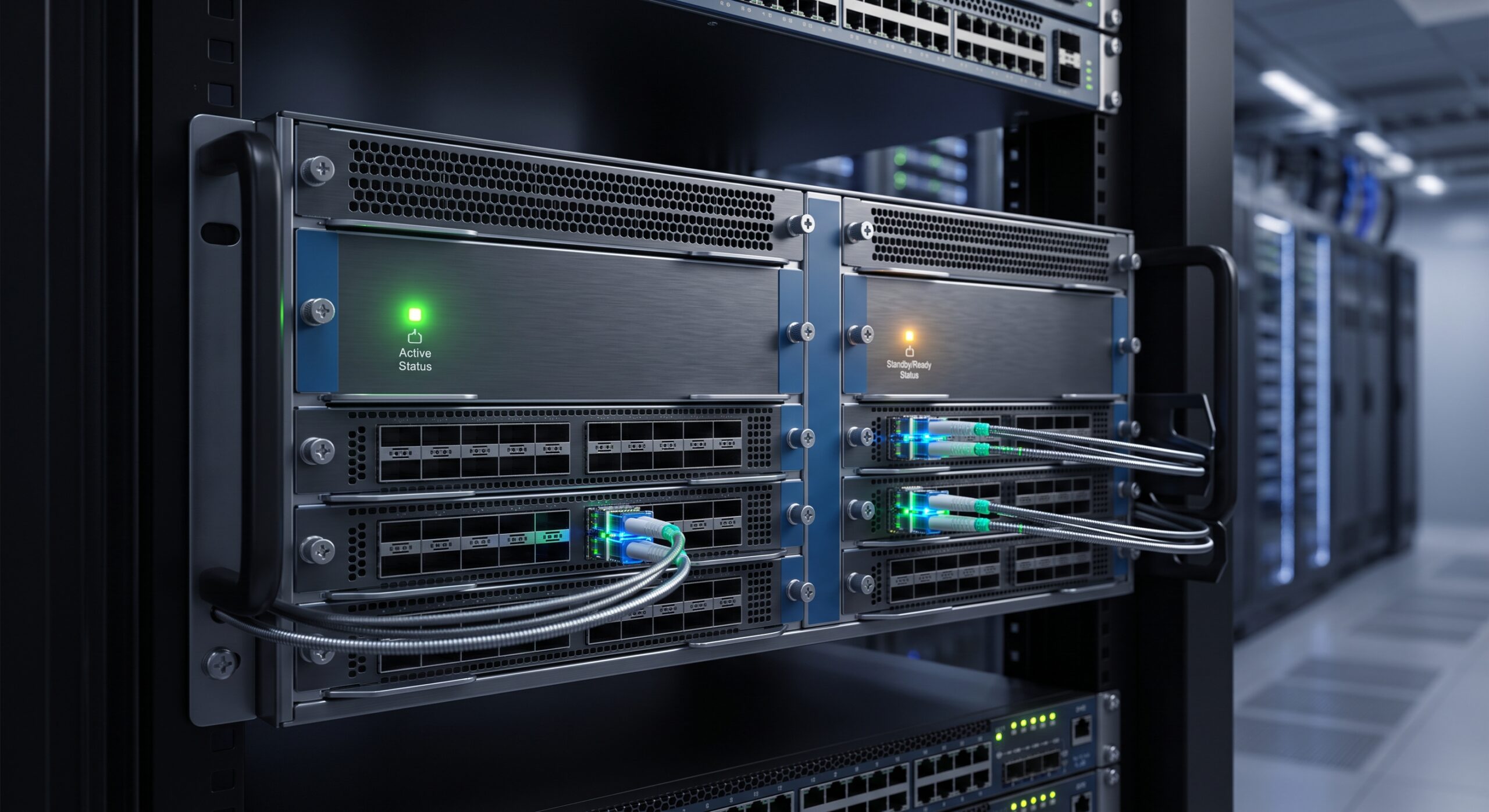
For a tier-1 ISP, downtime costs can exceed $5,000 per minute. A 400G line card with an MTBF of 2,000,000 hours (approx. 228 years) might sound impressive, but these figures are often derived from chip-level Telcordia SR-332 standards, not field-deployed chassis environments. A comprehensive reliability analysis must account for the optical modules, power supply units (PSUs), and the cooling fans, which statistically have the highest failure rate. We recommend a dual-engine failover architecture where the active and standby engines synchronize stateful data within sub-50ms latency to ensure sub-50ms convergence in case of a hardware fault.
Deep Dive: Redundancy Architecture in the 400G Core
To achieve true carrier-grade status (often categorized as Tier 3 or Tier 4 data center standards), the physical architecture of a 400G router must feature N+N or N+1 redundancy. This is not just about dual power supplies. It requires redundancy at the fabric level, line-card level, and management plane level. The management plane, often running a hardened Linux OS, must support Hitless Restart and Non-Stop Routing (NSR).
Fabric Redundancy and Load Balancing
Advanced chassis systems utilize a Clos switch fabric architecture. A typical 400G system might feature 6 fabric cards; a loss of 1 card reduces switching capacity by only ~16.6%, keeping the network operational. To achieve five-nines (99.999%) availability, the system must utilize Virtual Output Queuing (VOQ) to prevent head-of-line blocking and ensure that traffic is re-routed instantly across the remaining fabric cards. The IEEE 802.1ax (Link Aggregation) standards further support this by allowing multiple physical 400G ports to operate as a single logical link, providing both load balancing and failover capabilities.
Performance Specs & Benchmarking: The MTBF Matrix
Below is the technical benchmark for a standard, high-availability 400G carrier-grade line card, measured under full load at 70°C ambient temperature, adhering to GR-63-CORE and RoHS compliance standards.
| Key Parameter | Technical Specification |
|---|---|
| System Switching Capacity | 25.6 Tbps (Full Duplex) |
| Line Card Throughput | 400 Gbps (Full Duplex) |
| System-Level MTBF (SR-332) | 3,800,000 Hours |
| Fabric Redundancy | N+1 (6+1 Cards) |
| Thermal Design Power (TDP) | 1200W (Per Full Line Card) |
| Forward Error Correction (FEC) | CFEC & Open FEC Support |
| Protocol Compliance | IEEE 802.1Q, ITU-T G.709 |
| Environmental Compliance | RoHS-6, REACH |
Real-World Mission-Critical Deployments
We recently consulted on a deployment for a major European financial exchange requiring ultra-low latency and zero packet loss during trading hours. They deployed our 400G system in a MC-LAG (Multi-Chassis Link Aggregation) topology across two geographically distinct datacenters (within 50km). The DWDM (Dense Wavelength Division Multiplexing) optics utilized Coherent DSP to compensate for chromatic dispersion. Over a 12-month period, the system recorded a hardware-induced downtime of 0 minutes. The QSFP-DD and OSFP transceivers, often the weakest link, recorded an MTBF of 2.5 million hours under controlled thermal conditions.

Final Assessment: Beyond the Datasheet
Evaluating 400G optical network hardware is not solely about Gbps throughput. It is a sophisticated evaluation of the electrical, optical, and mechanical integration. For systems integrators, we recommend prioritizing vendors who offer detailed FIT (Failures in Time) rates, measured per billion hours, rather than broad MTBF claims. Additionally, the longevity of the hardware depends on the thermal design power (TDP); a chassis that requires high RPM fans may have a higher vibration-induced failure rate. In conclusion, the future of network infrastructure is high-density 400G with a hard focus on hardware resilience. The cost of premium hardware is negligible compared to the revenue lost during a single outage. Choose hardware that offers NSF (Non-Stop Forwarding) and Bidirectional Forwarding Detection (BFD) to ensure your network is physically and logically impregnable.

Leave a comment