
SLA Demands and the Criticality of the Secondary Loop
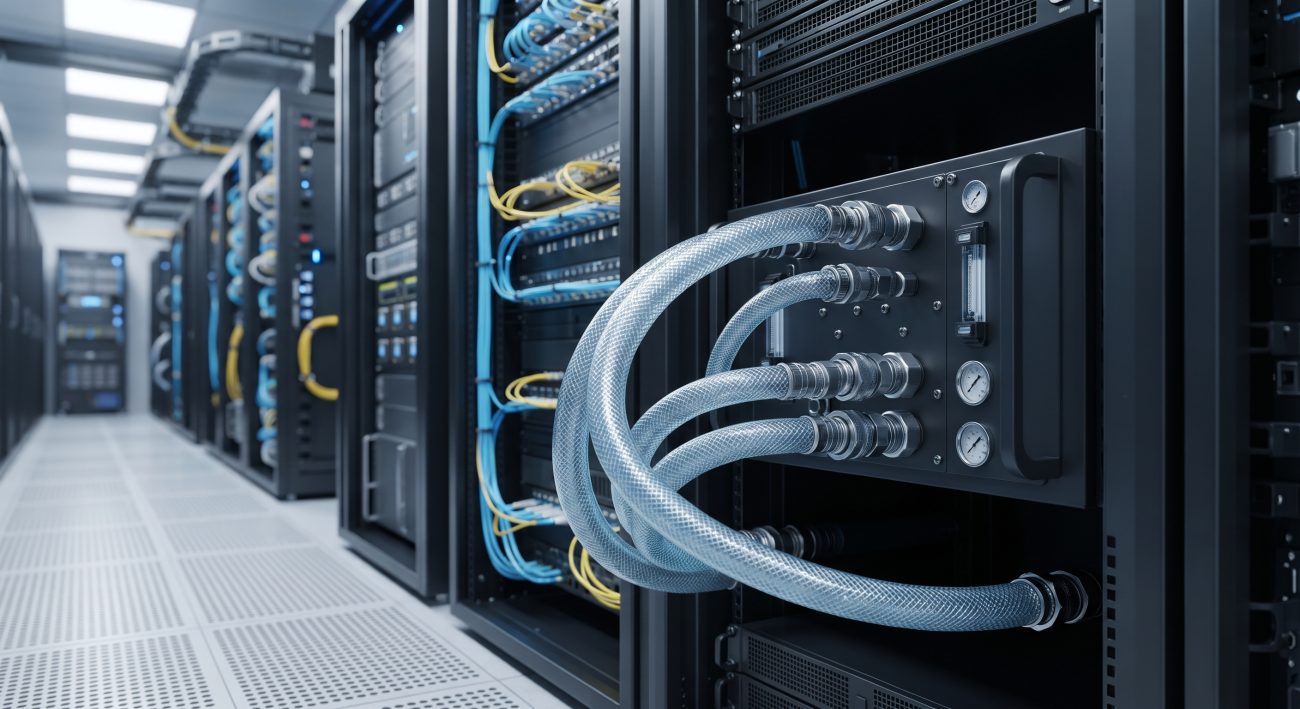
In the race toward 5G mmWave densification and edge AI inference, the thermal envelope of telecom cabinets has shifted from air-limited to liquid-critical. The Secondary Fluid Network Module (SFNM) serves as the vital boundary between facility chilled water and the sensitive dielectric loops of liquid-cooled cabinets. While much attention is paid to cold plate microchannels, the flexible hose burst pressure rating within the SFNM is the single most consequential metric for maintaining five-nines (99.999%) availability. A catastrophic hose failure does not merely cause a thermal throttle; it introduces a catastrophic short-circuit risk to adjacent 400G/800G optical transport shelves and power distribution units.
For network architects specifying carrier-grade infrastructure, the hose is no longer a passive accessory. It is an active pressure vessel subject to thermal cycling, pump ripple, and water hammer effects. This analysis evaluates the reliability engineering behind SFNM hose assemblies, focusing on MTBF (Mean Time Between Failures), dual-barrier redundancy, and the non-negotiable 4:1 burst pressure safety factor mandated by modern carrier standards.
Dual-Engine Failover Architecture and Hose Integrity
Redundant Seal Topography vs. Single-Point Hose Rupture
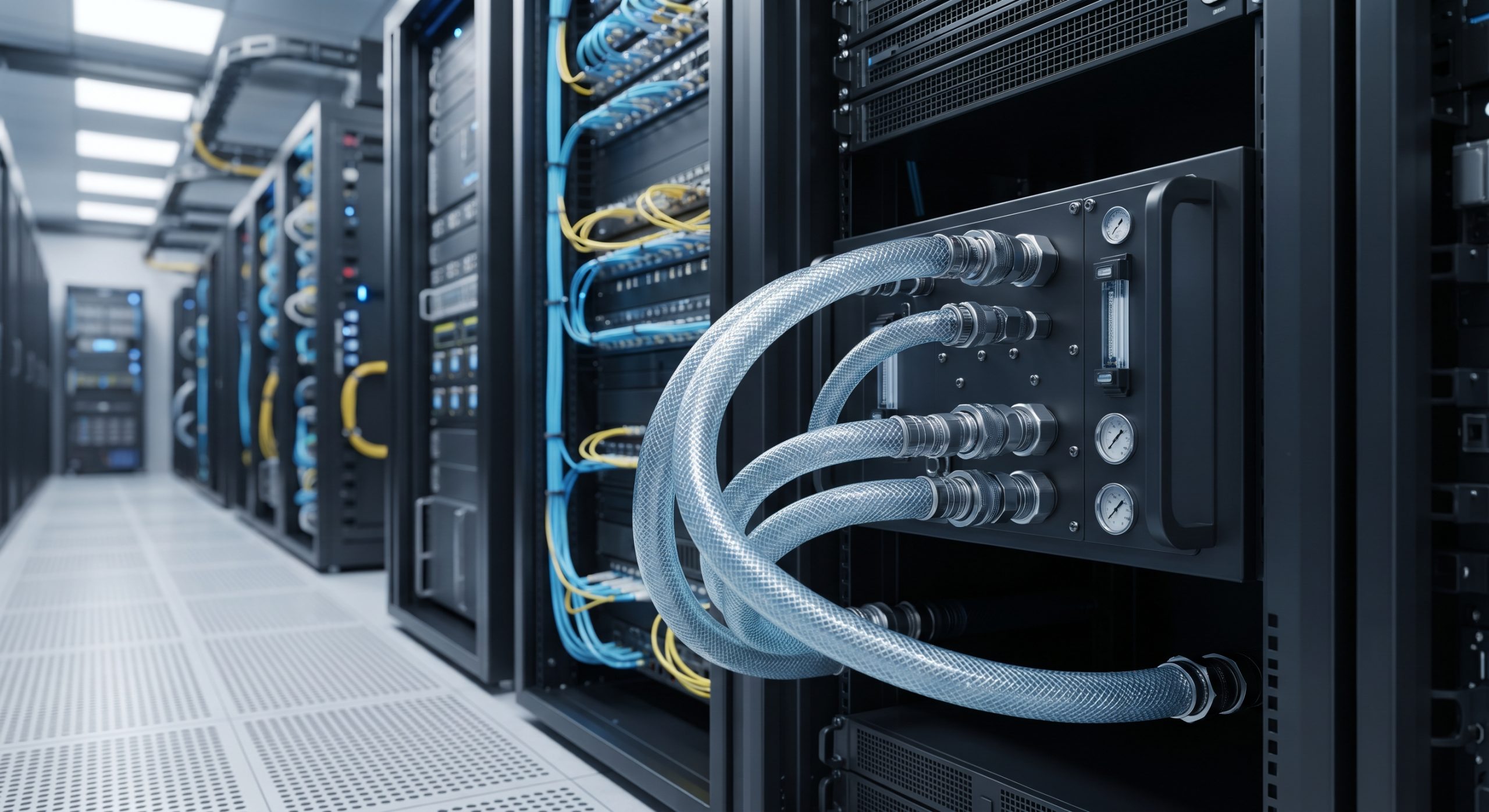
The architectural philosophy governing SFNM reliability has shifted from component-level robustness to system-level fault tolerance. A standard industrial hose may meet a basic pressure rating, but a carrier-grade SFNM integrates a dual-barrier seal architecture with redundant O-ring faces and a secondary containment shell . In the context of flexible hose burst pressure, this means the flexible conduit is often sleeved or routed within a containment channel. If the primary elastomeric core experiences fatigue micro-fractures due to pressure cycling (100,000 cycles to 1.5x rated pressure), the secondary shell captures the seepage and triggers an SNMP alarm via integrated leak detection sensors before any external fluid egress occurs .
This dual-engine approach to containment is essential because the failure mode of a flexible hose under burst conditions is rarely a clean pinhole. As observed in DEKRA iST burst testing, flexible hose assemblies typically fail via hose rupture or thread slippage at the fitting interface . The SFNM design mitigates this by specifying 316L stainless steel for wetted metallic fittings and PPSU thermoplastic for manifold bodies, ensuring that the mechanical grip on the hose remains stable across the -40°C to +85°C operational envelope .
The 4x Burst Pressure Mandate: Standards and Validation
The defining safety metric for any flexible hose in a liquid-cooled cabinet is the ratio of design burst pressure to maximum operating pressure (MOP). While general industrial hoses may rely on a 3:1 safety factor (as seen in some OCP blind-mate specifications), carrier-grade telecom SFNM units consistently mandate a 4:1 ratio . For a standard SFNM rated at 10 bar (145 psi) MOP, the flexible hose assembly must withstand a minimum of 40 bar (580 psi) before rupture .
This validation is not theoretical. It is executed via hydrostatic burst testing per ISO 1402 and ASME B31.3 process piping guidelines . The testing protocol requires the complete removal of air from the test circuit (to prevent adiabatic compression ignition or false burst readings) followed by stepwise pressurization until failure . The failure mode is then documented—whether it is a longitudinal split in the elastomer, a fitting blow-off, or a pinhole leak—to refine the hose crimp specification.
| Key Parameter | Technical Specification |
|---|---|
| Maximum Operating Pressure (MOP) | 10 bar (145 psi) |
| Design Burst Pressure (Flexible Hose) | 40 bar (580 psi) — 4x MOP |
| Wetted Materials (Hose/Fittings) | 316L SS, EPDM/FKM, PPSU |
| Operating Temperature Range | -40°C to +85°C |
| MTBF (Telcordia SR-332) | 1,200,000 hours @ 40°C |
| Pressure Cycling Validation | 100,000 cycles @ 1.5x MOP |
| Leak Detection | Dual-barrier sensor, SNMP v3 alarm |
| Compliance Standards | Telcordia GR-63/487, IEC 62368-1, ASME B31.3 |
MTBF Metrics and Mission-Critical Deployment Realities
Quantifying Reliability: 1.2 Million Hours and Beyond
The reliability of a flexible hose within an SFNM cannot be separated from the telemetry and materials science supporting it. According to accelerated life testing per Telcordia SR-332, a properly specified carrier-grade SFNM achieves an MTBF of 1,200,000 hours at 40°C ambient . This figure is derived not just from the hose itself, but from the entire fluidic path: the EPDM/FKM elastomer compatibility with propylene glycol and dielectric fluids, the pressure drop characteristics (ΔP at rated flow), and the thermal stability of the PPSU manifolds.
For a field deployment in a 5G mmWave edge site or a hybrid-cooled central office, this MTBF translates to a practical operational reality: the SFNM is designed to outlive the compute silicon it cools. The hose assembly is validated through 5,000-hour immersion testing in inhibited glycol and fluorinated dielectric fluids, ensuring that the tensile strength and elongation of the elastomer do not degrade to the point where a pressure spike (e.g., pump startup water hammer) causes a rupture .
Topology and Hot-Swap Considerations
In a star or ring fluid topology serving up to 48 branch circuits per module, the flexible hose is the final flexible link between the rigid SFNM manifold and the server rack . The integration of quick-disconnect (QD) couplings meeting IEC 62368-1 introduces an additional potential leak point that must be factored into the burst pressure analysis . A QD that disconnects under pressure without check-valve integrity is functionally equivalent to a hose burst. Therefore, the MTBF calculation for the fluid network must account for the mechanical wear of the QD sleeve and O-ring compression set over thousands of mate/de-mate cycles.
For systems integrators deploying in uncontrolled outdoor enclosures (per Telcordia GR-487-CORE), the flexible hose must also resist UV degradation and ozone attack, which can embrittle the outer cover and reduce the effective burst strength over a 20-year service life . The selection of FKM (Viton) or EPDM over commodity rubber is not a cost optimization; it is a reliability imperative to prevent catastrophic environmental stress cracking.

Final Assessment: Engineering Out the Single Point of Failure
The flexible hose burst pressure within a Secondary Fluid Network Module is the ultimate arbiter of thermal reliability in high-density telecom cabinets. While ASIC forwarding capacity and port density dominate marketing datasheets, the mechanical integrity of the coolant pathway determines whether a 400G edge node stays online during a pump surge or a thermal transient. By enforcing a 4:1 burst safety factor, specifying 316L/PPSU/EPDM material stacks, and validating through Telcordia SR-332 accelerated life testing, carrier-grade SFNM designs achieve 1.2 million hours MTBF—effectively decoupling thermal infrastructure failures from network downtime. For the network architect, the specification of the hose is not a plumbing detail; it is a core layer-1 high-availability decision.
Leave a comment