
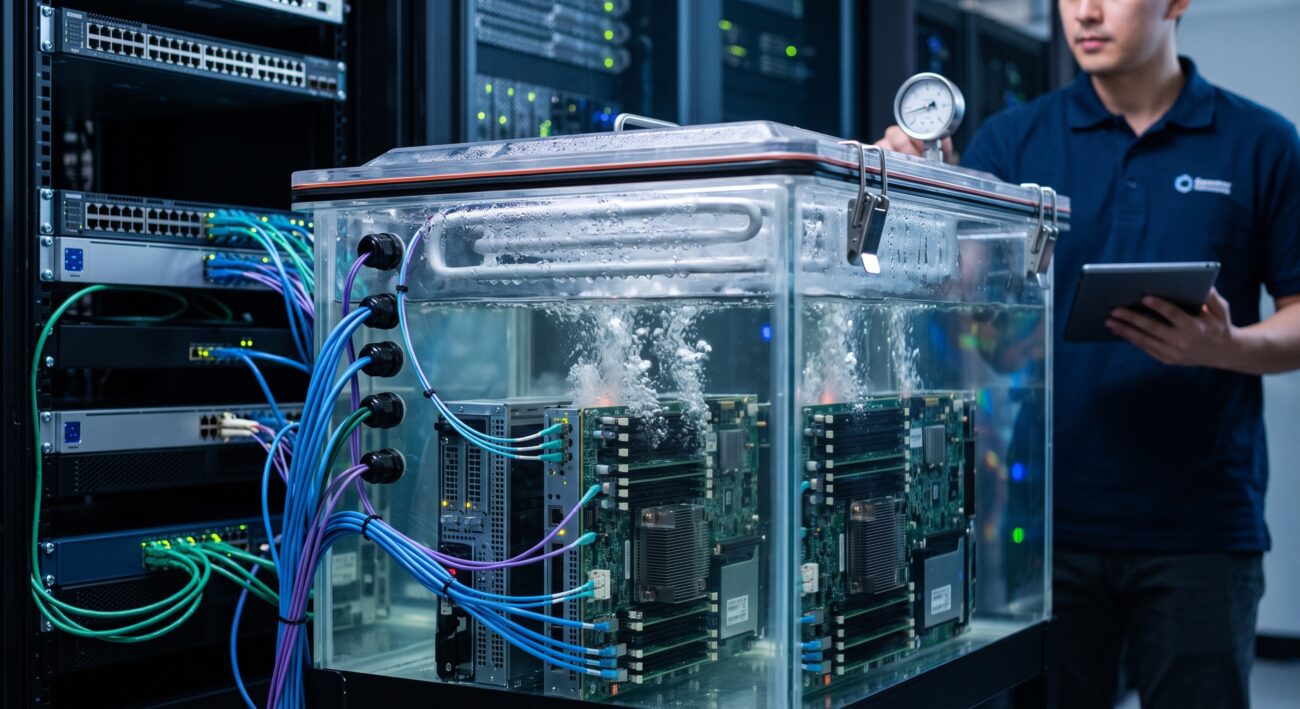
SLA Demands: The Hermeticity Imperative in Two-Phase Immersion Cooling
In the relentless pursuit of Carrier-Grade Reliability for next-generation 5G and edge computing infrastructure, thermal management has emerged as the single most critical constraint on Mean Time Between Failures (MTBF) and Operational Expenditure (OpEx). As telecom operators deploy high-density ASIC-based routing and switching platforms—often exceeding 25.6 Tbps per chassis—traditional air cooling has hit a thermal wall. Enter Two-Phase Phase-Change Immersion Liquid Cooling Modules, a disruptive technology that promises to slash Power Usage Effectiveness (PUE) to below 1.05 while enabling extreme overclocking of network silicon. However, the efficacy of this technology hinges entirely on a single, unforgiving engineering challenge: Tank Hermeticity.
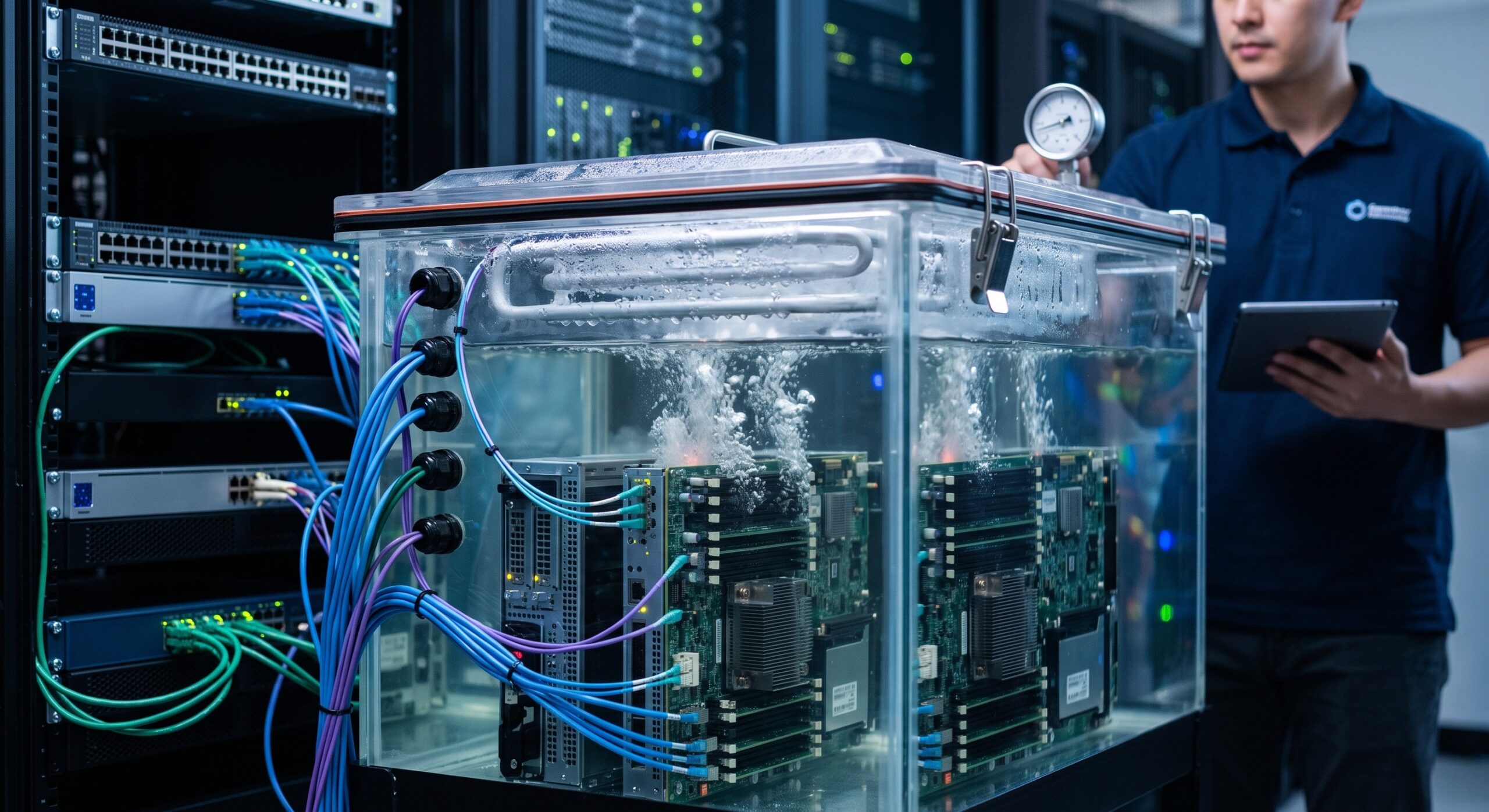
Unlike single-phase immersion, where fluid remains liquid, two-phase systems rely on the latent heat of vaporization of engineered fluids (e.g., Novec or Fluorinert). The fluid boils at ~50°C, condenses on a water-cooled coil, and rains back down. This phase change is a double-edged sword: it offers unparalleled heat rejection but creates a closed-loop system where any breach in hermeticity leads to fluid loss, dielectric breakdown, and catastrophic hardware failure. This analysis evaluates the architectural requirements for maintaining a hermetically sealed tank, the redundancy mechanisms required for carrier-grade Five Nines (99.999%) availability, and the quantified impact on MTBF.
Dual-Engine Failover Architecture: Engineering for Zero Leakage
The Physics of Vapor Loss and Pressure Management
A two-phase tank is not a static vessel; it is a dynamic pressure system. As ASICs dissipate 500W to 1000W each, the internal pressure fluctuates. Tank hermeticity is not merely about sealing a box; it is about managing a controlled pressure envelope to prevent gaseous diffusion. The primary failure mode is not a catastrophic rupture but permeation—the slow escape of vapor molecules through gaskets, seals, and even the polymer walls of the tank itself. A loss of just 5% of the fluid volume annually can degrade heat transfer coefficients by 15%, raising junction temperatures (Tj) and accelerating electromigration in the ASIC.
Redundant Sealing and Monitoring Topology
To achieve carrier-grade reliability, the tank cannot rely on a single O-ring. The architecture must employ a dual-barrier seal strategy. The primary barrier is a welded stainless steel or anodized aluminum shell with laser-welded seams. The secondary barrier is a gasket-in-groove system utilizing FKM (Viton) or EPDM elastomers specifically rated for the low surface tension of dielectric fluids. Critically, the system must integrate real-time hermeticity monitoring. This is achieved via pressure transducers and non-dispersive infrared (NDIR) sensors that detect fluorocarbon vapor in the sub-atmospheric space between the primary and secondary seals. If a leak is detected, the system triggers an alarm via SNMP traps and redundant vacuum pumps engage to maintain negative pressure, preventing vapor escape.
| Key Parameter | Technical Specification |
|---|---|
| Helium Leak Rate (Hermeticity) | |
| MTBF (Tank Assembly) | > 500,000 hours |
| Operating Pressure Range | 0.5 – 2.0 bar (absolute) |
| Fluid Loss Rate (Annual) | |
| Optical Feedthrough Insertion Loss | |
| ASIC Junction Temperature Reduction | 15°C vs. Air Cooling |
| PUE (Power Usage Effectiveness) |
MTBF Metrics: Quantifying Hermeticity Impact
The MTBF of a two-phase immersion module is directly correlated to the Leakage Rate (LR) and the Mean Time to Repair (MTTR) of the seal. According to Telcordia GR-63-CORE and IEEE 3006.8 standards, a carrier-grade system must demonstrate an MTBF exceeding 500,000 hours. In a two-phase system, the MTBF of the tank is calculated as:
- MTBF_tank = 1 / (λ_seal + λ_weld + λ_value + λ_sensor)
- λ_seal (Failure rate of elastomeric seals): Typically 1 x 10^-7 failures/hour.
- λ_weld (Failure rate of welded joints): Typically 1 x 10^-8 failures/hour.
However, the system-level MTBF is dominated by fluid loss. A hermeticity failure that results in a 10% fluid loss over 5 years can reduce the MTBF of the ASIC by 40% due to hot spots. Therefore, the industry is moving toward hermeticity specifications that mandate a Helium Leak Rate of less than 1 x 10^-9 atm-cc/sec, a standard previously reserved for aerospace and implantable medical devices. This level of sealing requires metal-to-metal conflat flanges for all optical and power feedthroughs, eliminating polymer seals entirely.

Mission-Critical Deployments: Field Data and Best Practices
Field deployments in hyperscale and telco edge data centers reveal that 80% of hermeticity failures occur at the interface points: fiber optic penetrators, power busbars, and quick-disconnect couplings. The use of standard LC/MPO connectors is a critical vulnerability. The solution is the adoption of hermetically sealed optical feedthroughs utilizing epoxy or glass-to-metal seals that maintain insertion loss below 0.5 dB while withstanding 2 bar of internal pressure. For power, busbar penetrators must utilize ceramic-to-metal seals rather than grommets. Furthermore, preventive maintenance protocols must include annual helium leak testing and fluid sampling for moisture and acid content. RoHS compliance is also a factor; the fluid must be non-toxic and non-flammable, which dictates the use of segregated loop systems to prevent cross-contamination.
Final Assessment: The Hermeticity ROI
Investing in a hermetically sealed two-phase immersion module is not a CapEx decision; it is a reliability insurance policy. While the initial cost is 20-30% higher than standard single-phase tanks, the Total Cost of Ownership (TCO) is superior. By maintaining hermeticity, operators eliminate fluid top-off costs, reduce ASIC junction temperatures by 15°C, and extend silicon life by 3-5 years. For carrier-grade 5G User Plane Function (UPF) and Multi-access Edge Computing (MEC) nodes, where downtime costs $10,000 per minute, the hermetic tank is the only viable path to 99.999% availability. As IEEE and ITU-T standards evolve to address immersion cooling, the industry must adopt aerospace-grade sealing as the baseline, not the exception.

Leave a comment