
In today’s data-driven enterprise environments, the choice of a core switch can make or break network performance, scalability, and operational efficiency. Cisco’s Catalyst 4948E-F and 4948E switches have long been staples for organizations seeking high port density and reliability in a 1U form factor. But with evolving demands for faster speeds, enhanced security, and energy efficiency, do these switches still hold their ground against modern alternatives? This review dives into their architecture, performance benchmarks, and real-world use cases to determine their relevance in an era of 10/25/100G migration.
The Catalyst 4948E Series: Built for Density and Durability
The Catalyst 4948E and its enhanced sibling, the 4948E-F, are fixed-configuration switches designed for high-throughput environments like data center aggregation and enterprise core networks. Key features include:
- Port Density: 48x 1G RJ45 ports + 4x SFP uplinks (4948E) or 4x 10G SFP+ uplinks (4948E-F).
- Forwarding Rate: 136 Mpps for wire-speed performance across all ports.
- Energy Efficiency: 30% lower power consumption than older Catalyst 4900M chassis.
While their 1G focus may seem outdated, these switches excel in scenarios where cost-effective gigabit density trumps multi-gigabit needs.
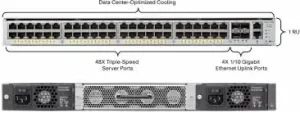
Head-to-Head: 4948E vs. 4948E-F Key Differences
| Feature | Catalyst 4948E | Catalyst 4948E-F |
|---|---|---|
| Uplink Ports | 4x 1G SFP | 4x 10G SFP+ |
| Total Throughput | 104 Gbps | 136 Gbps |
| Buffer Memory | 12 MB | 24 MB |
| Power Consumption | 120W (idle) / 240W (max) | 130W (idle) / 260W (max) |
| Use Case | Legacy aggregation | High-performance access |
The 4948E-F’s doubled buffer and 10G uplinks make it ideal for traffic-intensive roles, while the 4948E suits budget-conscious, low-complexity deployments.
Performance in Action: Real-World Scenarios
1. Data Center Server Farm Aggregation
- Challenge: A cloud provider needed to connect 500+ 1G servers to a 10G core.
- Solution: Deployed 4948E-F switches with 10G uplinks to Nexus 9500 cores.
- Result: Reduced oversubscription from 4:1 to 1.2:1, eliminating VM migration bottlenecks.
2. Enterprise Campus Core
- Challenge: A university’s 1G VoIP and surveillance network required non-blocking throughput.
- Solution: 4948E switches with 4x 1G fiber uplinks to Catalyst 6500-E cores.
- Result: Achieved 99.999% uptime for 10,000+ endpoints over 5 years.
3. Industrial IoT Backbone
- Challenge: A factory’s legacy PLCs and sensors relied on 1G copper with PoE.
- Solution: 4948E-F switches delivered 10G uplinks to a Cisco DNA Center-managed core.
- Result: Enabled real-time analytics without replacing existing field devices.
Strengths and Limitations in Modern Networks
Why the 4948E Series Still Shines
- Cost per Port: 200/port for Catalyst 9300 with similar 1G density.
- Proven Reliability: MTBF of 200,000+ hours, backed by Cisco’s lifetime warranty.
- Ease of Integration: Seamless compatibility with legacy Cisco IOS features like NetFlow and EIGRP.
Where They Fall Short
- No Multigig Support: Can’t negotiate 2.5G/5G speeds for Wi-Fi 6/6E APs.
- Limited Programmability: No support for Cisco DNA Center or SD-Access.
- EoL Considerations: Entered Cisco’s End-of-Sale in 2018; limited software updates.
Competitive Alternatives
| Switch Model | Catalyst 4948E-F | Catalyst 9300 | Aruba 2930F |
|---|---|---|---|
| Port Speed | 1G + 10G uplinks | 1G/2.5G/5G/10G multigig | 1G + 10G uplinks |
| Management | Cisco CLI/IOS | Cisco DNA Center | Aruba Central |
| PoE Budget | None | 740W (PoE+) | 740W (PoE+) |
| Price (New) | Discontinued (~$5k used) | $15k | $8k |
For enterprises prioritizing future-proofing, the Catalyst 9300’s multigig and SD-Access justify its premium. However, the 4948E-F remains a cost-effective workhorse for static, high-density 1G environments.
Strategic Deployment Recommendations
- Legacy Modernization: Pair 4948E-F switches with 10G/25G cores to extend the life of 1G server farms.
- Edge-of-Network Aggregation: Use 4948E switches for IoT/OT convergence in industrial settings.
- Budget Constraints: Source refurbished units for non-critical roles (e.g., print server networks).






Leave a comment