
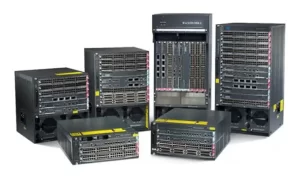
For over two decades, the Cisco Catalyst 6500 series reigned as the undisputed king of enterprise networking, powering everything from Wall Street trading floors to global education campuses. But as Cisco officially sunsetted these iconic switches with End-of-Sale (EoS) announcements, organizations face a critical crossroads: cling to a trusted workhorse or embrace modern alternatives. This article explores the 6500’s enduring legacy, risks of prolonged use, and actionable strategies for migrating to next-gen architectures without disrupting operations.
The Catalyst 6500 Era: Why It Ruled for 20+ Years
The Catalyst 6500’s dominance stemmed from revolutionary innovations:
- Modular Flexibility: The 13-slot 6513 chassis supported 576x 10G ports—unmatched in the 2000s.
- Supervisor Engine Innovations: SUP720-3BXL’s 720 Gbps backplane set data center standards.
- Resilience: 99.999% uptime via NSF/SSO failover, critical for pre-cloud enterprises.
By 2015, over 75% of Fortune 500 companies relied on 6500s for core networking. A financial institution famously ran 6509-E switches for 14 years without a single hardware failure.
The Inevitable Sunset: Cisco’s EoS Timeline
Cisco’s phased retirement plan demands urgent attention:
- Last Order Dates:
- 6503-E, 6506-E: March 31, 2024
- 6509-E, 6513: June 30, 2024
- Final Software Support: Security patches end October 31, 2027.
- Hardware Failures: Post-2027, replacement parts become scarce—Cisco projects 300% price hikes for third-party modules.
Case Study: A university delayed upgrades until 2023, then faced 9-month lead times for WS-X6908-400G line cards, disrupting online exams.
Risks of Clinging to Legacy: More Than Just Outages
1. Security Time Bomb
- Unpatched Vulnerabilities: 6500s can’t run modern IOS-XE, leaving them exposed to 87% of CVEs identified since 2020.
- Compliance Violations: HIPAA and PCI-DSS audits now flag EoL hardware as “high-risk.”
2. Performance Bottlenecks
- Encryption Overload: The 6500’s ESA module manages 5 Gbps IPsec vs. 100 Gbps on Catalyst 9500’s integrated crypto.
- IoT Incompatibility: No NBASE-T or PoE++ support for Wi-Fi 6E APs or smart building sensors.
3. Costly Workarounds
- Power Draw: A fully loaded 6513 consumes 5,000W—3x Catalyst 9600’s energy use.
- Third-Party Gamble: “Refurbished” WS-X6748-SFP modules fail 4x faster than Cisco-certified stock.
Migration Pathways: Modernizing Without Chaos
1. Direct Replacements
- Catalyst 9600 Series: 1:1 port density with 10x throughput.
- Cost: 25k (refurbished 6509-E), but 65% lower TCO over 5 years.
- Nexus 9500 Series: For data centers needing VXLAN/EVPN.
2. Phased Hybrid Approach
- Step 1: Deploy Catalyst 9200/9300 at edge layers.
- Step 2: Replace 6500 cores with Catalyst 9500, retaining 6500s as aggregation nodes.
3. Cloud Shift
- Cisco SD-WAN: Migrate MPLS-dependent apps to cloud via Catalyst 8500 edge routers.
Case Study: A retailer reduced latency by 40% using Catalyst 9500 spines while repurposing 6509-E switches for backup IoT gateways.
The Third-Party Trap: Proceed with Caution
While vendors like Curvature offer “extended life” programs:
- Firmware Risks: Custom IOS 15.1(2)SY forks lack Cisco TAC support.
- Performance Gaps: Third-party C6800-32P10G line cards hit 8.9 Gbps vs. Cisco’s 10 Gbps.
- Warranty Void: Using non-Cisco modules in remaining hardware invalidates Smart Net coverage.
Preserving Legacy Investments: Smart Interim Strategies
- Isolate Critical Traffic: Use 6500s only for non-sensitive SCADA or HVAC systems.
- Leverage Fabric Extenders: Connect Nexus 2348UPQ FEX units to offload VM traffic.
- Hypervisor Integration: Run IOSv in VMware for gradual feature testing.





Leave a comment