

EXECUTIVE SUMMARY
This document provides a comprehensive technical overview and comparative analysis of Direct Attach Copper Cables (DAC) and Active Optical Cables (AOC) for high-speed data center interconnects. As data rates escalate from 25G to 400G and beyond, the selection of an appropriate physical layer interconnect solution has become critical for optimizing network performance, power efficiency, and total cost of ownership (TCO). This whitepaper delineates the architectural distinctions, operational parameters, and application-specific advantages of DAC and AOC technologies, delivering authoritative guidance for infrastructure architects and procurement specialists.

ARCHITECTURE AND CHASSIS DESIGN
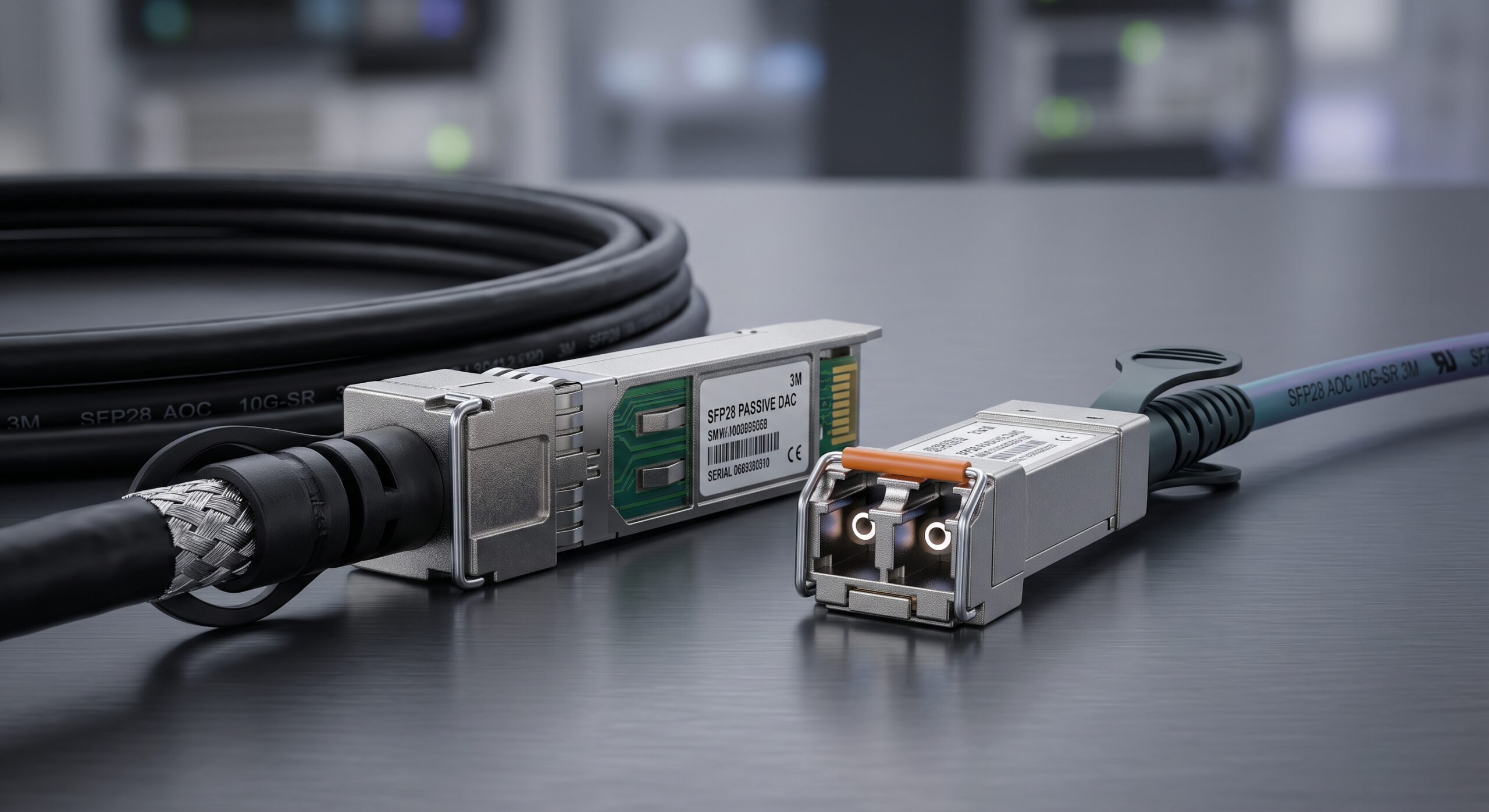
Direct Attach Cable (DAC) architecture utilizes twinaxial copper cabling with factory-terminated SFP, QSFP, or OSFP form-factor transceivers permanently bonded to the cable ends. The passive DAC variant relies solely on copper conductors for signal transmission without active electronic components in the signal path, offering a lossless, low-latency physical connection up to 5 meters at 100G speeds. Active DAC incorporates integrated retimers and equalization circuitry within the connector housings, extending reach to 7-10 meters while maintaining signal integrity. The connector housing integrates a small printed circuit board (PCB) with a passive equalizer or active retimer IC, which compensates for intersymbol interference (ISI) and deterministic jitter induced by the copper medium.
Active Optical Cable (AOC) architecture, conversely, employs optical fiber as the transmission medium, with integrated electro-optical transceivers embedded in each connector housing. Each AOC assembly comprises a transmit optical subassembly (TOSA) containing a Vertical-Cavity Surface-Emitting Laser (VCSEL) operating at 850nm or 1310nm wavelengths, a receive optical subassembly (ROSA) incorporating a PIN photodiode or avalanche photodiode (APD), and a controller IC managing laser biasing, temperature compensation, and digital diagnostic monitoring (DDM) functions. The optical engine converts electrical signals to modulated light, propagates through multi-mode or single-mode fiber, and reconverts to electrical signals at the far end. This active conversion provides inherent galvanic isolation and immunity to electromagnetic interference (EMI), enabling cable runs from 15 meters up to 100 meters for multi-mode fiber (MMF) and beyond 1 kilometer for single-mode fiber (SMF) variants.
HARDWARE FEATURES
DAC hardware implementations prioritize passive simplicity, featuring bare copper conductors with foil shielding and braided outer jackets to mitigate crosstalk and external EMI. Key design attributes include low insertion loss (≤ 0.5 dB per connector pair), minimal return loss (≥ 10 dB), and differential impedance of 100 ± 5 ohms for high-speed differential signaling. Active DAC variants integrate Clock and Data Recovery (CDR) circuits that re-time incoming signals, effectively resetting the timing budget and allowing longer channel lengths within the defined electrical specifications per IEEE 802.3 and SFF-8431/SFF-8636 standards.
AOC hardware integrates advanced optoelectronic components: high-speed VCSEL diodes with rise/fall times under 35 picoseconds, quad-channel parallel optical engines for 400G SR8 and DR4 applications, and sophisticated digital signal processors (DSP) for pulse amplitude modulation (PAM4) encoding and decoding. The cable construction employs tight-buffered or loose-tube optical fibers with aramid yarn strength members and LSZH (Low Smoke Zero Halogen) or OFNR (Optical Fiber Nonconductive Riser) jackets, ensuring mechanical robustness and fire safety compliance. Built-in EEPROM memory stores unique vendor identifiers, serial numbers, and calibrated operational parameters including laser bias current, temperature, supply voltage, and received optical power (Rx Power).
COMPLIANCE AND STANDARDS
Both DAC and AOC products listed herein conform to rigorous international standards: IEEE 802.3cd (25G/50G Ethernet), IEEE 802.3bs (200G/400G Ethernet), SFF-8679 (QSFP+), SFF-8665 (QSFP28), SFF-8024 (Management Interface), and SFF-8636 (Digital Diagnostic Monitoring). Environmental compliance is governed by RoHS (2011/65/EU) and REACH (EC 1907/2006) directives. Safety certifications include UL 60950-1, IEC 60825-1 (Class 1 Laser Safety), and FDA 21 CFR 1040.10 for laser products. The products also support MSA (Multi-Source Agreement) mechanical specifications for interoperability across diverse vendor equipment, including Cisco, Juniper, Arista, and Huawei switching platforms.
TECHNICAL SPECIFICATIONS
Table 1 provides a parametric comparison matrix encapsulating the critical operational metrics for DAC and AOC variants across multiple data rates and reach categories. The tabulated values reflect worst-case performance boundaries guaranteed across a temperature range of 0°C to 70°C and relative humidity up to 85% non-condensing. Cable insertion loss, power dissipation, and bit error rate (BER) are fundamental discriminators, with DAC exhibiting superior power efficiency in sub-5m links while AOC demonstrates clear advantage for medium-to-long reach inter-rack and inter-row deployments.
| Parameter | Passive DAC | Active DAC | AOC (MMF) | AOC (SMF) |
|---|---|---|---|---|
| Maximum Reach (25G) | 5 meters | 10 meters | 70 meters | 300 meters |
| Maximum Reach (100G) | 3 meters | 7 meters | 50 meters | 200 meters |
| Maximum Reach (400G) | 2.5 meters | 5 meters | 30 meters | 150 meters |
| Power Consumption (Per End) | 0 W | ≤ 0.15 W | ≤ 0.35 W | ≤ 0.50 W |
| Insertion Loss (Max) | 0.5 dB | 0.5 dB | 1.5 dB | 2.0 dB |
| BER (Worst Case) | 1E-15 | 1E-15 | 1E-15 | 1E-15 |
| Latency (End-to-End) | ||||
| Bend Radius (Min) | 30 mm | 25 mm | 10 mm | 10 mm |
| Cable Diameter (Typical) | 6.5 mm | 6.5 mm | 3.0 mm | 2.0 mm |
| Connector Types Supported | SFP+, QSFP+ | SFP28, QSFP28 | QSFP28, OSFP | QSFP-DD, OSFP |
| Operating Temperature Range | 0°C to 70°C | 0°C to 70°C | -10°C to 75°C | -10°C to 75°C |
| EMI Immunity | Moderate | Moderate | Excellent | Excellent |
ORDERING OPTIONS AND SKU GUIDE
Our comprehensive portfolio includes passive DAC cables ranging from 0.5 meters to 5 meters in 0.5m increments for 10G, 25G, 40G, 100G, and 400G Ethernet, in both SFP+ to SFP+, QSFP+ to QSFP+, and breakout configurations (e.g., QSFP+ to 4x SFP+). Active DAC options extend reach up to 7 meters or 10 meters depending on data rate. AOC products are available in lengths from 1 meter to 100 meters for MMF variants and up to 300 meters for SMF variants, supporting all major connector types including SFP28, QSFP28, and OSFP. Custom lengths are available upon request, subject to minimum order quantities and lead-time constraints. All units are factory tested for full bit error rate compliance, interoperability, and digital diagnostics calibration.
DEPLOYMENT RECOMMENDATIONS AND ARCHITECTURAL GUIDANCE
For top-of-rack (ToR) switching within the same cabinet or adjacent cabinets, passive DAC provides the most cost-effective and power-efficient solution, consuming zero active power and introducing sub-nanosecond latency. For middle-of-row (MoR) and end-of-row (EoR) deployments where cable distances exceed 5 meters, AOC becomes imperative to maintain signal integrity and achieve reliable link performance, particularly for PAM4 modulation schemes. In high-density spine-leaf architectures, AOC offers significant cable management advantages through reduced bend radius requirements (≤ 10mm) and lighter weight (approximately 50% less than equivalent copper assemblies). For hyperscale data center operators, the deployment of optical interconnects yields lower power per bit (as low as 0.5W per 100G link for short-reach AOC) compared to active DAC, driving better overall Power Usage Effectiveness (PUE) metrics at scale.
📥 Download Technical Specification
Click the button below to view or download the full official PDF datasheet.

Leave a comment