

EXECUTIVE SUMMARY
This document serves as the definitive technical reference for the deployment, configuration, and optimization of high-capacity Dense Wavelength Division Multiplexing (DWDM) networks leveraging next-generation optical transport platforms. As network traffic continues its exponential growth driven by 5G backhaul, hyperscale data center interconnect, and high-definition content delivery, the need for reliable, scalable, and spectrally efficient optical infrastructure has never been more critical. This guide provides systems engineers, network architects, and operational teams with a comprehensive framework for designing robust DWDM systems, from metro access networks to ultra-long-haul core backbones. We detail the architectural principles, hardware specifications, and engineering best practices that ensure maximum uptime, minimal latency, and optimal return on investment.

ARCHITECTURE & CHASSIS DESIGN
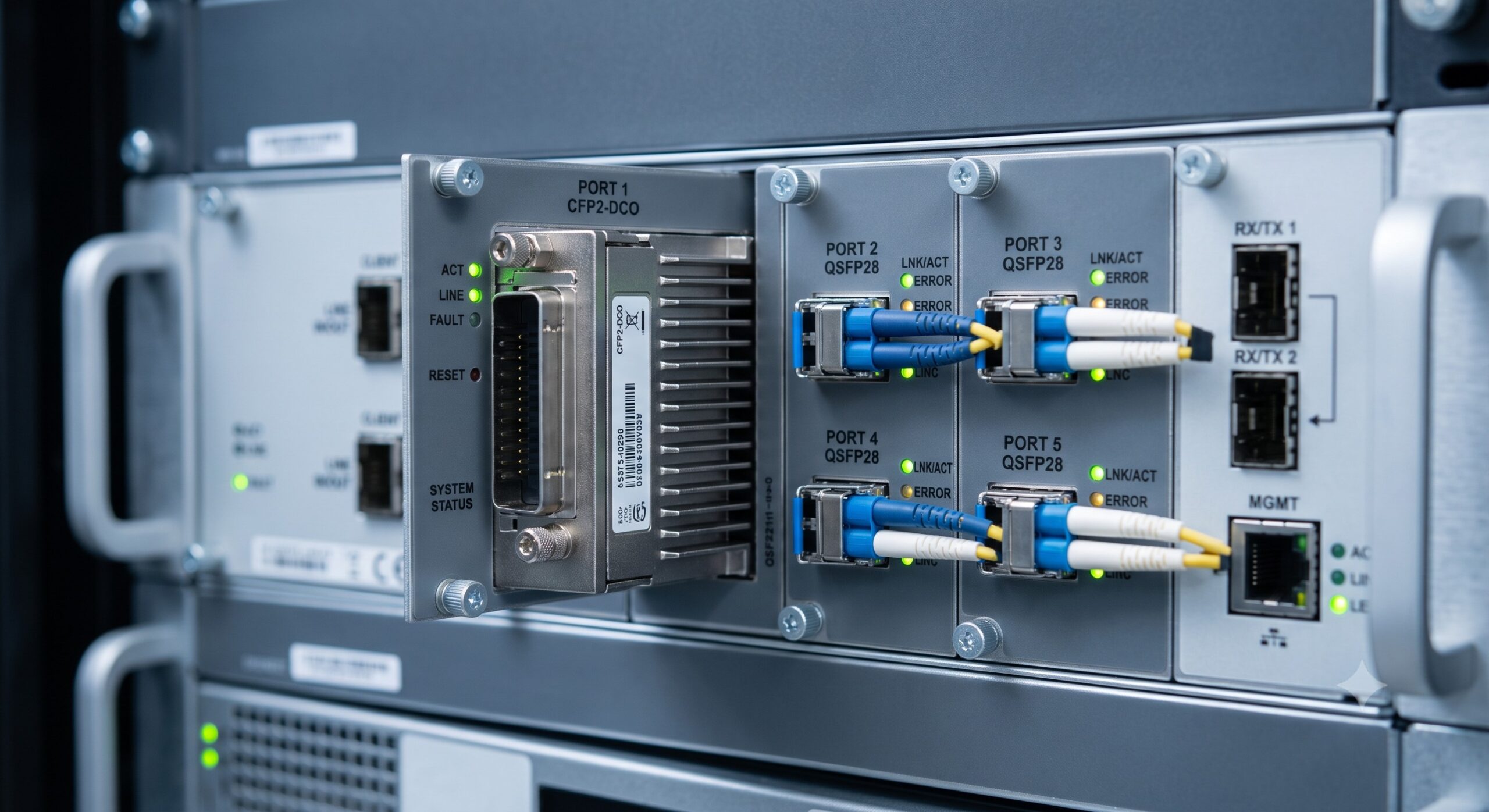
The foundation of any resilient DWDM network is a modular, carrier-grade chassis designed for high-density wavelength aggregation and optical transport. Our next-generation platform is built upon a 5-slot, 2RU modular chassis that supports a fully redundant, hot-swappable architecture. The backplane is engineered to support a non-blocking switching fabric with a total capacity of up to 1.2 Tbps, enabling the transparent multiplexing of up to 96 wavelengths on a single fiber pair using 50GHz grid spacing. The system is designed to accommodate a diverse mix of line cards, including 10G, 100G, and 400G DWDM transponders, as well as muxponder and transponder cards for service aggregation. Advanced thermal management, with front-to-back airflow and intelligent fan speed control, ensures reliable operation in temperatures ranging from -5°C to +55°C, making it suitable for both controlled data center environments and space-constrained Central Office (CO) deployments. The chassis design also incorporates comprehensive cable management features to maintain fiber bend radius compliance and simplify installation.
HARDWARE FEATURES
The platform distinguishes itself through a rich portfolio of hardware features engineered for maximum performance and operational simplicity. At the core is a dual redundant controller module that provides centralized management, alarm aggregation, and synchronization (SyncE and IEEE 1588v2 PTP). The system supports a wide variety of optical interfaces, including CFP2-DCO (Digital Coherent Optics), QSFP28, and SFP+, allowing for seamless integration with existing network equipment. The integrated optical amplifiers (EDFA) and Dispersion Compensation Units (DCU) are managed dynamically by the system’s control plane to optimize signal quality across varying span lengths. Key features include:
* Advanced Forward Error Correction (FEC) with Soft-Decision (SD-FEC) for extended reach and improved Optical Signal-to-Noise Ratio (OSNR).
* Automatic Power Adjustment and Wavelength Locking to ensure stable laser performance and channel spacing.
* Hardware-based Performance Monitoring (PM) at the optical and digital layers for proactive network maintenance.
* In-service Reconfiguration of wavelengths without impacting operational traffic.
COMPLIANCE & STANDARDS
This DWDM system is designed to meet and exceed the stringent requirements of global telecommunications standards, ensuring interoperability and future-proofness. It complies with ITU-T G.694.1 frequency grid recommendations, OIF 100G/400G DWDM implementation agreements, and IEEE 802.3 Ethernet standards. Additionally, the hardware is certified to NEBS Level 3 (Network Equipment-Building System) for environmental and safety compliance, and carries CE and FCC Class A certifications. The platform adheres to security frameworks including NIST 800-53 and FIPS 140-2 for cryptographic modules, ensuring that it is suitable for deployment in critical national infrastructure and government networks.
TECHNICAL SPECIFICATIONS
| Parameter | Specification |
|---|---|
| Form Factor | 2RU Modular Chassis (5 Slots) |
| Switching Capacity | 1.2 Tbps (Non-Blocking) |
| Max Wavelength Capacity | Up to 96 Channels (50GHz Grid) |
| Transponder Support | 10G, 100G, 400G (CFP2-DCO, QSFP28, SFP+) |
| Power Supply | 1+1 Redundant AC/DC (-48V) |
| Typical Power Consumption | 350W (Fully Loaded) |
| Operating Temperature | -5°C to +55°C |
| Cooling | Front-to-Back Airflow, Hot-Swappable Fans |
| Management Interfaces | RJ45 10/100/1000 Ethernet, RS-232 Console |
| Compliance | ITU-T G.694.1, OIF 400ZR, NEBS Level 3 |
ORDERING OPTIONS
The platform offers a highly flexible ordering structure to accommodate diverse network requirements. The base unit includes the 5-slot chassis, redundant power supplies (DC or AC options), and a standard cooling unit. A variety of controller and interface modules are available as separate line items, allowing customers to tailor the system to their specific capacity and reach needs. Software licensing is provided on a per-wavelength basis, with premium tiers for advanced features such as 400G support, enhanced encryption, and network management integration. Global spare parts kits, including optical modules and power supplies, are available to support standard RMA (Return Merchandise Authorization) procedures and ensure minimal downtime. For specific configurations, we recommend consulting the detailed ordering guide or contacting our sales support for assistance in creating a bespoke Bill of Materials (BoM).
📥 Download Technical Specification
Click the button below to view or download the full official PDF datasheet.

Leave a comment