
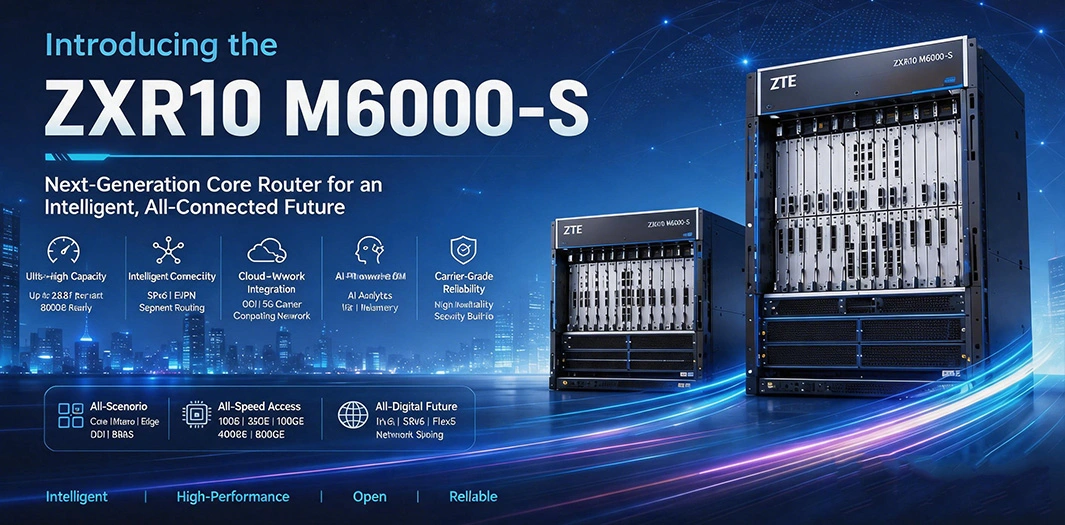
Product Positioning
ZXR10 M6000-S series routers are ZTE’s large-capacity and high-performance full-service routers. Focusing on the network requirements of 5G, big video, VR/AR, intelligent IoT and cloud computing , which can meet different network scenarios such as IP backbone network, MAN and data center interconnection. M6000-S series routers are the best choice for operators and enterprise customers to build ultra-broadband, intelligent and open networks in the 5G era. ZXR10 M6000-S series routers include M6000-3S, M6000-3S Plus, M6000-4SE, M6000-5S, M6000-8S, M6000-8S Plus, M6000-8SE, M6000-16SE and M6000-18S.
Competitive Analysis
This section is what gives the article a more professional and high-end feel.
The comparison can be made against the following mainstream carrier-grade routing platforms:
| Vendor | Product |
|---|---|
| Huawei | NetEngine 8000 |
| Cisco | NCS 5500/5700 |
| Juniper Networks | PTX |
| Nokia | 7750 SR |
| ZTE | Huawei | Typical Positioning |
|---|---|---|
| ZTE ZXR10 M6000-S | Huawei NetEngine 8000 | Next-generation core/backbone/IP transport platform |
| M6000-18S / 16SE | NE9000 | National backbone and provincial core network |
| M6000-8S / 8SE | NE8000 M Series | Metro core and IDC DCI |
| M6000-5S / 3S | Later-generation NE5000E models | Aggregation layer and edge PE |
| M6000-2S | Compact NE8000 F/M platforms | Edge access and distributed aggregation |
O&M and Automation Comparison
| Capability | M6000-S | NE8000 |
|---|---|---|
| Telemetry | Supported | Strong advantage |
| SDN Control | ZENIC ONE | iMaster NCE |
| Automated Deployment | Supported | More mature |
| Intelligent Optimization | AI-based analytics | iFIT |
| Fault Localization | Sub-second level | Sub-second level |
Huawei has a more mature ecosystem in terms of:
- Network automation
- SLA visualization
- Intelligent operations and maintenance (O&M)
While ZTE’s key advantages are mainly in:
- Domestic/localized deployment capability
- Cost efficiency
- 800GE evolution readiness
- Computing power network (AI + cloud-network convergence)
Conclusion
It can be simply understood as follows:
| Comparison Dimension | Stronger Vendor |
|---|---|
| Global market influence | Huawei NE8000 |
| Automation ecosystem | Huawei NE8000 |
| SRv6 maturity | Huawei NE8000 |
| Cost-effectiveness | ZTE M6000-S |
| Domestic substitution capability | ZTE M6000-S |
| 800GE evolution readiness | ZTE M6000-S |
| China carrier adaptability | Both are strong |
If you have any questions, please feel free to contact: sales@telecomate.com.

Leave a comment