

EXECUTIVE SUMMARY
The Liquid Cooling CDU Plate Heat Exchanger is a critical thermal management component engineered for direct-to-chip and high-density data center cooling architectures. As rack power densities escalate beyond 100 kW, the plate heat exchanger within the Coolant Distribution Unit (CDU) serves as the definitive interface between the facility water system and the technology cooling loop, determining overall system efficiency, approach temperature performance, and operational reliability. This document provides a comprehensive technical overview of the heat transfer characteristics, mechanical specifications, and performance envelope of OEM-grade brazed plate heat exchangers (BPHE) purpose-built for CDU integration. The design achieves a baseline overall heat transfer coefficient exceeding 3000 W/(m²·K) under nominal conditions, with a close approach temperature of ≤3°C, enabling precise secondary loop temperature control essential for processor and accelerator thermal stability .

ARCHITECTURE & THERMAL DESIGN
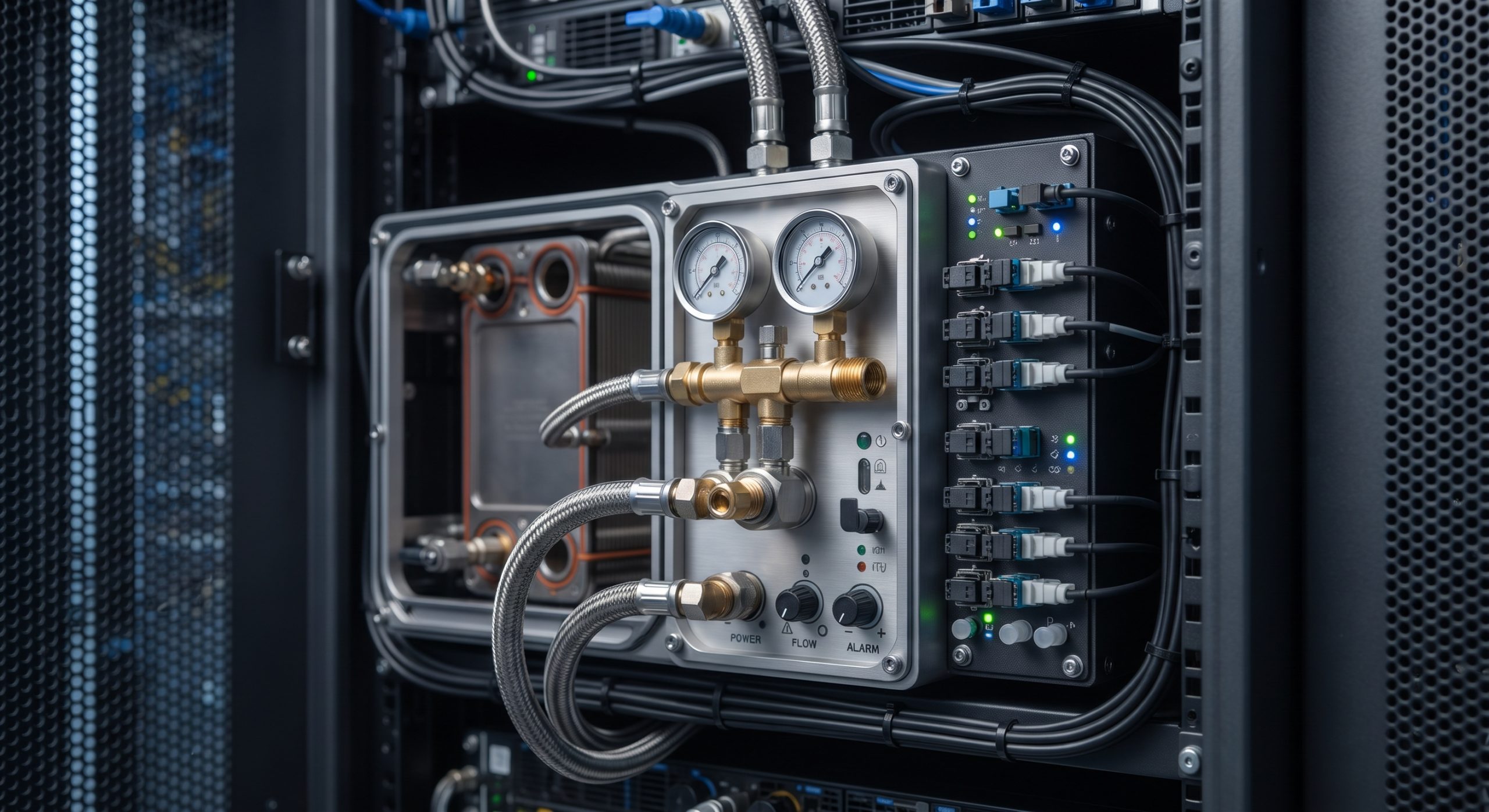
The CDU plate heat exchanger is constructed as a compact, high-efficiency brazed unit featuring a stack of corrugated stainless steel plates (AISI 316L) with copper or nickel-based brazing filler. The chevron plate pattern induces turbulent flow at low Reynolds numbers, maximizing convective heat transfer while maintaining pressure drop within the hydraulic budget of the CDU primary and secondary loops. The separation of the facility-side circuit (primary) and the IT equipment-side circuit (secondary) ensures that low-pressure, clean coolant is delivered to cold plates while isolating the sensitive technology loop from facility water contaminants and pressure fluctuations . The unit is integrated with a 50-micron filtration system upstream of the secondary inlet to protect microchannel cold plates from particulate fouling, a design imperative reinforced by CDU cleanliness standards specifying ISO 4406 cleanliness levels of 18/16/13 or better .
HARDWARE FEATURES
The heat exchanger assembly incorporates a sanitary flange and clamp connection design for tool-free installation and black-box swap capability, minimizing mean time to repair in mission-critical environments . The plate pack is compressed within a frame that accommodates thermal expansion without compromising gasket integrity under cyclic load conditions. For brazed variants, the absence of gaskets eliminates elastomer degradation risks, while detachable plate designs offer serviceability for inspection and cleaning in facilities with less stringent fluid quality management. The unit is rated for a design pressure range of 1.6 MPa to 3.0 MPa on the primary side, consistent with CDU-specific pressure vessel requirements that exceed general HVAC standards due to proximity to high-value IT loads . Fatigue endurance is validated to 10⁵ pressure cycles at 1.1× design pressure, simulating variable-flow operational regimes over the equipment lifecycle .
COMPLIANCE & STANDARDS
This heat exchanger platform is engineered to satisfy the emerging technical requirements for CDU plate heat exchangers in data center liquid cooling systems. Relevant standards include PED 97/23/EC for pressure equipment, with brazed units conforming to burst pressure criteria of no less than five times the design pressure . Cleanliness compliance follows rinse-test verification with particulate limits aligned to ISO 4406:2021, preventing manufacturing residue from migrating into the secondary loop. Leak integrity is confirmed via helium mass spectrometry, with leak rates held to thresholds compatible with dielectric coolant retention and facility water isolation. The design supports operational temperature ranges from −20°C to 200°C for brazed configurations, accommodating both chilled water and warm-water cooling regimes increasingly favored for heat reuse applications .
TECHNICAL SPECIFICATIONS
The following table summarizes the key performance and mechanical parameters of the CDU plate heat exchanger under nominal design conditions (primary inlet 40°C, secondary inlet 25°C, 5°C approach per CDU standard工况) . Actual performance may vary with flow rate, fluid properties, and fouling state; selection software should be consulted for project-specific operating points.
| Parameter | Specification |
|---|---|
| Heat Exchanger Type | Brazed Plate Heat Exchanger (BPHE) / Detachable Plate Heat Exchanger (PHE) |
| Plate Material | AISI 316L Stainless Steel, 0.4–0.5 mm thickness |
| Brazing Material | Copper (Cu) or Nickel (Ni) based filler |
| Design Pressure (Primary) | 1.6 MPa to 3.0 MPa |
| Design Pressure (Secondary) | 1.6 MPa to 3.0 MPa |
| Design Temperature Range | −20°C to +200°C (Brazed); −20°C to +140°C (Detachable with EPDM) |
| Overall Heat Transfer Coefficient (Nominal) | ≥ 3000 W/(m²·K) |
| Approach Temperature (Nominal) | ≤ 3°C |
| Pressure Drop (Primary, Rated Flow) | ≤ 100 kPa |
| Pressure Drop (Secondary, Rated Flow) | ≤ 80 kPa |
| Fouling Factor Allowance (Water-based) | ≤ 0.0002 m²·K/W after 500 h continuous operation |
| Fouling Factor Allowance (Glycol-based) | ≤ 0.0003 m²·K/W after 500 h continuous operation |
| Burst Pressure | ≥ 5 × Design Pressure |
| Fatigue Life | 10⁵ cycles at 1.1 × Design Pressure |
| Connection Type | Sanitary flange / clamp or welded flange |
| Connection Size Range | DN50 to DN100 |
| Filtration Requirement (Secondary Loop) | 50 μm absolute |
| Cleanliness Standard | ISO 4406:2021, 18/16/13 or better |
ORDERING OPTIONS
Two primary configurations are available to suit different maintenance philosophies and fluid compatibility requirements. The Brazed Plate Heat Exchanger (BPHE) variant offers a sealed, gasket-free construction with copper or nickel brazing, ideal for closed-loop systems where fluid quality is rigorously managed. The Detachable Plate Heat Exchanger (PHE) variant provides mechanical disassembly for plate inspection and cleaning, recommended for installations where facility water quality may vary or where periodic internal inspection is mandated by site procedures . Both variants are available with connection sizes from DN50 to DN100, with material certificates to EN 10204 3.1 upon request. Consult the factory for glycol-compatible gasket selection and pressure rating verification for specific project conditions.
📥 Download Technical Specification
Click the button below to view or download the full official PDF datasheet.

Leave a comment