
Introduction: The Strategic TCO Decision in Fiber Access Networks
In the competitive landscape of telecom infrastructure, the choice between Fiber-to-the-Building (FTTB) and Fiber-to-the-Home (FTTH) is more than a technical specification—it is a strategic financial decision impacting long-term profitability and network competitiveness. While FTTH is universally acclaimed as the end-state architecture for broadband access, a myopic focus on peak performance obscures the nuanced Total Cost of Ownership (TCO) calculus that network architects and CTOs must navigate. This analysis dissects the CapEx, OpEx, and performance vectors of FTTB and FTTH, providing a data-driven framework for maximizing Network ROI amidst the global fiber rollout.
CapEx Analysis: Initial Investment and Infrastructure Trade-offs
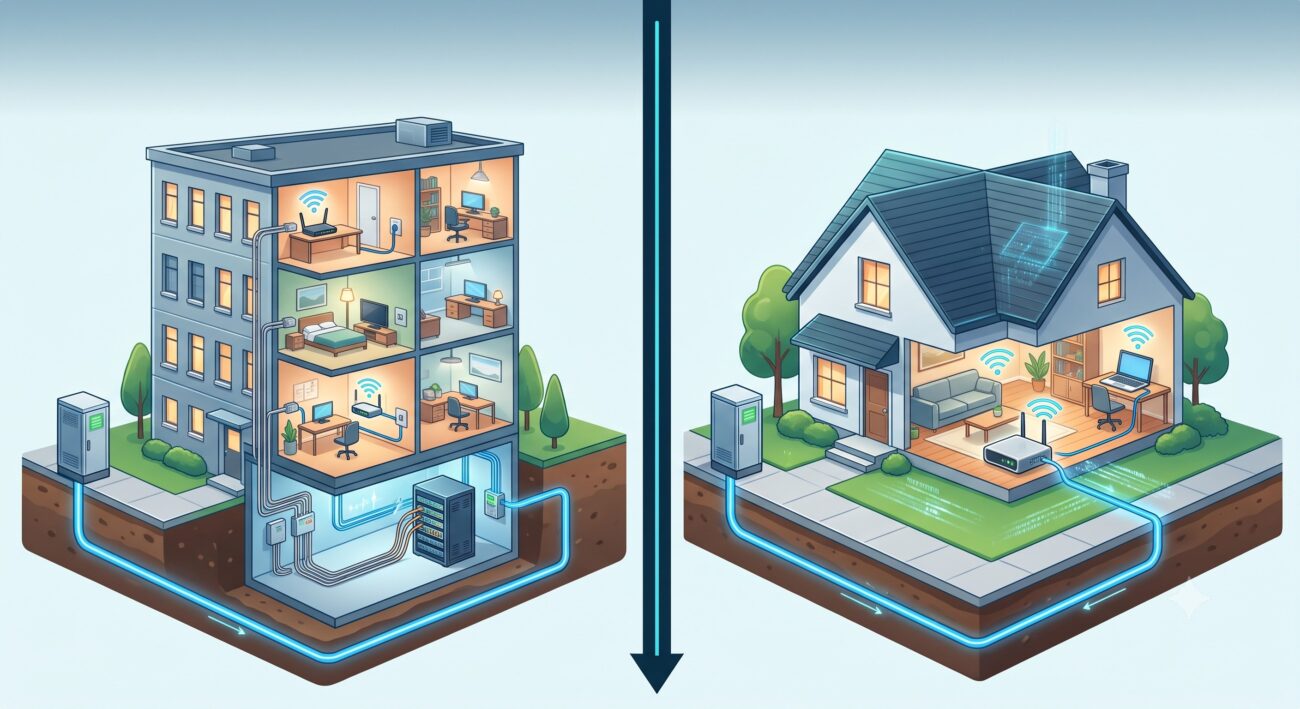
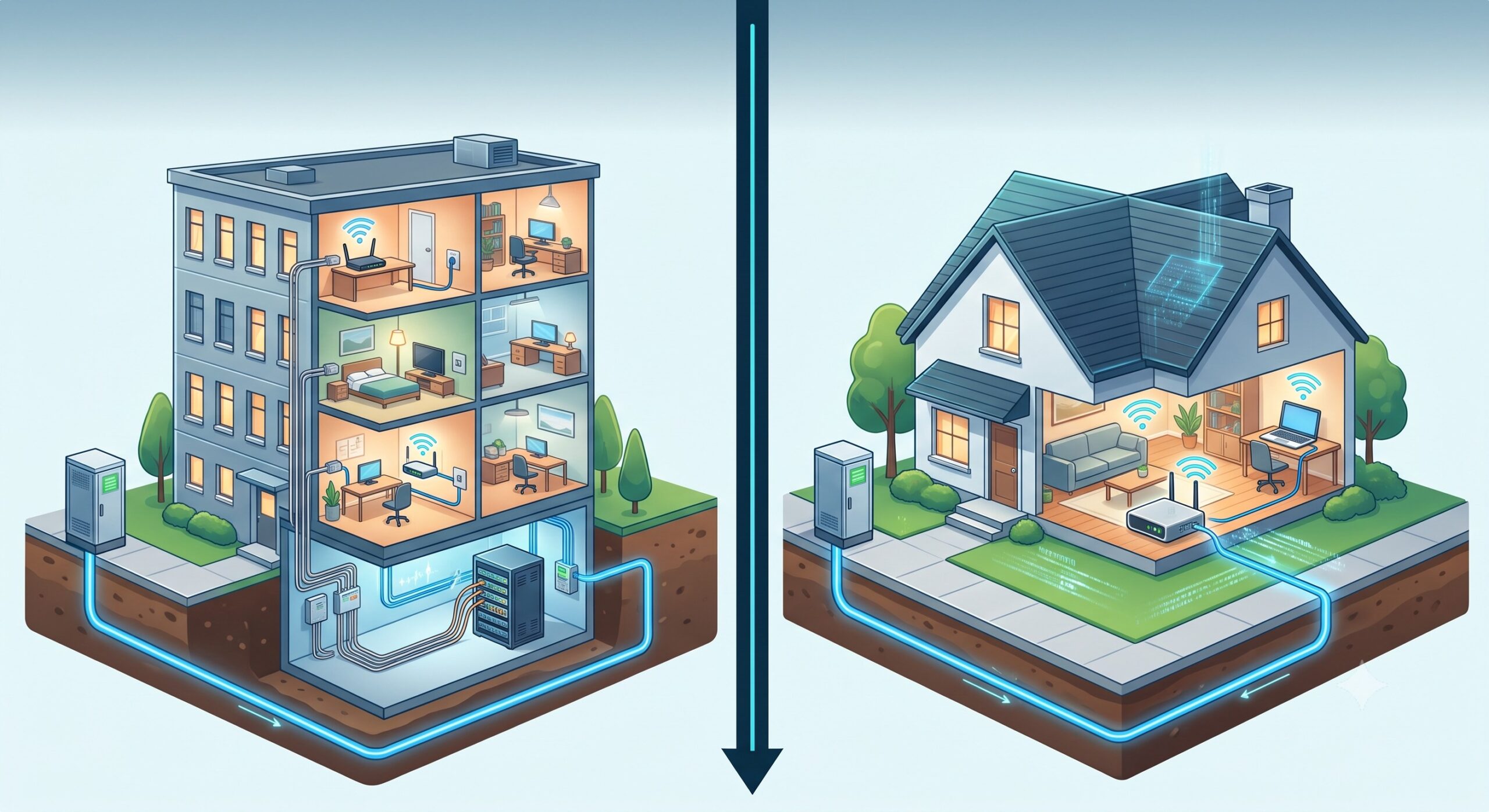
The initial capital expenditure is the most tangible differentiator. FTTH demands significant upfront investment due to the need to deploy optical fiber directly to each individual residential unit (Home) or business premises, requiring extensive civil works, in-home installations, and the deployment of Optical Network Terminals (ONTs) or SFU/HGU devices for every subscriber. This has historically placed FTTH at a cost disadvantage, with average user costs estimated between $3,000 to $5,000 in early deployments, though this gap has narrowed significantly .
Conversely, FTTB offers a compelling CapEx advantage. By terminating the fiber at a central distribution point within a multi-dwelling unit (MDU) or office building—typically a basement or telecommunications room—it allows operators to leverage existing in-building copper infrastructure (e.g., Ethernet, coaxial cable) for the final connection. This approach minimizes costly in-home fiber installations and permits the sharing of a single Optical Network Unit (ONU) among 8 to 32 users, dramatically reducing the cost per user .
OpEx Drivers: Power, Maintenance, and Network Reliability
While FTTB wins on initial build cost, its operational expenditure profile presents significant long-term liabilities. The ONU at the building requires a dedicated, continuous power supply, often necessitating permits, backup batteries, and incurring ongoing electricity costs. This active outdoor equipment increases the network’s Mean Time Between Failures (MTBF) risk and demands regular maintenance and security measures, as the equipment must be housed in waterproof, vandal-resistant cabinets .
In contrast, FTTH’s architecture is predominantly passive from the OLT to the subscriber’s home. The absence of active, powered electronics in the field (ODN) dramatically reduces network complexity, enhances reliability, and slashes maintenance OpEx. Furthermore, the energy efficiency per user for Passive Optical Network (PON)-based FTTH is significantly superior; at comparable data rates, its power consumption and resulting carbon footprint are an order of magnitude lower than VDSL-based FTTB solutions .
Performance and Revenue Generation: The Bandwidth Gap
The TCO equation must also account for the revenue-generating potential of the network, which is intrinsically tied to performance. FTTH delivers a true end-to-end fiber connection, offering symmetric, ultra-low-latency connectivity with bandwidth capabilities of 1 Gbps to 10+ Gbps . This architecture is future-proof and capable of supporting high-value applications like multi-gigabit enterprise services, cloud computing, and 8K video, providing a clear path to monetize premium service tiers.
FTTB, while delivering speeds significantly higher than legacy copper-only networks, faces a bottleneck: the final copper segment. This last-mile copper restricts maximum throughput to 1 Gbps to 2.5 Gbps in shared environments, introducing potential latency and reliability issues . While sufficient for current SOHO and residential needs, this performance ceiling may limit future upselling opportunities and could make the network obsolete as bandwidth demands scale, potentially requiring premature, costly upgrades or a complete overhaul to FTTH .
| Feature | FTTB (Fiber to the Building) | FTTH (Fiber to the Home) |
|---|---|---|
| Fiber Endpoint | Building basement or telecom room | Inside individual home or premises |
| Last-Mile Medium | Copper (Ethernet, Coax, VDSL) | Fiber Optic (End-to-End) |
| Typical User Bandwidth | 1 Gbps to 2.5 Gbps (Shared) | 1 Gbps to 10+ Gbps (Dedicated) |
| Network Architecture | Point-to-Multipoint (Active ONU at building) | Point-to-Multipoint (Passive ODN, active ONT at home) |
| Power Requirements | Requires local power at ONU (Building) | Powered at subscriber premises |
| Reliability (MTBF) | Lower due to active outdoor components | Higher due to passive outdoor infrastructure |
| Deployment Cost (CapEx) | Medium (Leverages existing copper) | High (Requires new fiber to each unit) |
| Operational Cost (OpEx) | Higher (Power, maintenance, backup power) | Lower (Negligible field maintenance) |
| Upgrade Path | Limited by copper; requires 10G-EPON upgrades or full overhaul | Wavelength upgrades (e.g., 10G-PON, 25G-PON) possible |
Migration and Upgrade Scenarios: Protecting Your Investment
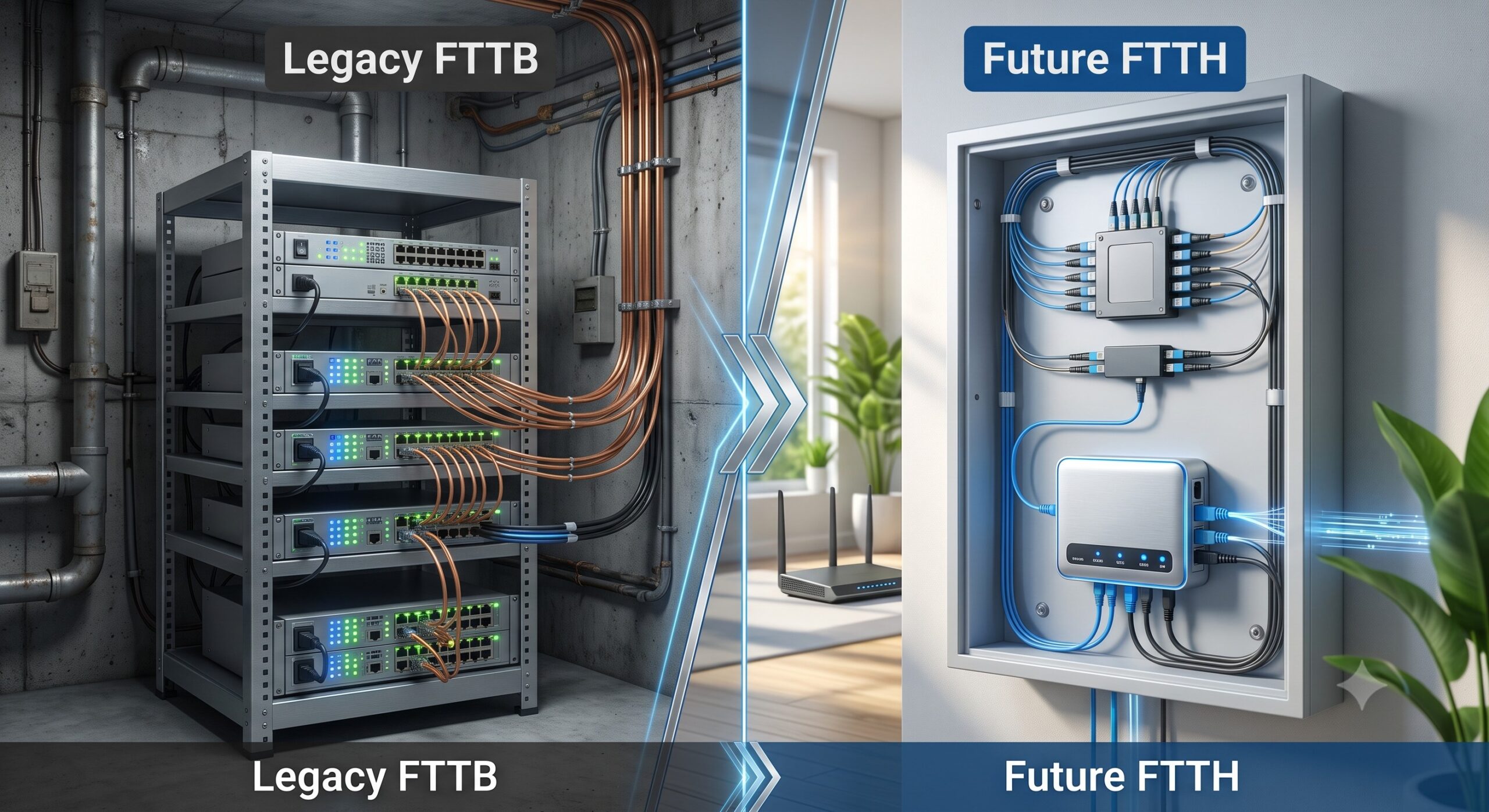
A critical TCO consideration is the network’s evolutionary path. A rigid FTTH deployment locks in high costs but ensures a future-proof, low-maintenance asset. However, for networks initially built on FTTB, the upgrade dilemma is critical. A full-scale conversion to FTTH is often prohibitively expensive and operationally destructive, requiring the replacement of in-building copper with fiber, decommissioning existing ONU equipment, and re-cabling individual units .
A more viable and economically sound strategy for incumbent FTTB networks is a technology upgrade, such as migrating from EPON to 10G-EPON. This approach maintains the existing optical and copper topology, replacing only the OLT and ONU line cards to increase core network bandwidth by 10 times without altering the last-mile infrastructure . This strategy maximizes the ROI on existing FTTB assets while buying time for a future FTTH migration when the unit economics are more favorable.
Conclusion: Strategic Alignment for Optimized ROI
There is no one-size-fits-all answer to the FTTB vs. FTTH debate. The optimal choice hinges on a holistic TCO analysis aligned with business strategy, subscriber demographics, and competitive dynamics.
- Choose FTTH for Greenfield & Premium Markets: For new developments, high-end residential, and enterprise-heavy areas, the superior performance, minimal OpEx, and future-proofing justify the higher CapEx, promising long-term ROI through premium service offerings and operational efficiency.
- Choose FTTB for Brownfield & Cost-Sensitive Dense Urban Areas: As a pragmatic, high-reach solution for dense urban environments, FTTB offers a rapid, cost-effective method to deliver fiber-grade speeds by reusing existing copper. Its lower barrier to entry makes it ideal for initial market penetration, with the understanding that a clear upgrade path to 10G-EPON or eventually FTTH is in the roadmap to sustain long-term growth and network leadership.
Ultimately, a data-driven TCO model that accounts for CapEx, OpEx, and lifecycle revenue will guide CTOs to the architecture that delivers maximum network ROI.

Leave a comment