
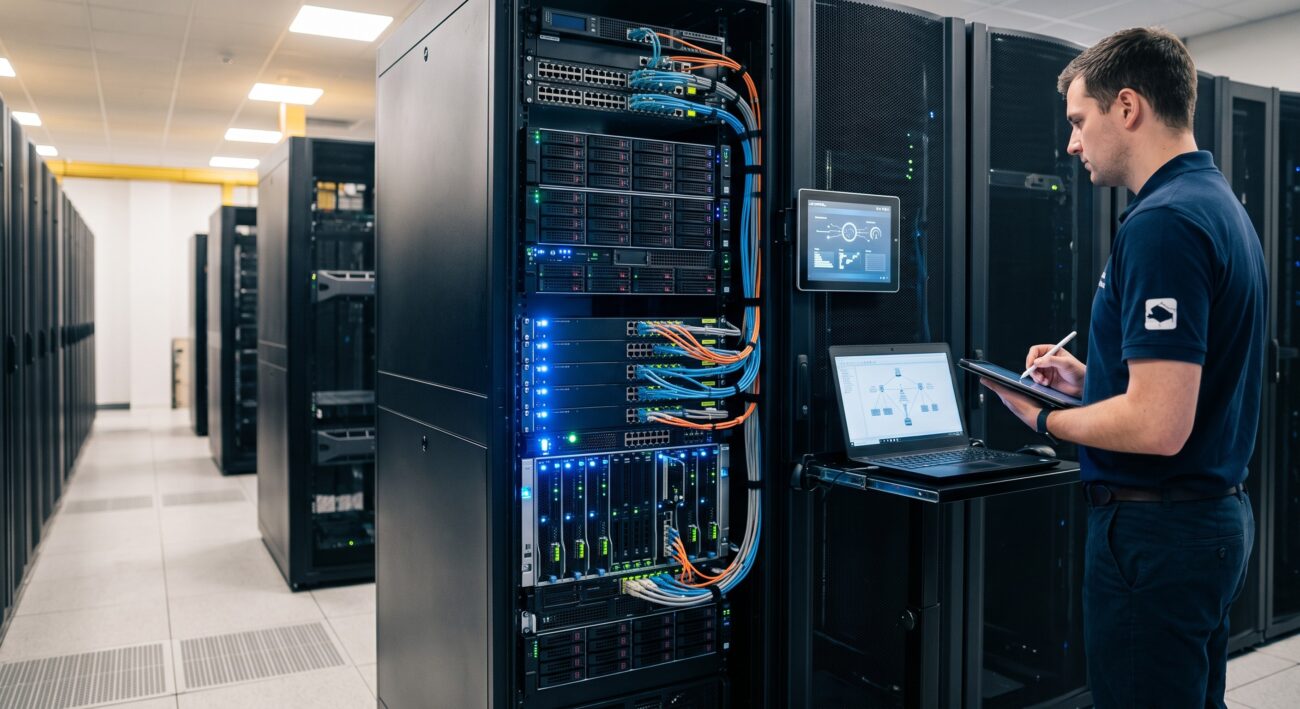
SDN/NFV HARDWARE ROLE
Storage virtualization represents a foundational pillar within modern Software-Defined Networking (SDN) and Network Functions Virtualization (NFV) architectures, enabling the abstraction of physical storage resources into logically pooled, centrally managed entities. For telecom operators and enterprise edge deployments, the integration of storage virtualization into the hardware infrastructure delivers transformative operational and capital efficiencies. This document defines the hardware platform requirements, architectural integration points, and deployment methodology for implementing storage virtualization within carrier-grade SDN/NFV environments. The solution enables seamless orchestration of virtualized storage volumes across distributed compute nodes while maintaining line-rate forwarding performance and ultra-low latency characteristics demanded by 5G core, multi-access edge computing (MEC), and virtualized RAN (vRAN) workloads.

CENTRALIZED CONTROL INTEGRATION
The hardware platform serves as the physical foundation for a centralized storage control plane, tightly integrated with SDN controllers and NFV orchestration frameworks such as OpenStack, Kubernetes, and ONAP. Through standardized Southbound APIs (RESTCONF, NETCONF, and gRPC), the system enables policy-driven provisioning, real-time telemetry, and automated lifecycle management of virtual storage pools. Key integration capabilities include:
Software-Defined Storage Controller Interoperability: Native support for distributed storage fabrics including Ceph, GlusterFS, and proprietary OEM storage virtualization engines. The hardware provides dedicated management interfaces and out-of-band control paths to ensure separation of control and data planes.
NFV Infrastructure (NFVI) Compatibility: Full compliance with ETSI NFV ISG architectural framework, supporting Virtualized Infrastructure Manager (VIM) integration for dynamic resource allocation. Storage resources are exposed as virtual block devices, object stores, and file systems to guest Virtual Machines (VMs) and containerized Network Functions (CNFs).
Orchestration & Automation: Embedded lifecycle management agents enable zero-touch provisioning via Redfish and IPMI 2.0, with support for Ansible, Terraform, and vendor-specific orchestration suites. Policy-based automation reduces operational expenditure (OPEX) by up to 40% through elimination of manual storage provisioning tasks.
Multi-Tenancy Isolation: Hardware-assisted I/O memory management units (IOMMU) and Single Root I/O Virtualization (SR-IOV) ensure strict tenant isolation at the storage controller level, preventing cross-tenant data leakage while maintaining near-native performance.
VIRTUAL FORWARDING CAPACITIES
The platform delivers high-performance virtual forwarding and storage access capabilities through a combination of dedicated hardware acceleration and optimized software datapaths. The architecture supports simultaneous operation of storage virtualization workloads alongside routing, switching, and security functions without performance degradation.
Storage Traffic Offload: Dedicated storage processing engines handle iSCSI, NVMe-oF, Fibre Channel over Ethernet (FCoE), and NFS/SMB protocol termination, freeing general-purpose CPU cores for VNF/CNF execution. Hardware CRC offload and TCP Segmentation Offload (TSO) ensure line-rate storage traffic at 100Gbps per port.
Non-Blocking Backplane: A 25.6 Tbps non-blocking switching fabric provides full-duplex connectivity between storage controller line cards, compute blades, and uplink modules. The backplane supports priority-based flow control (PFC) and Enhanced Transmission Selection (ETS) for lossless storage traffic.
NVMe over Fabrics (NVMe-oF) Acceleration: Integrated hardware engines support RoCEv2 and iWARP RDMA transport for NVMe-oF, delivering sub-10-microsecond latency and 99.9999% availability for mission-critical storage volumes. Jumbo frame support up to 9216 bytes maximizes storage throughput efficiency.
Cache Coherency & Tiering: Multi-level hardware caching (L1/L2/L3) with intelligent tiering between NVMe SSDs, SATA SSDs, and HDD storage pools. The system supports up to 512TB of addressable virtual storage per chassis with automated data placement policies.
Quality of Service (QoS): Per-volume and per-tenant QoS enforcement with granular bandwidth throttling, IOPS limiting, and latency budgets. Hardware-based traffic shaping ensures storage traffic does not starve latency-sensitive control plane functions.
SYSTEM PARAMETERS
The following technical specifications define the hardware platform’s capabilities for storage virtualization deployments in carrier-grade SDN/NFV environments. All parameters are verified under nominal operating conditions unless otherwise stated.
| Parameter | Specification |
|---|---|
| Form Factor | 1RU / 2RU / 4RU Chassis Options |
| Switching Capacity | 25.6 Tbps Non-Blocking Fabric |
| Storage Interface Support | NVMe-oF, iSCSI, FCoE, NFS, SMB, FC |
| Max Addressable Storage | 512 TB per Chassis (Expandable via Fabric) |
| Storage Protocol Offload | Hardware-Accelerated iSCSI, NVMe-oF, FCoE |
| RDMA Support | RoCEv2, iWARP, InfiniBand |
| Cache Architecture | L1/L2/L3 with Intelligent Tiering |
| Power Supply | 1+1 Redundant AC/DC (Hot-Swappable) |
| Cooling | Front-to-Back Airflow, N+1 Fan Trays |
| Management Interfaces | Redfish, IPMI 2.0, SNMP v3, NETCONF/YANG |
| Orchestration Integration | OpenStack Cinder, Kubernetes CSI, vSphere vVols |
| Security | TCG Opal 2.0, FIPS 140-2 L2, Secure Boot |
| Operating Temperature | -5°C to +55°C (NEBS Level 3) |
| MTBF | > 250,000 Hours |
| Compliance | ETSI NFV, NEBS L3, UL/IEC 60950-1, RoHS |
COMPLIANCE MATRIX
The hardware platform has been designed, tested, and certified to meet the rigorous standards required for telecom and enterprise storage virtualization deployments. The following compliance matrix summarizes the relevant certifications and standards.
ETSI NFV Compliance: Full compliance with ETSI GS NFV-INF 003, NFV-INF 004, and NFV-INF 005 specifications for NFV infrastructure hardware. Storage virtualization functions are implemented in accordance with ETSI GS NFV-SWA 001 for software architecture.
Storage Networking Standards: INCITS T11 Fibre Channel, INCITS T10 SCSI, IETF iSCSI (RFC 7143), NVM Express over Fabrics 1.0, SNIA Swordfish 1.0, and SNIA SMI-S 1.6 compliance.
Data Integrity & Security: TCG Opal 2.0 self-encrypting drive (SED) support, IEEE 1619.1 for tape storage encryption, and FIPS 140-2 Level 2 validated cryptographic modules. Hardware Root of Trust (RoT) ensures secure boot and firmware attestation.
Environmental & Safety: NEBS Level 3 (GR-1089, GR-63), UL 60950-1, IEC 60950-1, EN 60950-1, and RoHS 2011/65/EU compliance. EMC certifications include FCC Part 15 Subpart B, EN 55032, EN 55035, and VCCI Class A.
Management & Orchestration: Redfish 1.8+, SNMP v3, NETCONF/YANG, RESTCONF, and IPMI 2.0. Full integration with OpenStack Cinder, Kubernetes CSI, and VMware vSphere Virtual Volumes (vVols).
INTEGRATION DIAGRAM
The deployment architecture for storage virtualization within an SDN/NFV environment follows a three-tier logical model: the physical hardware layer, the virtualized infrastructure layer, and the orchestration/management layer. The hardware platform occupies the foundational tier, providing the compute, storage, and network resources upon which virtualized storage controllers and data paths are instantiated.
In a typical deployment, multiple hardware nodes are clustered to form a distributed storage fabric. Each node contributes local NVMe or SSD storage to a shared pool, with data replicated or erasure-coded across nodes for redundancy. The SDN controller manages network paths between storage nodes and compute nodes, ensuring optimal traffic engineering and QoS enforcement. The NFV orchestrator coordinates the lifecycle of virtual storage functions (vSFs) and their associated virtual network functions (VNFs), enabling dynamic scaling and fault recovery.
The platform supports both hyper-converged and disaggregated architectures. In hyper-converged mode, storage, compute, and networking resources reside in a single chassis, ideal for edge deployments with limited space and power. In disaggregated mode, dedicated storage nodes provide pooled capacity to remote compute nodes over high-speed fabric, suitable for large-scale core datacenter deployments.
Key integration interfaces include:
– Northbound: RESTCONF/NETCONF to SDN controller and NFV orchestrator
– Southbound: NVMe-oF, iSCSI, FCoE to storage devices and arrays
– East-West: RoCEv2, VXLAN, GENEVE for inter-node storage traffic
– Management: Redfish, IPMI, SNMP for hardware lifecycle management
📥 Download Technical Specification
Click the button below to view or download the full official PDF datasheet.

Leave a comment