
Overview & Thematic Scope
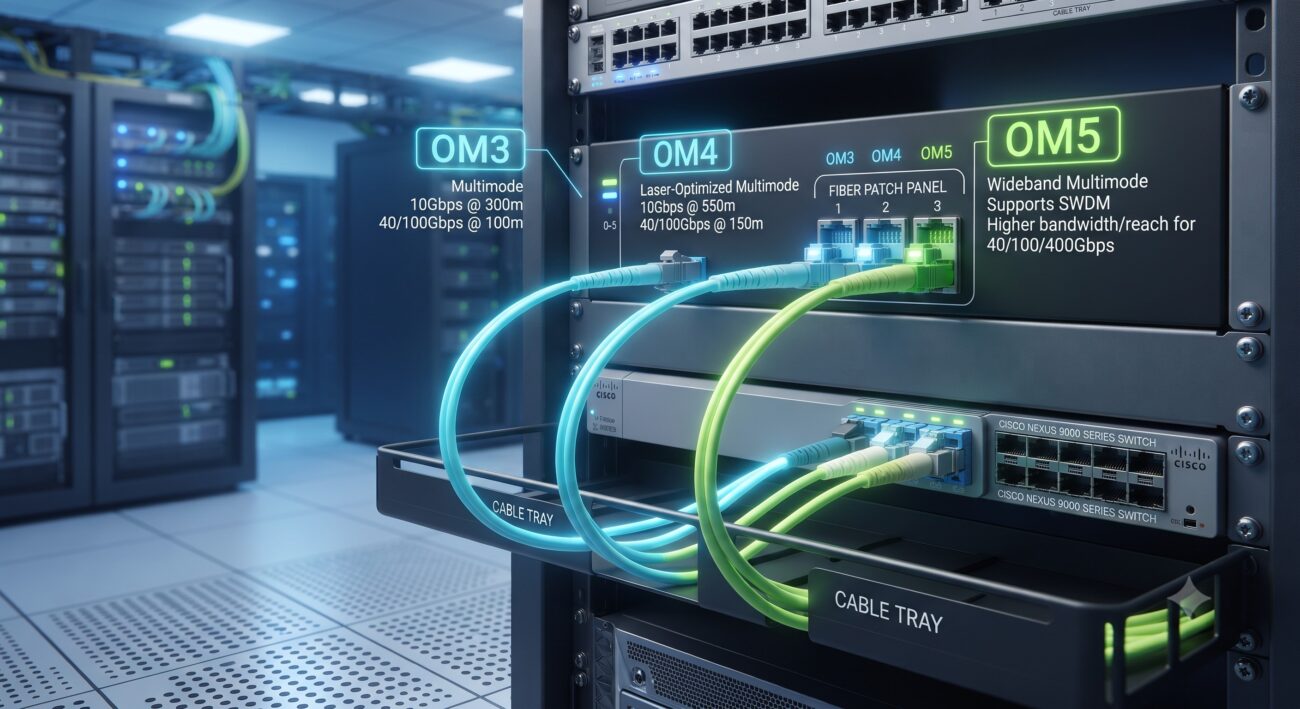
Choosing the right multimode fiber (MMF) for your network infrastructure is a critical decision that impacts performance, scalability, and cost. This FAQ addresses the most common technical and deployment questions from network engineers and IT managers comparing OM3, OM4, and OM5 fiber cables. We clarify the core distinctions in reach, bandwidth, and wavelength support to help you future-proof your data center or enterprise network.
Frequently Asked Questions
- Q1: What is the primary difference between OM3, OM4, and OM5 fiber cables?
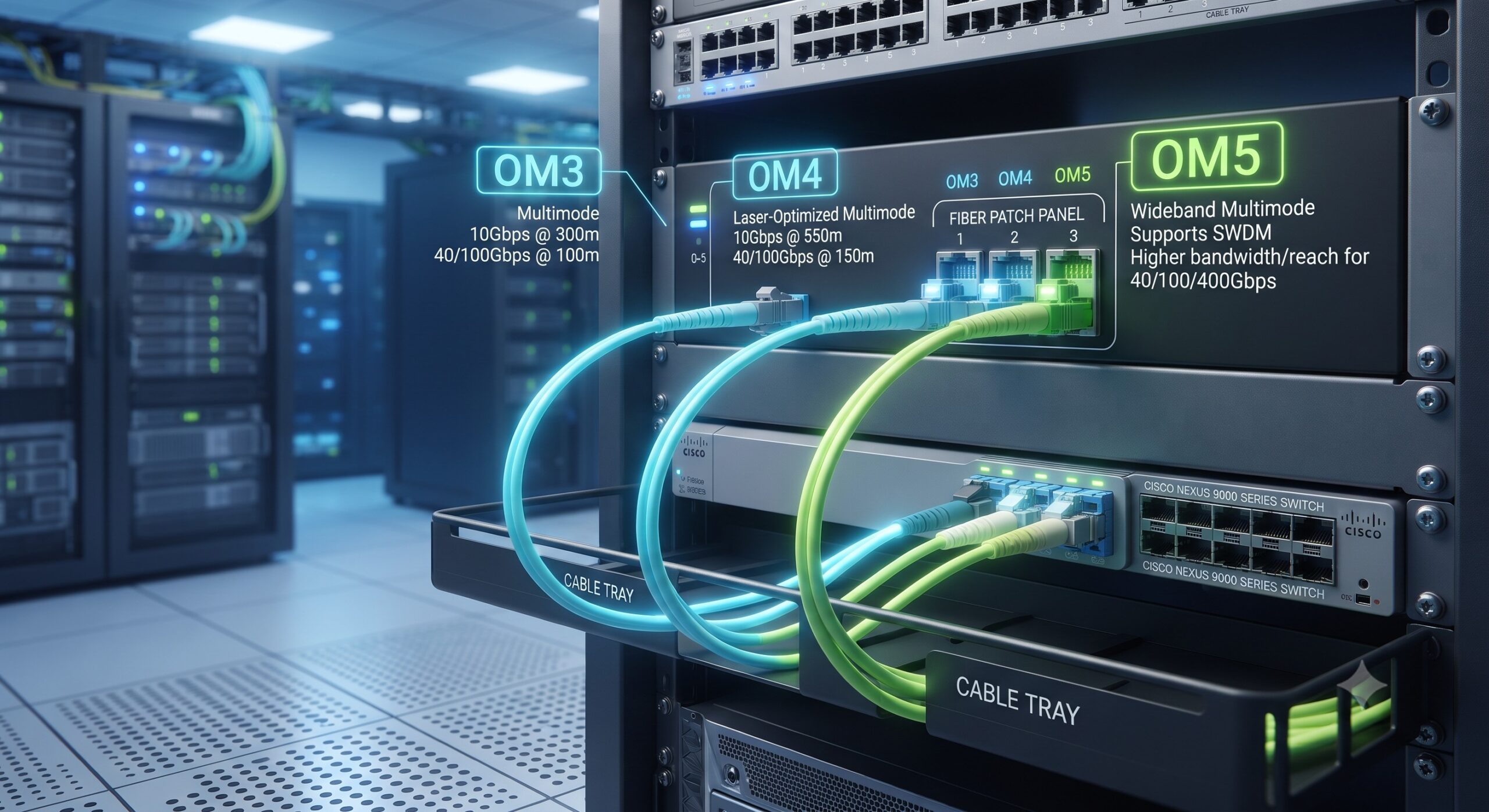
- The primary difference is their reach and bandwidth at specific wavelengths. OM3 and OM4 are optimized for 850nm VCSELs, while OM5 is specifically engineered to support Short Wavelength Division Multiplexing (SWDM) across a broader spectrum of 850-953nm. OM4 offers the longest reach for standard 850nm applications, whereas OM5 provides the highest aggregate bandwidth by using multiple wavelengths to achieve 400Gbps over a single pair of fibers at distances up to 150 meters.
- Q2: How far can OM3, OM4, and OM5 fiber cables transmit data for 100G Ethernet?
- For 100G Ethernet (100GBASE-SR4), the maximum reach for OM3 is 70 meters, and for OM4 it is 100 meters. OM5, when used with SWDM (100GBASE-SWDM4), can reach 150 meters. In contrast, OM5’s performance for 100G over 850nm is similar to OM4 at 100 meters, making its primary advantage the extended reach via SWDM.
- Q3: Which fiber type should I choose for future 400G network upgrades?
- For 400G Ethernet (400GBASE-SR8), all three support up to 100 meters (OM3) and 150 meters (OM4 and OM5) when using eight fibers at 850nm. However, for 400G over a single pair of fibers using SWDM technology (400GBASE-SWDM4), OM5 is the only choice, supporting distances up to 150 meters. If you are planning a high-density, short-reach 400G deployment, OM5 is the most future-proof option.
- Q4: Is OM5 fiber backwards compatible with OM3 and OM4 transceivers?
- Yes, OM5 is fully backwards compatible with OM3 and OM4 transceivers and cables. It uses the same 50/125µm core diameter, so any standard multimode transceiver (e.g., 10G-SR, 40G-SR4, 100G-SR4) will operate with OM5. However, to realize OM5’s SWDM advantage, you must use SWDM-optimized transceivers. Otherwise, its performance is similar to OM4.
- Q5: How do the costs compare between OM3, OM4, and OM5 fiber cables?
- OM3 is the most cost-effective option for short-reach legacy applications. OM4 is generally 20-30% more expensive than OM3 due to its higher bandwidth and longer reach. OM5 is the most expensive, often costing 50-100% more than OM4, as it requires more precise manufacturing to support multiple wavelengths. The total cost of ownership (TCO) should consider the higher cost of OM5 cabling against the potential savings on fewer transceivers and fiber pairs in dense environments.
- Q6: For a data center migration, is it better to upgrade to OM5 now or stick with OM4?
- The answer depends on your timeline and density needs. If your immediate need is to support 100G to 150 meters with minimal infrastructure change, OM4 is a proven and cost-effective choice. However, if you anticipate needing 400G in the next 3-5 years and want to minimize fiber count in your data center, upgrading to OM5 now is the strategic investment. OM5’s SWDM support can reduce the number of fibers required for high-speed links, simplifying cable management.
- Q7: Do OM5 cables require special cleaning or testing tools?
- No, OM5 cables do not require specialized cleaning or testing tools beyond what is standard for multimode fiber. However, because they support multiple wavelengths, optical testing (e.g., using an Optical Time-Domain Reflectometer or OTDR) should ensure the link performs across the entire 850-953nm range. This may require a test source capable of SWDM wavelengths to fully certify the cable’s performance.

Leave a comment