

STRATEGIC HARDWARE POSITIONING
The modern telecommunications and data center ecosystem faces an unprecedented challenge: balancing the relentless demand for higher-bandwidth optical connectivity against the significant capital expenditure associated with new transceiver procurement. Refurbished optical transceivers, when subjected to rigorous, OEM-grade quality control (QC) standards, present a strategic solution that delivers carrier-grade performance at a substantially reduced total cost of ownership. This document serves as the definitive technical reference for our comprehensive refurbishment validation protocol, detailing the methodologies, equipment, and pass/fail criteria that ensure every recertified transceiver performs identically to factory-fresh units. Our program is designed not merely to test functionality, but to guarantee long-term reliability, optical integrity, and full interoperability across a diverse range of legacy and next-generation networking equipment.

TCO EFFICIENCIES
Deploying refurbished transceivers that meet our stringent quality standards yields significant operational and financial advantages. The most immediate benefit is a direct reduction in hardware acquisition costs, typically ranging from 50% to 70% below the OEM list price for new optics. This substantial savings enables network operators to accelerate infrastructure upgrades, expand capacity in budget-constrained environments, and allocate capital to other critical areas such as software-defined networking (SDN) controllers or cybersecurity enhancements. Beyond the initial purchase price, our QC standards ensure that refurbished units offer a lifecycle and Mean Time Between Failures (MTBF) comparable to new transceivers, minimizing costly downtime and truck rolls. The environmental impact is also a key consideration; by extending the useful life of high-quality optical components, we contribute to the circular economy, reducing electronic waste and the carbon footprint associated with manufacturing new modules.
SCALABILITY ADVANTAGES
Our quality control framework is built upon scalable processes capable of handling high-volume throughput while maintaining uncompromising precision. The workflow is designed to evaluate transceivers across all major form factors—including SFP, SFP+, SFP28, QSFP+, QSFP28, and CFP variants—and for all standard protocols, from 1G Ethernet to 400G and emerging 800G applications. The scalability of our process is a function of automated test stations, robotic handling systems for connector cleaning, and AI-driven data analysis for anomaly detection. This allows us to meet the demands of hyperscale data center operators, service providers, and enterprise clients with consistent, repeatable, and verifiable results. The strategic advantage lies in the ability to offer a reliable, high-quality alternative to new optics without sacrificing performance or delivery timelines, providing a flexible supply chain solution that can adapt to fluctuating demand.
SPECIFICATION REPORT
Our qualification process is a multi-stage, rigorous regimen that subjects every refurbished transceiver to a series of stress tests, optical measurements, and digital diagnostics. The following sections detail the core testing phases and their associated pass/fail thresholds.
PHASE 1: PHYSICAL AND VISUAL INSPECTION (PVI)
Every transceiver undergoes a detailed external examination.
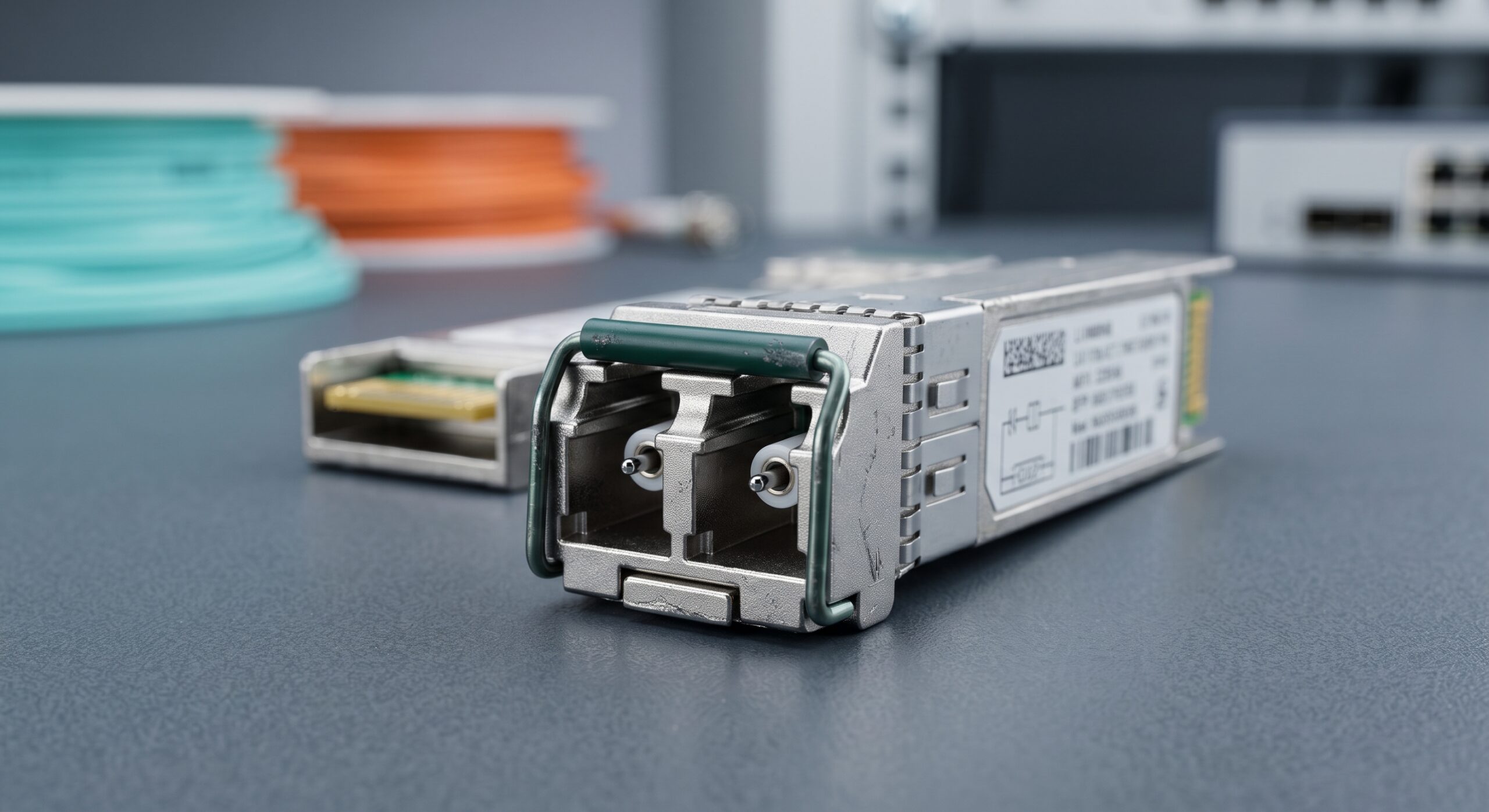
– Connector Endface: Inspected under a 400x magnification video microscope. Surfaces must be free of scratches, pits, and contamination to ensure minimal insertion loss. Cleanliness is verified to IPC-8497-1 standards.
– Mechanical Shell: Examined for dents, cracks, or deformations that could compromise the module’s shielding or proper seating in the port.
– Latch Mechanism: Actuated and tested to ensure secure, reliable locking. A faulty latch is grounds for immediate rejection.
– Label Integrity: Serial numbers, model numbers, and regulatory marks must be legible and correspond to the internal EEPROM data.
PHASE 2: DIGITAL DIAGNOSTIC (DDM/DOM) AND EEPROM VALIDATION
Using a protocol-specific host board, we validate the transceiver’s memory.
– EEPROM Integrity: Verification of all fields against the SFF-8472 or SFF-8636 memory map specifications. The vendor code, manufacturing date, and part number are cross-referenced for authenticity.
– DDM Calibration: Real-time monitoring parameters (Temperature, Voltage, TX Bias Current, TX Optical Power, RX Optical Power) are checked for proper functionality and accurate calibration relative to our reference test equipment. The thresholds for alarms and warnings are also verified.
PHASE 3: OPTICAL AND ELECTRICAL PERFORMANCE TESTING
This is the cornerstone of our validation process, conducted on calibrated network analyzers, oscilloscopes, and optical power meters.
– TX Optical Power: The module’s output power is measured against its rated specification (e.g., -3 dBm to +3 dBm for an 10G LR). It must be within the specified range and stable over a 2-minute warm-up period.
– RX Sensitivity: The receiver’s ability to detect signals at the specified sensitivity threshold (e.g., -14.4 dBm for 10G LR) with a Bit Error Rate (BER) of less than 1E-12 is verified using a variable optical attenuator and a BER tester.
– Extinction Ratio: Measured to ensure the optical pulse is distinct and the laser is performing correctly.
– Wavelength Accuracy: Verified against the channel grid (e.g., 1310nm, 1550nm) to guarantee DWDM or CWDM multiplexing compatibility.
– Eye Pattern Mask Testing: The optical eye diagram is evaluated against the standards defined in IEEE 802.3 to ensure signal integrity, rise/fall times, and jitter are within specified limits.
PHASE 4: BIT ERROR RATE (BER) AND MARGIN TESTING
We perform a comprehensive BER test over a 24-hour cycle, incorporating the module into a full duplex loopback system. A long-term test at 70°C ambient temperature, simulating worst-case operational conditions, is conducted to confirm stability under thermal stress.
PHASE 5: DATA ENCRYPTION AND SECURITY
For modules supporting AES or other encryption standards, we verify the encryption engine’s performance at line rate and ensure that security keys can be securely loaded and authenticated.
| Parameter | Specification |
|---|---|
| Form Factor | SFP, SFP+, SFP28, QSFP+, QSFP28, CFP |
| Data Rate | 1G, 10G, 25G, 40G, 100G, 400G |
| Optical Wavelength | 850nm (SR), 1310nm (LR), 1550nm (ER/ZR), CWDM, DWDM |
| Max Transmission Distance | Dependent on type: 30m (SR) to 80km+ (ZR/ DWDM) |
| Tested Bit Error Rate (BER) | |
| Power Supply Voltage | 3.1V to 3.5V |
| Connector Type | LC Duplex (Standard), MTP/MPO (Parallel) |
| Compliance Standards | SFF-8472, SFF-8431, SFF-8636, IEEE 802.3 (various) |
SAFETY CERTIFICATIONS
All our refurbished transceivers are recertified to meet the stringent safety and regulatory standards as new units.
– Laser Safety: Certified as Class 1 laser products in compliance with IEC 60825-1. This ensures the transceiver is safe for operation under all conditions of normal use without the risk of hazardous optical radiation.
– EMI/EMC: Compliance with FCC Part 15 Class A and CISPR 22 standards guarantees that the module does not generate harmful electromagnetic interference and is immune to external disturbances.
– RoHS and WEEE Compliance: Adherence to the Restriction of Hazardous Substances Directive, confirming that the transceivers are free from lead, mercury, and other harmful materials, promoting a greener and safer product lifecycle.
– Reliability and MTBF: The components are engineered for high reliability, with a projected MTBF exceeding 1,000,000 hours, making them suitable for use in mission-critical telecom and enterprise backbone applications.
VISUAL DEPLOYMENT SUMMARY
In a typical deployment scenario, the refurbished transceiver functions as an integral component of a high-density aggregation layer, connecting a Top-of-Rack (ToR) switch to a Spine switch. The unit is hot-pluggable and supports a range of fiber types. The table below provides a consolidated view of key parameters, while the accompanying image illustrates the potential chassis installation context.
📥 Download Technical Specification
Click the button below to view or download the full official PDF datasheet.

Leave a comment