
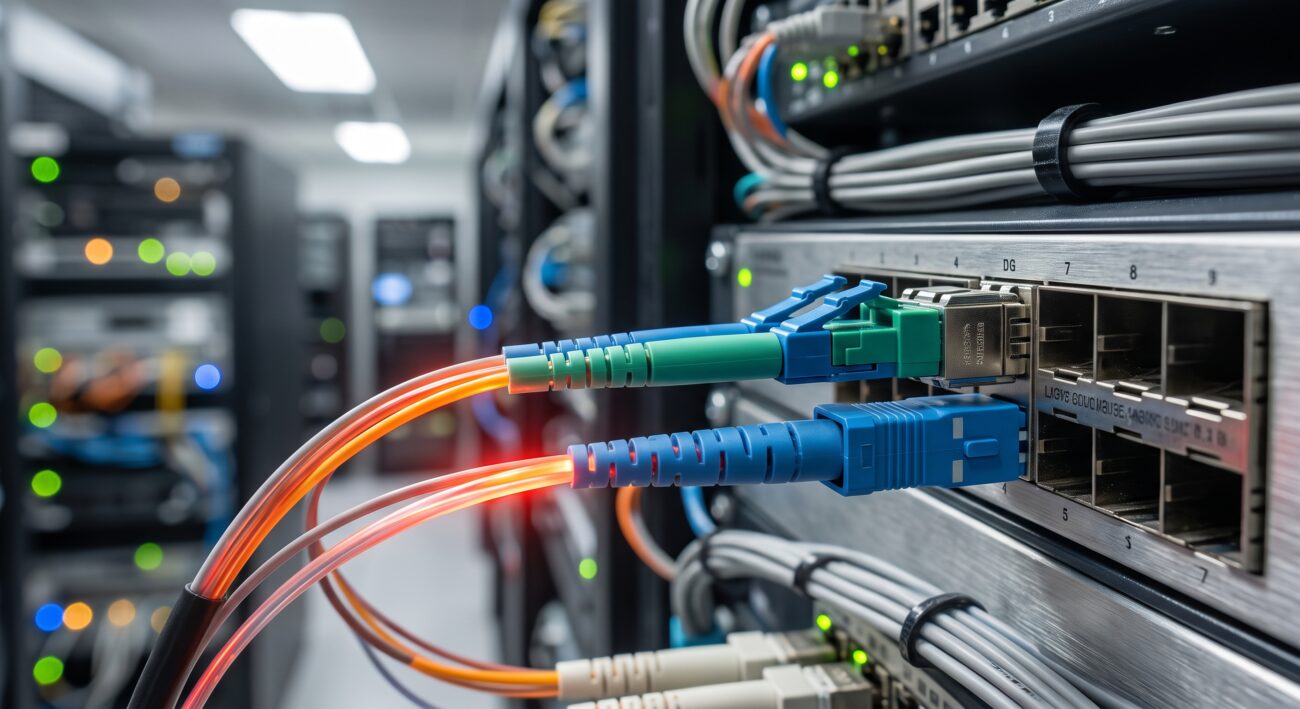
Introduction: The Connector Conundrum in Modern Fiber Networks
In the realm of high-speed optical networking, the choice between LC vs SC fiber connectors is far from trivial. As data centers scale to support 400G and 800G Ethernet and service providers push the limits of DWDM, the physical layer determines signal integrity, density, and long-term operational costs. This definitive guide dissects the engineering, standards, and real-world deployment strategies for these two dominant form factors. With over two decades of industry standardization under the auspices of bodies like IEEE and ITU-T, understanding the subtleties of LC vs SC fiber connectors is essential for any network architect aiming to optimize for both performance and total cost of ownership.
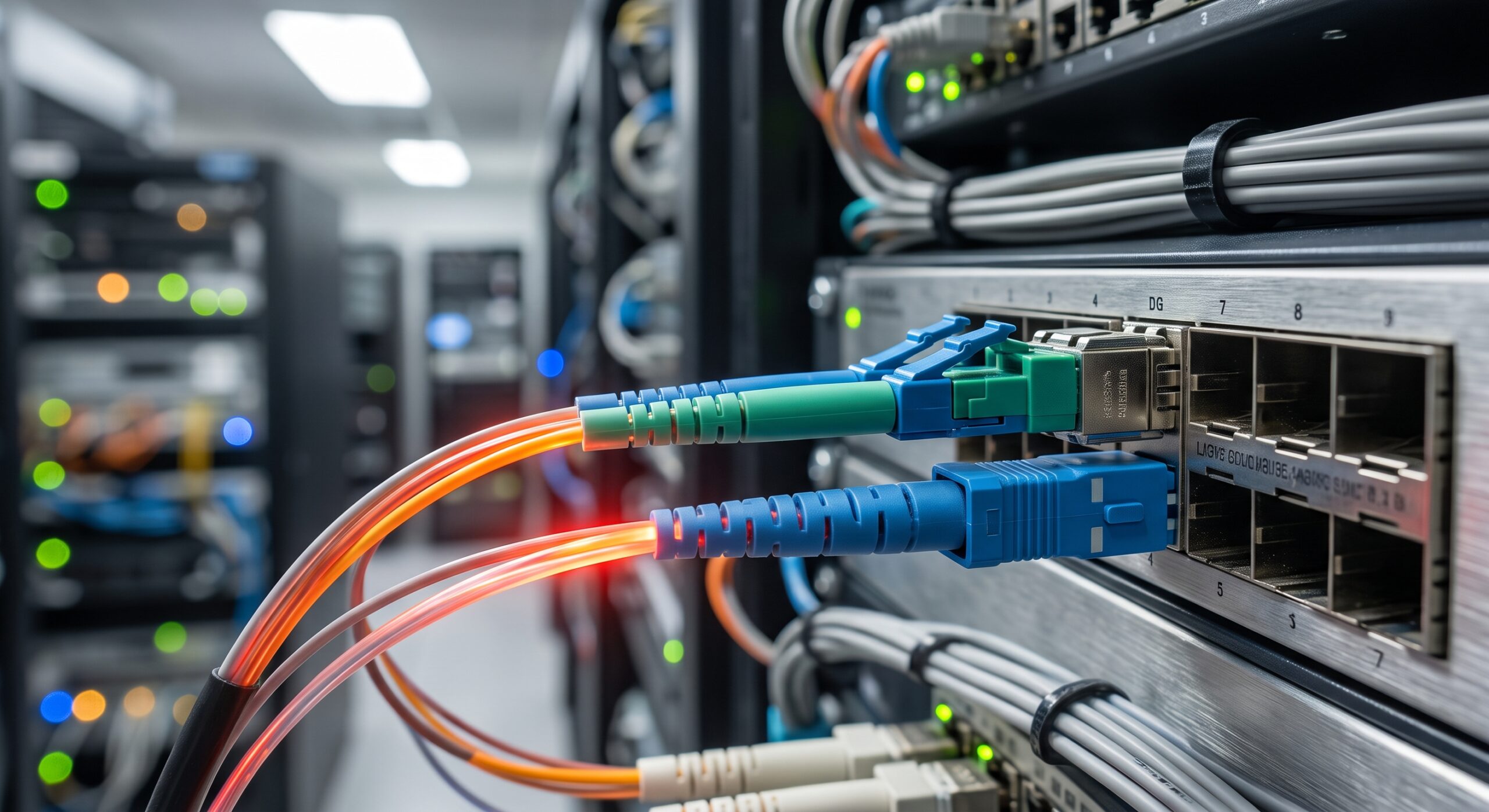
Core Architecture and Physical Topology
Form Factor and Mechanical Design
The LC (Lucent Connector) utilizes a 1.25 mm ferrule, half the size of the SC (Standard Connector) which employs a 2.5 mm ferrule. This difference is the primary driver for density. A standard SFP transceiver typically houses a duplex LC interface, whereas SC is prevalent in legacy GBIC and higher-power passive optical networks. The LC’s latch mechanism—resembling a miniature RJ45—provides a robust pull-proof retention, crucial in high-vibration environments. Conversely, the SC’s push-pull snap mechanism, standardized under ISO/IEC 11801, offers a simpler, more tactile engagement, reducing the risk of improper mating in field installations.
Optical Performance Metrics: IL and RL
When evaluating LC vs SC fiber connectors, the optical budget is paramount. Both connectors are available in UPC (Ultra Physical Contact) and APC (Angled Physical Contact) polish variants. For single-mode applications (OS2), typical insertion loss (IL) for a high-quality LC or SC connector is ≤ 0.2 dB (mean ≤ 0.1 dB), as per Telcordia GR-326-CORE standards. Return loss (RL) for UPC is ≥ 55 dB, while APC delivers ≥ 65 dB, critical for high-power laser applications to prevent back-reflection damage. Data from the NTT-AT reliability tests show a mean time between failures (MTBF) exceeding 1,000,000 hours for both types under standard EIA/TIA-455-34A procedures, confirming their carrier-grade dependability.
| Key Parameter | LC (Lucent Connector) | SC (Standard Connector) |
|---|---|---|
| Ferrule Diameter | 1.25 mm | 2.5 mm |
| Typical Insertion Loss (SM) | ≤ 0.2 dB | ≤ 0.2 dB |
| Typical Return Loss (UPC) | ≥ 55 dB | ≥ 55 dB |
| Typical Return Loss (APC) | ≥ 65 dB | ≥ 65 dB |
| Maximum Port Density (1U) | 72 (Duplex) | 48 (Duplex) |
| Primary Use Case | Datacenters, High-speed Transceivers (SFP) | FTTH, Carrier Backbone, Legacy |
| Latching Mechanism | RJ-45 style (Pull-proof) | Push-Pull Snap |
| Industry Standard | IEC 61754-20 | IEC 61754-4 |
High-Density Datacenter Scaling: The LC Advantage
Rack Space and Port Density
In the era of high-density datacenter scaling, the physical footprint of LC vs SC fiber connectors becomes a decisive factor. A standard 1U panel can accommodate up to 72 duplex LC ports (144 fibers) versus a maximum of 48 duplex SC ports (96 fibers) when utilizing standard adapters. This 50% increase in port density directly translates to reduced real estate costs and optimized cooling airflow. This aligns with the IEEE 802.3bs standard for 400G Ethernet, where parallel optics (e.g., 8-fiber MPO to 4x duplex LC) often necessitate LC interfaces for breakout into QSFP-DD transceivers.
Thermal and Airflow Considerations
The reduced footprint of the LC connector allows for more efficient cable management, minimizing airflow obstructions. Studies on thermal dynamics in high-density racks have shown that using LC vs SC fiber connectors can yield a 10-15% improvement in airflow efficiency due to reduced cable bend radius requirements and less congestion behind faceplates. This is particularly relevant for next-generation silicon photonics engines, which operate at higher thermal limits.
Deployment Scenarios: Enterprise vs. Carrier-Grade
Enterprise LAN and Structured Cabling
In enterprise environments, the choice of LC vs SC fiber connectors often defaults to SC for backbone cabling due to its robustness and ease of termination in the field. SC’s larger ferrule offers a slight tolerance advantage during field splicing and polishing, making it a preferred choice for FTTO (Fiber to the Office) and legacy campus networks. However, with the increasing adoption of Ethernet 10GBase-LR and 25GBase-SR optics, the LC connector has become the de facto standard for active equipment interfaces due to its compatibility with SFP/SFP+ and SFP28 form factors.
Carrier-Grade Reliability and FTTH
For carrier-grade reliability and PON (Passive Optical Network) applications, the SC/APC connector is often the undisputed champion. The ITU-T G.652 and G.657 recommendations for bend-insensitive fiber frequently utilize SC/APC interfaces to ensure minimal loss in outside-plant environments. The push-pull mechanism allows for easy insertion in tight distribution boxes, a critical factor for field technicians performing last-mile installations. Despite this, modern XGS-PON and NG-PON2 OLT ports are increasingly adopting LC/UPC to align with 100G line cards, blurring the lines of this historical segregation.

Migration and Compatibility Considerations
Backward Compatibility and Hybrid Cables
When planning a migration strategy, network architects must consider the backward compatibility of LC vs SC fiber connectors. Hybrid patch cables (LC-SC) are readily available and comply with TIA-568.3-D standards, enabling gradual transitions without forklift upgrades. However, it’s critical to match polish types (UPC to UPC or APC to APC) to avoid excessive return loss. Mixed polishing can introduce up to 0.5 dB additional loss, potentially exceeding the optical power budget for 80 km DWDM links.
Future-Proofing for 800G and 1.6T
The next generation of optical transceivers, as defined by the 800G Pluggable MSA, relies heavily on the LC connector for single-mode fiber interfaces. While SC connectors are physically capable of supporting these data rates, the industry consensus leans towards the LC form factor for its proven performance in high-frequency applications, specifically regarding its ability to maintain return loss stability across extreme temperature fluctuations (-40°C to +85°C) as per GR-326-CORE Category B requirements.
Conclusion: Selecting the Right Connector for Your Architecture
In the debate of LC vs SC fiber connectors, there is no one-size-fits-all answer. The LC connector offers superior density and is the undisputed champion for high-speed transceivers (400G/800G) and spine-leaf architectures within modern data centers. The SC connector, with its larger footprint and robust push-pull mechanism, remains the gold standard for carrier-grade outside plant, FTTH, and environments where field termination ease and mechanical tolerance are prioritized. As networks evolve, the convergence towards multi-fiber push-on (MPO) for parallel optics further complicates this landscape, but for duplex links, the LC connector’s trajectory suggests it will dominate the next decade of enterprise and cloud networking. Assess your port density requirements, thermal constraints, and technician skill sets to make an informed decision that aligns with your long-term operational strategy.

Leave a comment