
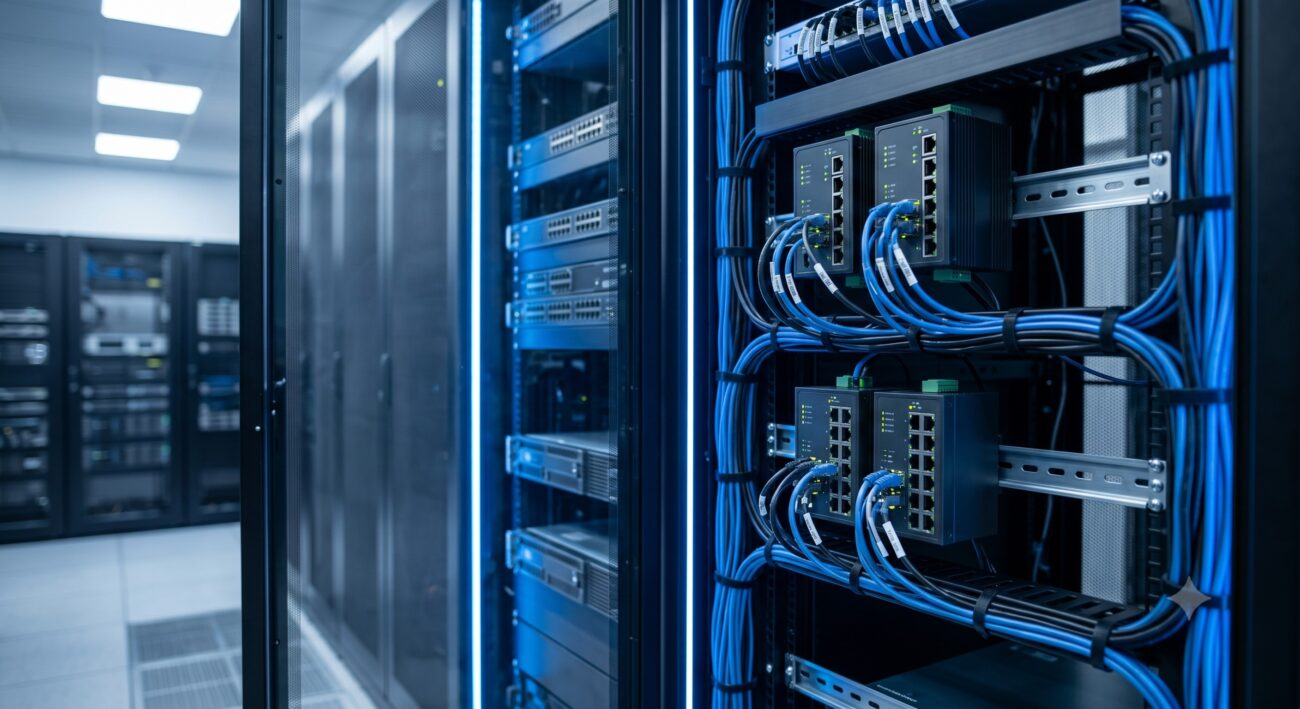
RUGGEDIZED TELECOM INFRASTRUCTURE APPLICATION NOTE: INDUSTRIAL ETHERNET SWITCH DIN RAIL
1. RUGGEDIZED DESIGN PHILOSOPHY
The modern industrial network edge demands more than mere connectivity; it requires a foundational element that can withstand the harshest physical environments while delivering carrier-grade data throughput. The [industrial ethernet switch din rail] series has been engineered from the ground up to address the unique challenges of factory automation, intelligent transportation systems (ITS), power utility substations, and military field communications. This application note details the technical architecture, environmental hardening, and performance capabilities of a platform designed to thrive where commercial-grade equipment fails.
Unlike traditional enterprise switching, the DIN-rail form factor dictates a compact, fanless, and highly shock-resistant mechanical envelope. Our design philosophy prioritizes thermal efficiency through passive convection, utilizing a finned aluminum chassis that acts as a primary heat sink, eliminating single points of failure associated with active cooling. Every component, from the electrolytic capacitors to the RJ45 connectors, has been selected for an extended operational temperature range of -40°C to +75°C, ensuring reliable startup and operation under extreme cold or intense solar radiation.

2. THERMAL & ELECTRICAL TOLERANCE
The [industrial ethernet switch din rail] implements a multi-stage protection scheme that isolates the internal logic from electrical disturbances common in industrial settings. The power input module accepts a wide range of DC voltages (12-48 VDC or 24-110 VDC for high-voltage variants) and features dual redundant power inputs with auto-failover. This is complemented by reverse polarity protection, overcurrent protection, and a built-in surge suppressor capable of withstanding ±4kV ESD (IEC 61000-4-2) and ±2kV surge (IEC 61000-4-5).
Thermal management is addressed through a combination of hardware and software strategies. The physical design maximizes surface area for heat dissipation, while the Marvell or Broadcom switching silicon is rated for industrial junctions. Software-level monitoring provides real-time temperature telemetry via SNMP, allowing network management systems to proactively adjust traffic patterns or generate alerts if ambient temperatures approach critical thresholds. This robust electrical and thermal tolerance guarantees an industry-leading Mean Time Between Failures (MTBF) exceeding 1 million hours, validated through accelerated life testing.
3. OPERATIONAL ADVANTAGES
Beyond physical resilience, the [industrial ethernet switch din rail] provides a sophisticated Layer 2 and Layer 3 feature set, typically reserved for larger rack-mounted systems, enabling advanced network segmentation and redundancy. Native support for ITU-T G.8032 Ethernet Ring Protection Switching (ERPS) enables sub-50ms failover recovery, essential for maintaining network stability in ring topologies found in factory floors and transportation corridors. This is further enhanced by IEEE 802.1w Rapid Spanning Tree Protocol (RSTP) and Multiple Spanning Tree Protocol (MSTP) for redundant mesh designs.
Traffic prioritization capabilities include strict and Weighted Round Robin (WRR) queuing, ensuring deterministic latency for critical control traffic (e.g., EtherNet/IP, PROFINET, Modbus TCP). The switch also serves as an intelligent edge device, supporting IGMP snooping for efficient multicast filtering and a robust Access Control List (ACL) engine for implementing security policies at the port level. This operational sophistication allows network architects to build resilient, predictable, and secure Industrial Internet of Things (IIoT) networks.
4. CERTIFICATIONS MATRIX
The platform has successfully undergone rigorous certification testing to meet the specific demands of global industry standards. The comprehensive suite of approvals validates its suitability for deployment in heavy industrial and public infrastructure projects.
– Industrial Automation: IEC 61131-2 and UL 61010-1/61010-2-201 for PLC environments.
– EMC/EMI Immunity: EN 55032/55024, CISPR 32, and FCC Part 15 Class A.
– Environmental Engineering: IEC 60068-2-6 (Vibration), IEC 60068-2-27 (Shock), and IEC 60068-2-32 (Free Fall).
– Safety Approvals: UL 508 and CSA C22.2 No. 14 (Industrial Control Equipment).
– Railway/Transport: EN 50121-4 (EMC for railway signaling) and EN 50155 (for rolling stock variants).
5. EXACT SPECS
The following detailed specifications define the performance boundaries and power characteristics of the managed [industrial ethernet switch din rail] platform, providing engineers with the essential data for system design and integration.
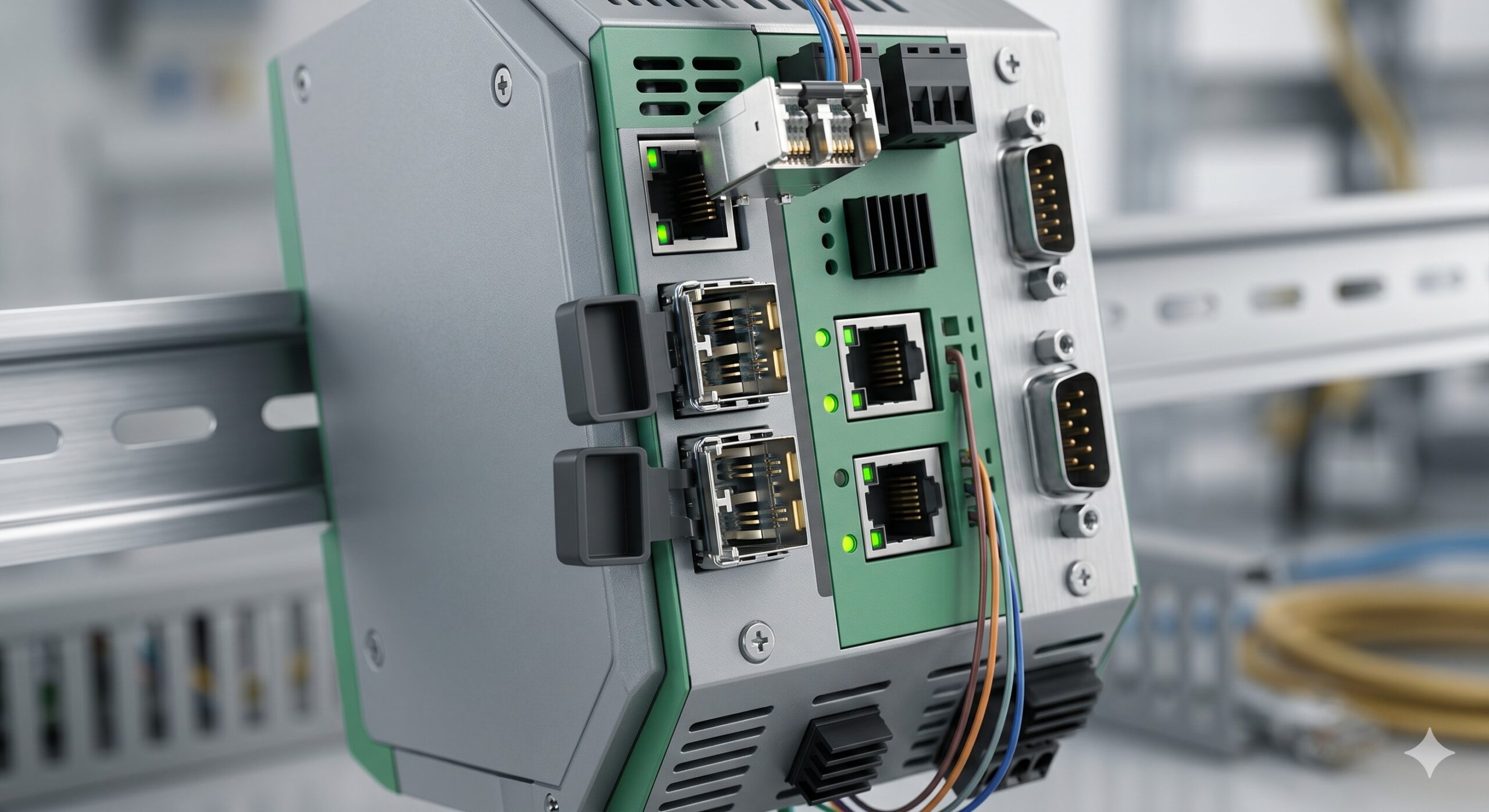
– Port Configuration: 8 x 10/100/1000BASE-T (RJ45) auto-negotiation, plus 2 x 100/1000BASE-X SFP slots (shared or dedicated).
– Switching Fabric: 20 Gbps non-blocking capacity with a forwarding rate of 14.88 Mpps (64-byte packets).
– MAC Address Table: 8K entries with automatic aging.
– Jumbo Frame Support: Up to 9.6 KB.
– VLAN: IEEE 802.1Q with up to 4K active VLANs and port-based VLAN assignment.
– Dimension (W x D x H): 60 x 140 x 120 mm (approximately 2.4 x 5.5 x 4.7 in).
– Power Consumption: Typical 12W; Maximum 18W.
– Mounting: Standard 35 mm DIN-rail (EN 60715) and wall-mount bracket optional.
| Parameter | Specification |
|---|---|
| Form Factor | Compact DIN-rail Mount (35mm EN 60715) |
| Switching Capacity | 20 Gbps (Non-blocking) |
| Power Supply | 12-48 VDC Redundant Input (Reverse Polarity Protection) |
| Operating Temperature | -40°C to +75°C (Fanless Design) |
| Storage Temperature | -40°C to +85°C |
| Relative Humidity | 5% to 95% (Non-condensing) |
| Mean Time Between Failures (MTBF) | > 1,000,000 hours (Telcordia SR-332) |
| Safety Approvals | UL 508, CSA C22.2 No. 14, IEC 61131-2 |
| EMI/EMC Standards | FCC Part 15 Class A, EN 55032, CISPR 32 |
| Ethernet Protocols | IEEE 802.3, 802.3u, 802.3ab, 802.3z, 802.3x, 802.1Q, 802.1p, 802.1w, 802.1D, 802.3ad |
6. FIELD DEPLOYMENT SCHEMATIC
A typical deployment scenario for the [industrial ethernet switch din rail] positions the device at the edge of an industrial control network, serving as the primary aggregation point for field devices. The unit is mounted within a climate-controlled or unheated IP40-rated cabinet, receiving primary power from the plant’s 24 VDC bus. Uplinks via the SFP ports connect to a higher-tier aggregation ring using single-mode fiber, ensuring galvanic isolation and long-distance transmission. Downlink ports connect directly to PLCs, remote I/O blocks, and machine vision cameras.
This physical topology is mirrored in the logical configuration, where the switch operates as a ring node in an ERPS network. It applies strict Quality of Service (QoS) policies to prioritize control traffic (VLAN 100) over data traffic (VLAN 200). The device’s diagnostic features, including port mirroring and link fault propagation, allow for rapid troubleshooting, minimizing costly downtime. The resulting architecture is a robust, secure, and manageable edge network node.
📥 Download Technical Specification
Click the button below to view or download the full official PDF datasheet.

Leave a comment