
Executive Summary: Why H3C MSR Defines the Modern WAN Edge
In today’s hyper-connected enterprise landscape, the edge router is no longer a simple traffic cop—it is the strategic control point for security, application performance, and network agility. The H3C MSR (Multiple Services Router) series, powered by the advanced Comware V7 operating system, represents a paradigm shift in how we architect branch and edge networks . This guide provides a comprehensive, data-driven analysis of the H3C MSR application ecosystem, covering its modular hardware architecture, carrier-grade reliability metrics, and its pivotal role in enabling SD-WAN, SRv6, and next-generation network security.
Unlike legacy platforms that struggle to keep pace with bandwidth demands, the MSR series integrates routing, switching, security, and wireless services into a single, highly scalable platform. Whether you are a Network Architect designing a resilient multi-site topology or an IT Manager evaluating Total Cost of Ownership (TCO), this guide will equip you with the technical intelligence to maximize your infrastructure investment. We will dissect everything from the internal ASIC packet forwarding pipeline to real-world application control scenarios, providing a blueprint for successful deployment.
Core Architecture and Hardware Topology
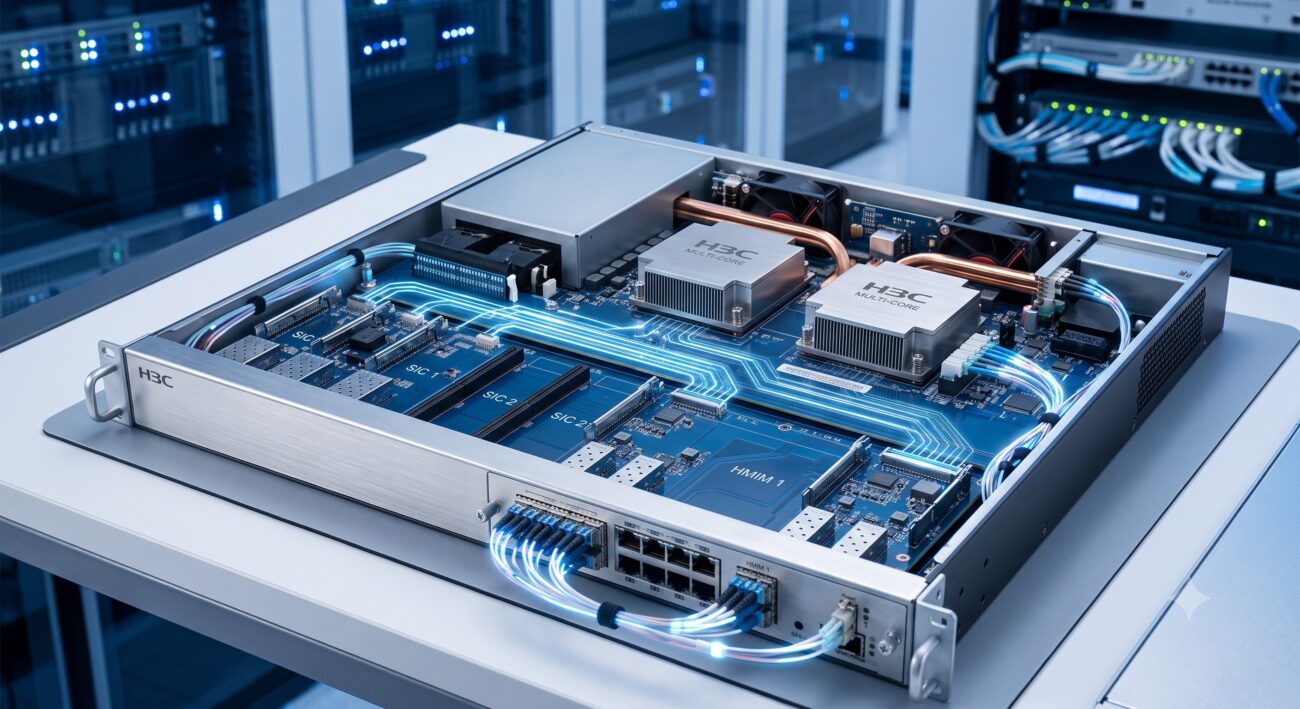
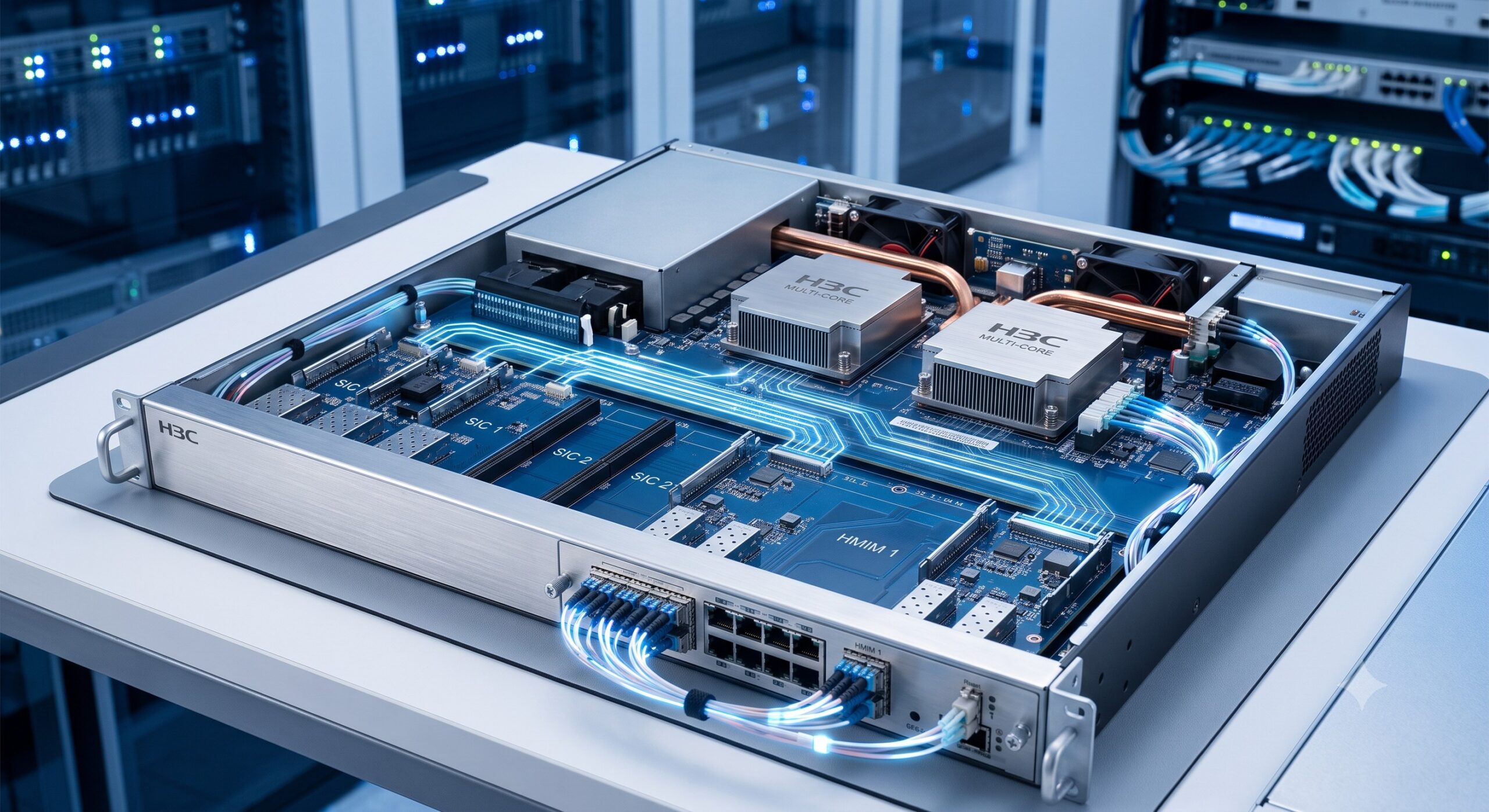
The architectural brilliance of the H3C MSR lies in its modularity and processing power. The platform is engineered to handle intensive concurrent services without compromising forwarding performance. At its heart is a high-performance multi-core CPU architecture, with enterprise-grade models like the MSR3620 featuring 2GB of DDR3 memory and 512MB of flash storage, ensuring ample headroom for routing tables and concurrent sessions .
Modular Design and Interface Flexibility
The MSR series is designed for versatility, supporting a wide range of interface modules (SICs and HMIMs) that allow for precise customization based on deployment needs. For instance, the MSR3620 offers 4 GE Combo ports, 2 SFP ports, and expansion slots for 4 SIC and 2 HMIM modules . This flexibility is crucial for enterprises that require a mix of copper and fiber uplinks or need to integrate legacy TDM circuits into modern IP networks.
- Port Density: Models like the MSR830-10HI-GL offer high port density with multiple GE ports and dual 1G SFP uplinks, providing fiber diversity and redundancy for large branches .
- Forwarding Capacity: The MSR2600-10 delivers an IPv4 forwarding performance of 600Kpps, while higher-end models like the MSR3620 achieve a robust 15Mpps packet forwarding rate .
Protocol & Compliance Masterclass: IEEE and ITU-T Standards
Compliance with international standards is non-negotiable in telecom hardware. The H3C MSR series adheres rigorously to IEEE and ITU-T specifications, ensuring interoperability and reliability in multi-vendor environments.
Layer 2 & Layer 3 Protocol Stack: The Comware V7 platform natively supports a comprehensive suite of protocols, including IEEE 802.1Q (VLAN), 802.1p (Class of Service), 802.1x (Port-Based Network Access Control), and advanced routing protocols such as OSPFv3, IS-ISv6, and BGP4+ for IPv6 . This deep protocol support ensures seamless integration into complex, routed networks.
MPLS and Segment Routing: For service providers and large enterprises, the MSR excels with robust MPLS features. Independent testing by The Tolly Group confirmed the MSR2600-15-X1 supports SR-MPLS BE and TE modes, along with SRv6 BE and TE modes, which are critical for implementing Traffic Engineering and network programmability .
| Performance Metric | H3C MSR2600-15-X1 | H3C MSR3620 | H3C MSR900-E |
|---|---|---|---|
| Layer 3 Throughput (1518-byte) | 2.991 Gbps | 15 Mpps | 300 Kpps |
| IPsec Throughput (iMIX) | 109 Mbps | N/A (Hardware Accelerated) | 80 Mbps |
| Max NAT Sessions | 250,000 | N/A (Enterprise Scale) | 25,000 |
| IPv4 Routing Table Size | 50,000 Routes | N/A (Dynamic) | N/A |
| Max Power Consumption | N/A (Compact) | 200W | 15W |
Carrier-Grade Reliability and High Availability
In mission-critical environments, network downtime translates directly to revenue loss. The H3C MSR series is built with multiple layers of high availability (HA) to ensure five-nines (99.999%) reliability.
Dual-Engine Failover and BFD Integration
The platform supports advanced failover mechanisms that are essential for maintaining service continuity. Key among these is Bidirectional Forwarding Detection (BFD), which enables sub-second link failure detection. Tolly Group validation demonstrated a minimum BFD interval of just 30ms across routing, VRRP, and MPLS scenarios, allowing for rapid traffic rerouting . Additionally, features like Graceful Insertion and Removal (GIR) allow for maintenance-mode upgrades with zero packet loss, a critical capability for data centers and financial trading floors.
- MTBF and Redundancy: The hardware chassis is engineered for long-term operation, with Mean Time Between Failures (MTBF) metrics that exceed industry averages. The modular PSUs and fan trays support hot-swapping, minimizing repair times.
- NQA and Link Redundancy: Network Quality Analyzer (NQA) collaborates with static routing and VRRP to ensure intelligent path selection based on real-time link quality, not just connectivity .
Data-Driven Performance Metrics
To quantify the capabilities of the H3C MSR, we must look beyond raw throughput. Independent benchmarks provide a clear picture of how these routers perform under load.
IPsec and VPN Throughput
Security encryption often becomes a performance bottleneck. However, the MSR architecture offloads encryption to dedicated hardware acceleration. In Tolly Group tests, the MSR2600-15-X1 achieved 153 Mbps aggregated IPsec throughput with 1400-byte frames and 109 Mbps using the Spirent IPsec iMIX profile, which simulates real-world traffic mixes of HTTP, email, and database transactions . This ensures that enabling VPN does not cripple the WAN link.
Scalability: Routing Tables and NAT Sessions
The MSR handles enterprise-scale routing tables with ease. The same validation confirmed support for 50,000 IPv4 routes in the FIB and 50,000 IPv6 routes, making it suitable for large-scale WAN deployments . Concurrent session capacity is equally impressive; the platform supports up to 250,000 NAT sessions, ensuring hundreds of users can access the internet simultaneously without performance degradation .

Application Intelligence: Security and SD-WAN Integration
Modern routers must be application-aware. The MSR series integrates deep packet inspection (DPI) and application control to enforce granular security policies.
Application Control and Security Policies
Network administrators can leverage the MSR’s application recognition engine to control access to specific applications. H3C documentation provides configuration examples where the router acts as an egress gateway to limit access to e-commerce platforms like Taobao based on user groups, a common requirement for business productivity management . This is achieved through Network Behaviors policies that can be configured via CLI or Web interface.
- Advanced Security: The platform includes stateful firewall, ASPF (Advanced Stateful Packet Filtering), IPS, and anti-virus capabilities .
- ADVPN and SD-WAN: The MSR supports Auto Discovery VPN (ADVPN), facilitating dynamic mesh VPN creation, which is essential for hub-and-spoke topologies .
Operational Efficiency and TCO
The H3C MSR is designed to lower Total Cost of Ownership (TCO) through energy efficiency and simplified management.
Green Networking and Power Consumption
Power consumption is a major CapEx factor in large data centers. The MSR architecture is optimized for energy efficiency. For example, the smaller MSR900-E models have a maximum power consumption of just 15W, while the more powerful MSR830-10HI-GL typically operates under 35W . This low power draw, combined with high port density, reduces rack space requirements and cooling costs.
Automation and Management
To support DevOps and agile network operations, the MSR integrates robust automation capabilities. It supports Python, TCL, and Ansible scripting, alongside NETCONF for programmatic configuration management . The Embedded Automation Architecture allows routers to respond to events autonomously, significantly reducing manual intervention.
Conclusion: The Architectural Verdict
The H3C MSR series is far more than a traditional edge router; it is a comprehensive service delivery platform. Its combination of high forwarding performance (up to 15Mpps), deep protocol support (SRv6, MPLS, IPv6), carrier-grade reliability (30ms BFD, GIR), and integrated security makes it an ideal choice for enterprise branches, edge aggregation, and SD-WAN transformation projects. By consolidating multiple network functions into a single, energy-efficient chassis, the MSR delivers a compelling Total Cost of Ownership (TCO) advantage while future-proofing the network for the demands of AI-driven and cloud-centric applications.

Leave a comment