

SYSTEM OVERVIEW
The Huawei CloudEngine S12700E series represents the flagship tier of agile switches purpose-built for campus core and data center aggregation roles requiring deterministic forwarding, control-plane separation, and carrier-grade resilience. The forwarding fabric architecture embodies a fundamental design philosophy: decouple the control plane from the data plane to enable independent scaling, fault isolation, and non-blocking throughput across every service slot.
Unlike conventional chassis switches where the main control unit also carries forwarding responsibilities, the S12700E employs dedicated Switch Fabric Units (SFUs) that function exclusively as the data plane core. This architectural separation ensures that control-plane events—routing protocol convergence, management operations, or MPU failover—do not contend with line-rate packet forwarding. The result is a forwarding engine that maintains wire-speed performance under all operational conditions.

INTERNAL ASIC & BACKPLANE
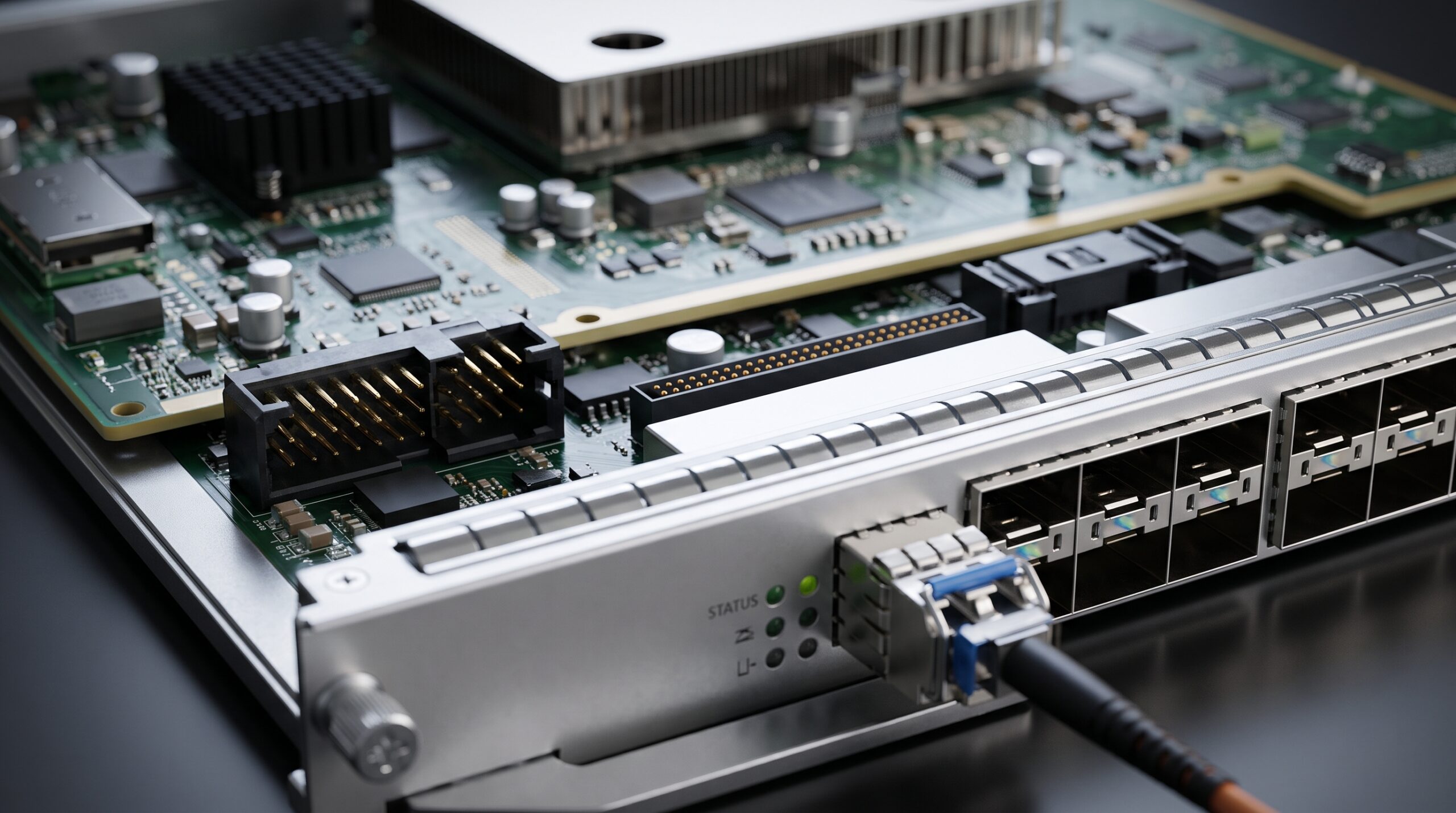
The S12700E forwarding fabric is anchored by the LST7SFUEX100 Switch Fabric Unit, a dedicated data plane module that provides high-speed, non-blocking data channels between all service modules installed in the chassis. Each SFU integrates three functional subsystems: a switching module responsible for the actual data plane forwarding, a local clock module that supplies working clocks to all on-board chips, and a power supply module for autonomous voltage regulation.
The switching capacity delivered by the fabric architecture scales with chassis size and SFU population. The S12700E-4 supports 952/2876 Tbps switching capacity with two SFU slots; the S12700E-8 reaches 1904/5752 Tbps with four SFU slots; and the S12700E-12 achieves 2856/8628 Tbps with four SFU slots. This capacity is distributed across all service slots in a non-blocking topology, meaning every line card can simultaneously operate at its maximum forwarding rate without head-of-line blocking.
The fabric employs cell-based switching rather than packet-based forwarding internally, a design choice that enables deterministic latency and eliminates internal buffering inefficiencies. Load balancing across multiple SFUs occurs automatically: when a chassis is equipped with multiple fabric units, traffic is forwarded simultaneously across all active SFUs. Should one SFU fail, its traffic is redistributed to the remaining units.
Each SFU carries 1 GB of memory and 128 MB of flash storage, with full hot-swapping capability. An OFL (Offline) button on the SFU front panel allows administrators to isolate the module from the active fabric before physical removal, ensuring service continuity during maintenance operations.
POWER & THERMAL MECHANISMS
The forwarding fabric operates within a chassis-level power and cooling envelope designed for continuous carrier-grade operation. Power delivery to each SFU is handled by the module’s integrated power supply, which conditions and regulates voltage independently of the chassis power distribution.
Thermal management follows a left-side and front-to-rear airflow pattern, with fans operating under automatic speed control based on real-time temperature telemetry. This airflow design accommodates standard data center rack configurations with cold-aisle intake, and the automatic fan adjustment minimizes acoustic output and power consumption under partial load conditions.
Maximum chassis power consumption varies by model: 3344 W for the S12700E-4, 6950 W for the S12700E-8, and 8981 W for the S12700E-12. These figures reflect fully populated configurations with all service slots and fabric units operational.
PHYSICAL LIMITS
The S12700E platform is offered in three chassis form factors, each defining the physical envelope within which the forwarding fabric operates.
S12700E-4: 10U height, dimensions 442 mm (W) × 517.4 mm (D) × 441.7 mm (H), four service slots, two SFU slots, supporting up to 192 × 10GE, 160 × 25GE, 96 × 40GE, or 96 × 100GE ports.
S12700E-8: 15U height, dimensions 442 mm (W) × 517.4 mm (D) × 663.95 mm (H), eight service slots, four SFU slots, supporting up to 384 × 10GE, 320 × 25GE, 192 × 40GE, or 192 × 100GE ports.
S12700E-12: 19U height, dimensions 442 mm (W) × 517.4 mm (D) × 841.75 mm (H), twelve service slots, four SFU slots, supporting up to 576 × 10GE, 480 × 25GE, 288 × 40GE, or 288 × 100GE ports.
All chassis share a common service slot architecture capable of housing the same line card portfolio, providing deployment flexibility across different scale requirements. The SFU slots are physically distinct from service slots, reflecting the architectural separation of control and data planes.
PARAMETER REGISTRY
The following table summarizes the core forwarding fabric specifications across all S12700E chassis models.
| Parameter | Specification |
|---|---|
| Chassis Models | S12700E-4 / S12700E-8 / S12700E-12 |
| Form Factor | 10U / 15U / 19U |
| Switching Capacity | 952/2876 Tbps (S12700E-4); 1904/5752 Tbps (S12700E-8); 2856/8628 Tbps (S12700E-12) |
| SFU Model | LST7SFUEX100 (Switch Fabric Unit E, X1) |
| SFU Memory / Flash | 1 GB / 128 MB |
| Redundancy | N+1 hot standby; automatic traffic redistribution on failure |
| Hot Swapping | Supported (with OFL button isolation procedure) |
| Power Supply | Module-level integrated regulation within chassis power envelope |
| Cooling | Left-side and front-to-rear airflow; automatic fan speed adjustment |
| Max Power Consumption | 3344 W (S12700E-4); 6950 W (S12700E-8); 8981 W (S12700E-12) |
GLOBAL SUPPORT INFRASTRUCTURE
The S12700E forwarding fabric is engineered for continuous operation across geographically distributed deployments. Each SFU supports N+1 hot standby redundancy: in a configuration with multiple SFUs, the failure of any single unit triggers automatic traffic redistribution to the remaining operational fabric modules.
Fabric units are hot-swappable, enabling replacement without powering down the chassis or interrupting service on unaffected paths. The offline button procedure ensures that maintenance personnel can safely isolate a unit from the active data plane before physical removal. The RUN/ALM indicator provides visual confirmation of operational status: slow green blinking indicates normal operation, steady red signals a fault condition requiring intervention, and steady yellow indicates the module is powered off.
Software compatibility spans multiple major release trains. The LST7SFUEX100 is supported in V200R019C00 and later versions on S12700E-4 and S12700E-8 chassis, with specific patch and mod file requirements documented for boards manufactured after June 2021. The S12700E-12 chassis supports the fabric unit from V200R019C00 onward.
All SFUs within a single chassis must be the same model. Mixing different fabric unit variants within one chassis is not supported, ensuring consistent forwarding behavior and predictable performance characteristics across the data plane.
📥 Download Technical Specification
Click the button below to view or download the full official PDF datasheet.

Leave a comment