
Ultra-Low Latency Demands in Modern Telecom Core
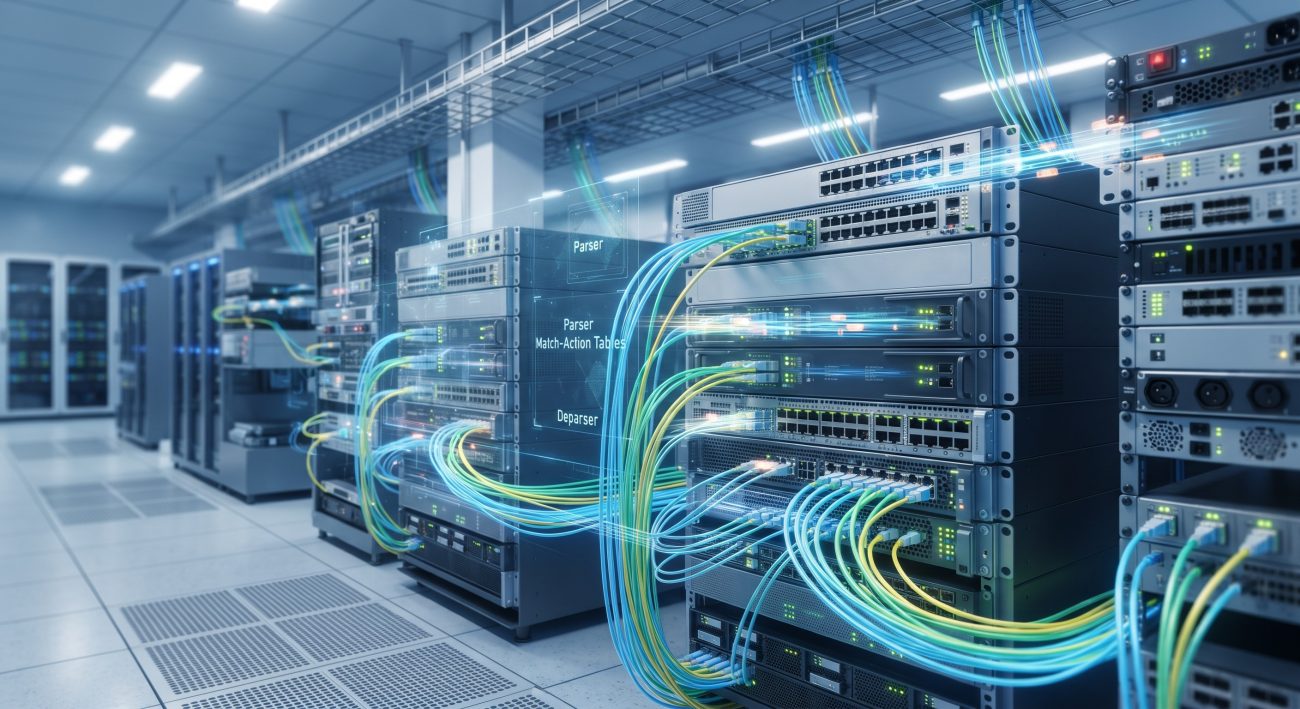
The modern carrier-grade network core is under unprecedented pressure. With the proliferation of 5G user plane functions, AI/ML workload distribution, and financial trading infrastructure, the tolerance for packet forwarding jitter has collapsed from microseconds to nanoseconds. Legacy fixed-function switching ASICs, while reliable, enforce a rigid forwarding pipeline that often introduces unnecessary recirculation latency and limits the ability to implement custom telemetry or security logic inline. Programmable Switch Pipelines via P4 Domain Languages represent the architectural answer to this constraint, allowing network architects to define the parser, match-action tables, and deparser logic directly in silicon .
This analysis dissects the packet pipeline of P4-programmable switching silicon, quantifies the latency envelope under production-representative workloads, and evaluates the operational limits of deploying this technology in latency-sensitive telecom environments. The focus is strictly on the data plane execution efficiency, the impact of match-action stage depth on forwarding latency, and the trade-offs between programmability and deterministic performance.

ASIC Packet Forwarding Pipeline: From Parser to Deparser
The PISA Architecture and Latency Attribution
At the heart of every P4-capable switch lies a Protocol Independent Switch Architecture (PISA) or a derivative thereof. Unlike fixed-function ASICs that hardwire specific protocol parsing and forwarding behavior, a PISA pipeline consists of a programmable parser, a series of match-action stages (often called MAUs or Match-Action Units), and a programmable deparser . The latency contribution of each component is distinct and must be understood before deploying latency-critical services.
The parser is implemented as a finite state machine that extracts header fields based on the P4 program. On first-generation programmable silicon such as the Intel Tofino (6.5 Tb/s), the parser was limited in the number of states and transitions, which directly impacted the achievable header depth and protocol complexity . In latency terms, a deeper parse graph translates to additional clock cycles. For standard IPv4/IPv6 and MPLS forwarding, the parser latency remains negligible (sub-20 ns). However, when implementing custom encapsulations for Segment Routing over IPv6 (SRv6) or in-band network telemetry (INT), the parser state count becomes a measurable contributor to the total forwarding latency.
The match-action pipeline is where the majority of the forwarding latency budget is consumed. Each MAU stage executes a lookup (exact match, ternary, or longest prefix match) and applies an associated action. The number of stages required by a P4 program directly correlates with latency: a program requiring 12 stages will exhibit higher latency than one requiring 6 stages, all else being equal. In production deployments, this creates a fundamental tension between feature richness (more stages for ACLs, telemetry, and encapsulation) and raw forwarding speed.
Recirculation and Its Latency Penalty
A critical latency factor often overlooked in marketing specifications is recirculation. When a packet requires processing that exceeds the available pipeline stages in a single pass—such as complex MPLS network actions or multi-level tunnel decapsulation—the switch must recirculate the packet from egress back to ingress. Each recirculation loop adds a full pipeline traversal latency and consumes internal bandwidth. Recent architectural improvements in next-generation programmable silicon, such as the X2 from Xsight Labs, explicitly target this penalty by removing the recirculation overhead common in serial P4 pipelines through a parallel execution model . For latency-sensitive telecom applications, the ability to execute complex forwarding logic in a single pass is often more valuable than raw throughput.
| Key Parameter | Technical Specification |
|---|---|
| Switching Capacity (Tofino-class) | 6.5 Tb/s per ASIC, 4×1.6 Tb/s pipelines |
| Switching Capacity (Next-Gen) | 12.8 Tb/s, 4×3.2 Tb/s pipelines |
| Forwarding Latency (L2/L3 + ECMP) | 350–450 ns (Tofino), |
| Port Density (Typical) | 65×100GE / 130×50GE / 260×25GE |
| Programmable Parser Depth | Up to 32 states (varies by silicon generation) |
| Match-Action Stages | 12–16 ingress, 2–4 egress (typical) |
| Packet Buffer | Single shared buffer, typically 20–130 MB |
| IPv4 Route Capacity | Up to 1.3 million routes (Tofino) |
| Recirculation Support | Yes (legacy); minimized/eliminated in parallel architectures |
| Telemetry Capability | Native INT, P4Runtime-driven |
Performance Metrics Matrix: Quantified Latency and Throughput
The following data synthesizes published specifications and empirical benchmarks from production deployments and academic evaluations of P4-programmable switching platforms. These figures represent the practical envelope for carrier-grade deployment.
For the widely deployed Tofino-class silicon (6.5 Tb/s), the total packet latency through the pipeline with standard L2/L3 forwarding and ECMP typically measures in the range of 350 to 450 nanoseconds under zero-load conditions. Under realistic load with competing traffic and table occupancy above 70%, latency can increase by 15–25% due to memory contention and arbitration delays. Throughput remains at line-rate (6.5 Tb/s) regardless of table occupancy for well-optimized P4 programs, provided the program fits within the allocated stage resources.
Next-generation platforms targeting the post-Tofino market (such as the 12.8 Tb/s X2) demonstrate sub-600 ns latency with full IP routing and ECMP enabled across four 3.2 Tb/s pipelines . The critical differentiator is the ability to maintain this latency profile while executing custom P4 logic for telemetry or security enforcement that would require recirculation on earlier architectures.
It is essential to note that these figures assume cut-through forwarding is enabled where supported. Store-and-forward mode, while necessary for certain integrity checks and multi-stage processing, introduces additional buffer latency proportional to packet size (approximately 1.2 µs for a 1500-byte packet at 10 Gbps). For ultra-low latency trading or 5G URLLC applications, cut-through operation with a minimal P4 program is mandatory.
Traffic Shaping and Low-Latency Topologies
In-Network Telemetry for Latency Visibility
Programmable pipelines enable a capability that fixed-function switches cannot provide: line-rate, per-packet telemetry without sampling. Using P4, operators can embed timestamp and queue-depth metadata directly into packets as they traverse the switch fabric, enabling end-to-end latency attribution at nanosecond granularity. Research implementations such as P4InfoSen-INT have demonstrated prioritized INT encoding that captures queue time, bandwidth, and port information within the P4 pipeline itself, with minimal impact on forwarding latency .
For telecom operators, this telemetry is not merely diagnostic; it is operational. When SLA commitments specify sub-millisecond round-trip latency for enterprise VPN services, the ability to identify the exact switch and queue contributing to a latency violation is the difference between rapid remediation and prolonged SLA breach.
Topological Considerations for Deterministic Latency
Deploying P4-programmable switches in latency-critical topologies requires specific architectural discipline. The spine-leaf model, while standard in data centers, is not inherently optimized for latency determinism. For telecom core and edge applications, a collapsed spine or direct interconnect topology reduces the number of switching hops between endpoints, thereby reducing cumulative queuing and forwarding latency.
Furthermore, the placement of P4 enforcement points matters. Placing programmable switches at the network edge—where traffic enters the carrier domain—allows for early application of QoS marking, security ACLs, and telemetry insertion before traffic traverses the core. This “programmable edge, deterministic core” model leverages the flexibility of P4 where it is most needed while preserving the low-latency simplicity of the core fabric.
Verdict: Balancing Programmability Against Determinism
The packet pipeline analysis of Programmable Switch Pipelines via P4 Domain Languages reveals a maturing technology that has moved beyond academic curiosity into production-grade telecom infrastructure. The latency numbers—sub-500 ns for Tofino-class silicon and approaching sub-400 ns for next-generation platforms—are competitive with fixed-function alternatives when the P4 program is optimized for stage efficiency and recirculation is minimized .
However, the operational verdict must be nuanced. Programmability introduces variability: a poorly written P4 program can consume excessive stages, trigger recirculation, and erode the latency advantages of the hardware. Network architects must treat P4 pipeline design with the same rigor as ASIC resource planning, establishing clear stage budgets and latency SLAs for each forwarding function. For telecom operators evaluating migration from legacy fixed-function hardware, the decision should hinge on whether the operational value of custom telemetry, inline security enforcement, or protocol extensions justifies the engineering investment in P4 pipeline optimization. In latency-sensitive core routing, the answer is increasingly yes—provided the pipeline is engineered with the same precision as the silicon it runs on.
Leave a comment