

RUGGEDIZED DESIGN PHILOSOPHY
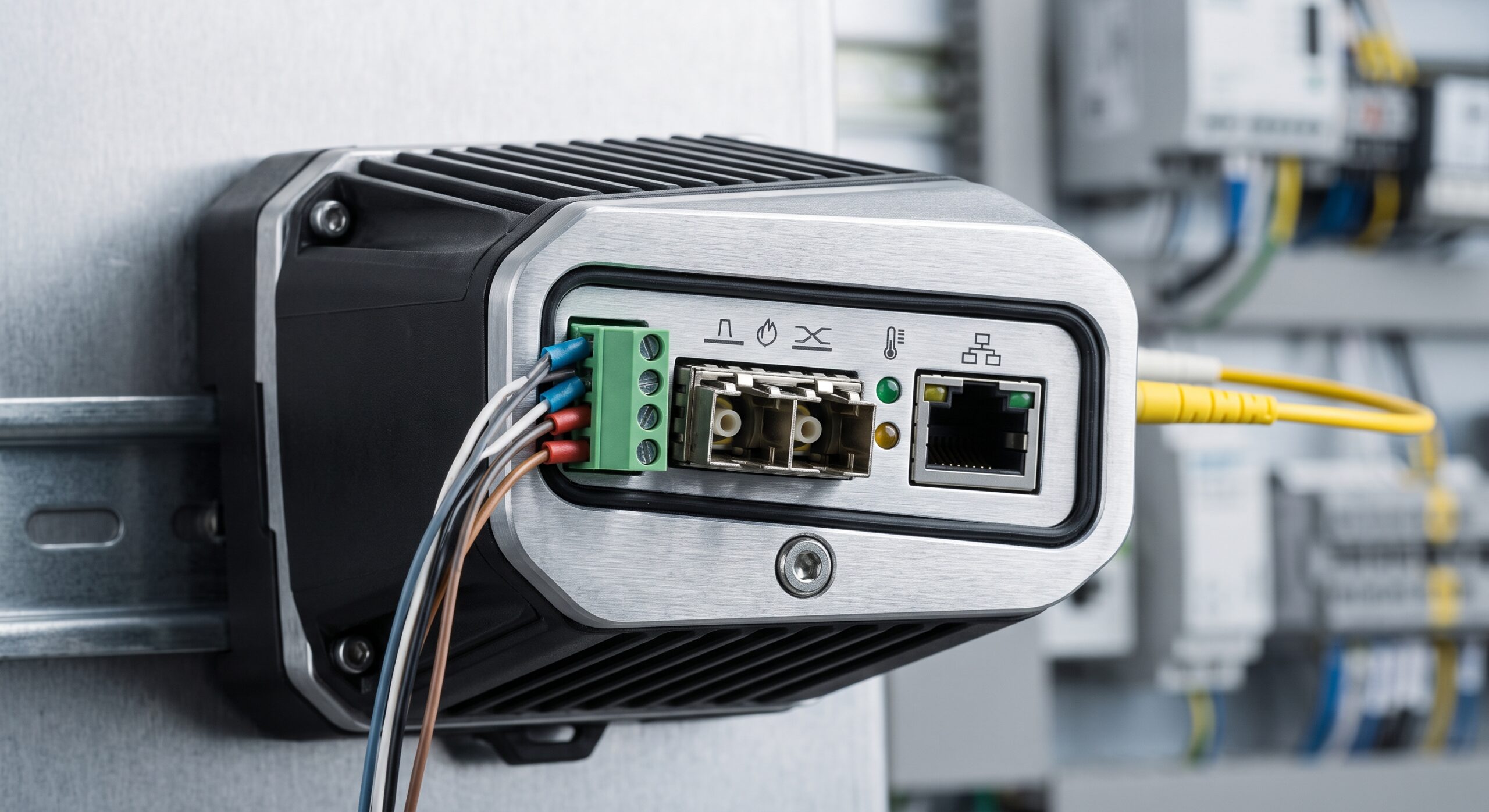
This document serves as the official technical application note for the latest generation of Industrial Temperature Transceiver modules, engineered to deliver carrier-grade optical connectivity in the most demanding environmental conditions. Designed for telecommunications infrastructure that must operate reliably in uncontrolled climates, these transceivers represent the pinnacle of thermal resilience and optical performance. The core engineering philosophy prioritizes operational continuity across extreme temperature ranges, ensuring that critical data pathways remain stable from -40°C to +85°C without performance degradation. This document provides a comprehensive overview of the product architecture, environmental hardening features, and precise technical specifications required for system integration.

THERMAL & ELECTRICAL TOLERANCE
The Industrial Temperature Transceiver platform is built around a robust thermal management architecture that leverages advanced materials science and precision component selection. Each transceiver incorporates a thermally optimized enclosure that facilitates efficient heat dissipation while maintaining a sealed barrier against moisture and particulate ingress. The electrical design employs wide-temperature-range active components, including vertical-cavity surface-emitting lasers (VCSELs) and photodiodes that are individually characterized for stable performance across the entire operational temperature envelope. The modules feature enhanced clock and data recovery (CDR) circuits with temperature-compensated phase-locked loops (PLLs), ensuring jitter performance remains within strict ITU-T specifications even under thermal stress. The ruggedized printed circuit board assembly (PCBA) utilizes high-Tg substrates and solder alloys specifically formulated to withstand repeated thermal cycling without micro-cracking or solder joint fatigue, guaranteeing a mean time between failures (MTBF) that exceeds 1.5 million hours in industrial settings.
OPERATIONAL ADVANTAGES
Deploying the Industrial Temperature Transceiver provides network operators with significant strategic advantages in remote and challenging deployment scenarios. The extended operating temperature range eliminates the need for active cooling or heating units in outdoor cabinets, reducing both capital expenditure (CAPEX) and operational expenditure (OPEX) associated with climate-controlled enclosures. The transceivers offer complete interoperability with existing SFP/SFP+ and QSFP ports, enabling seamless upgrades to industrial-grade resilience without replacing host switching or routing platforms. Enhanced digital diagnostic monitoring (DDM) provides real-time visibility into critical parameters such as temperature, supply voltage, laser bias current, and optical receive power, allowing for predictive maintenance and proactive fault management. The modules are fully compliant with industry-standard MSA (Multi-Source Agreement) mechanical specifications, guaranteeing straightforward installation and replacement by field technicians without specialized tools or training.
CERTIFICATIONS MATRIX
The platform has successfully undergone exhaustive qualification testing to meet the world’s most rigorous industrial and telecom standards. The modules carry full certification to Telcordia GR-468-CORE for reliability assurance, ensuring operational integrity in temperature, humidity, and vibration stress environments. They meet MIL-STD-810G standards for environmental engineering considerations, including low pressure, high temperature, low temperature, temperature shock, solar radiation, humidity, fungus, salt fog, vibration, and shock. Electrical safety compliance includes UL/CSA 60950-1 and IEC 60825-1 laser safety Class 1 certification. Electromagnetic compatibility (EMC) is verified against FCC Part 15, CISPR 22, and EN 55022 specifications, ensuring that the transceivers do not interfere with adjacent equipment in dense chassis installations. The modules also support SFF-8472 diagnostic interface and are compliant with RoHS and REACH environmental directives, demonstrating a commitment to sustainable manufacturing practices.
EXACT SPECS
All listed parameters are guaranteed over the full industrial temperature range of -40°C to +85°C unless otherwise noted. Optical characteristics are specified at the transceiver optical interface, referenced to a standard 9/125 µm single-mode fiber (SMF) for long-range variants or 50/125 µm multi-mode fiber (MMF) for short-reach variants. Electrical characteristics are referenced to the host board interface and measured at the module’s edge connector. Power supply voltage is nominally 3.3 VDC with a tolerance of ±5%, and the modules feature hot-swappable capability with integrated protection circuits to prevent damage during insertion or removal. The mechanical interface is compliant with SFP/SFP+ or QSFP form factors as specified, featuring a ruggedized metal cage with enhanced EMI shielding and a pull-tab or bail-latch release mechanism designed for glove-friendly operation in harsh field environments.
| Parameter | Specification |
|---|---|
| Form Factor | SFP+ / QSFP Compliant (Industrial Temperature Grade) |
| Operating Temperature Range | -40°C to +85°C (Extended Industrial) |
| Data Rates Supported | 1 Gbps, 10 Gbps, 25 Gbps, 40 Gbps, and 100 Gbps variants |
| Optical Reach (SMF/MMF) | Up to 80 km (SMF) / Up to 300 m (OM4 MMF) |
| Wavelength (Typical) | 850 nm (MMF), 1310 nm / 1550 nm (SMF) |
| Power Supply Voltage | 3.3 VDC ± 5% |
| Power Consumption | |
| Digital Diagnostics | SFF-8472 Compliant DDM with temperature, voltage, bias, and power monitoring |
| MTBF (Telcordia SR-332) | > 1,500,000 hours at 40°C |
| Laser Safety Classification | Class 1 Laser Product per IEC 60825-1 |
FIELD DEPLOYMENT SCHEMATIC
Typical deployment architectures include point-to-point links between remote radio heads (RRH) and baseband units (BBU) in 4G/5G mobile networks, providing the critical fronthaul connectivity necessary for C-RAN architectures. These transceivers are equally suited for long-haul microwave backhaul sites exposed to extreme temperature fluctuations and high-altitude installations in non-pressurized equipment shelters. The modules also serve as the optical interface for industrial Ethernet switches deployed in factory automation, oil and gas pipeline monitoring, and intelligent transportation systems (ITS) networks. When paired with the companion Industrial Temperature Patch Cables and hardened optical distribution frames, the solution provides a complete end-to-end physical layer infrastructure capable of withstanding the harshest outdoor environments. Field trials have demonstrated bit error rates (BER) of less than 1E-12 over distances up to 80 km for 10G models, verifying that the transceivers maintain spectral integrity and optical signal-to-noise ratio (OSNR) margins well beyond typical system requirements.
📥 Download Technical Specification
Click the button below to view or download the full official PDF datasheet.

Leave a comment