

EXECUTIVE SUMMARY
This document serves as the definitive technical reference for the Small Form-Factor Pluggable (SFP), Enhanced Small Form-Factor Pluggable (SFP+), and Quad Small Form-Factor Pluggable (QSFP) transceiver form factor standards. As the ubiquitous interface for high-speed data communication in enterprise, data center, and carrier-grade networks, these MSA-compliant standards define the mechanical, electrical, and thermal parameters necessary for seamless interoperability. This datasheet provides network architects, procurement specialists, and systems engineers with comprehensive specifications, compliance guidelines, and performance benchmarks for selecting the optimal optical and electrical interface solutions.

ARCHITECTURE & CHASSIS DESIGN
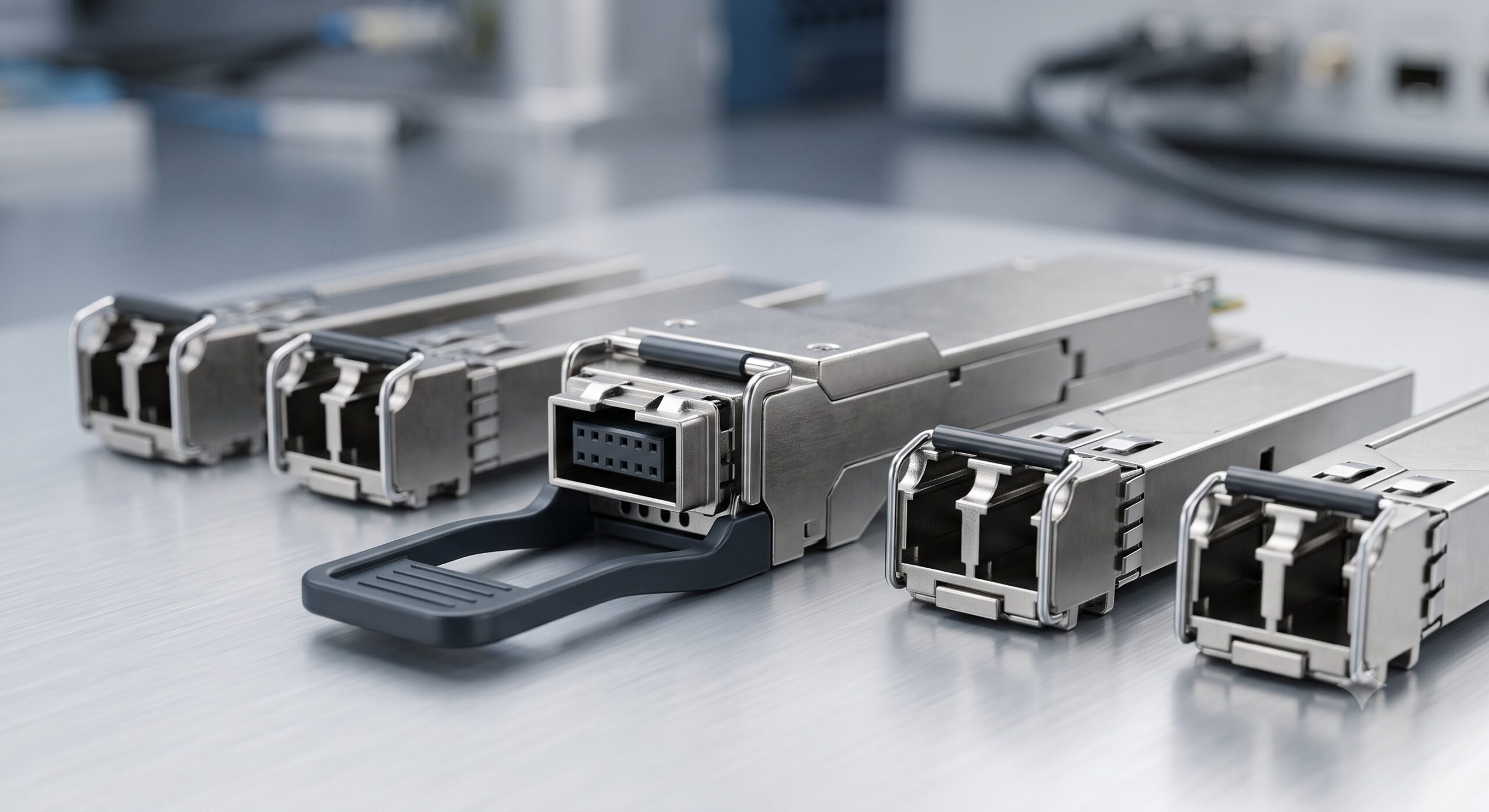
The architectural lineage of these pluggable interfaces is rooted in the need for modularity and serviceability in dense networking environments. The SFP standard, initially defined to replace larger GBIC modules, consolidated form factor requirements into a compact footprint of 13.4mm x 8.5mm x 56.5mm. The subsequent SFP+ standard evolved this architecture to support 10 Gbps line rates while maintaining backward compatibility with SFP mechanical cages. The QSFP standard expanded the form factor to accommodate four independent high-speed lanes, enabling 40 Gbps (QSFP) and 100 Gbps (QSFP28) aggregated throughput within a single module measuring 18.35mm x 8.5mm x 72.4mm.
Each standard employs a hot-swappable electrical interface with a 20-pin (SFP/SFP+) or 38-pin (QSFP) edge connector, implementing a serial EEPROM for system identification and diagnostic monitoring. The chassis design integrates a metallic cage with an electromagnetic interference (EMI) shield, a heat sink or thermal pad interface for heat dissipation, and a bail-latch or push-pull tab mechanism for secure module ejection.
HARDWARE FEATURES
Data Rate and Modulation Capabilities: The SFP standard supports data rates from 155 Mbps to 4 Gbps, utilizing NRZ modulation. SFP+ extends this to 8.5 Gbps and 10 Gbps, with support for 16 Gbps Fibre Channel in specific variants. QSFP modules support 4×1 Gbps, 4×10 Gbps, or 4×25 Gbps (QSFP28) lane configurations, depending on the version, employing NRZ or PAM4 modulation for 200/400 Gbps applications.
Diagnostic Interface: All standards incorporate a digital diagnostic monitoring (DDM) interface via the I2C bus. This provides real-time measurement of transceiver temperature, supply voltage, laser bias current, transmit optical power, and receive optical power, enabling predictive maintenance and link integrity assurance.
Connector Options: The optical interface utilizes duplex LC connectors for SFP/SFP+ and MPO/MTP multi-fiber connectors for QSFP, supporting both parallel and wavelength-division multiplexing (WDM) architectures.
COMPLIANCE & STANDARDS
Multi-Source Agreement (MSA) Compliance: All modules adhere to the SFF-8431 (SFP+) and SFF-8436/8665 (QSFP) specifications. These documents define the mechanical outline, host board electrical pad assignments, and module-to-host communication protocols.
IEEE Standards: The electrical interface conforms to IEEE 802.3 for Ethernet data rates (10GBASE-SR/LR/ER, 40GBASE-SR4/LR4, 100GBASE-SR4/LR4). Additionally, compliance with Fibre Channel (FC-PI-x) and InfiniBand standards ensures interoperability across storage and high-performance computing networks.
Electromagnetic Compatibility (EMC): Modules are fully RoHS compliant and meet FCC Class B, VCCI Class B, and CISPR 22 Class B emission standards.
TECHNICAL SPECIFICATIONS
Mechanical Dimensions: SFP/SFP+ modules measure 13.4 x 8.5 x 56.5 mm. QSFP modules measure 18.35 x 8.5 x 72.4 mm.
Environmental Operating Ranges: Commercial grade modules operate from 0°C to 70°C. Industrial grade modules are certified for -40°C to +85°C, designed for extreme outdoor and telecom central office deployments.
Power Consumption: Typical SFP modules draw under 1.0W. SFP+ modules draw up to 1.5W for long-reach ER variants. QSFP modules draw from 3.5W (SR4) to 6.0W (LR4) for 100G applications, with newer DSP-based QSFP-DD modules requiring up to 12W for 400G.
Reach and Optical Budget: Standardized over 11 optical interfaces (from 100m SR to 80km ZR), utilizing 850nm VCSEL, 1310nm FP/DFB, and 1550nm EML lasers.
| Parameter | Specification |
|---|---|
| Form Factor | SFP (13.4×8.5×56.5mm), SFP+ (13.4×8.5×56.5mm), QSFP (18.35×8.5×72.4mm) |
| Data Rates | SFP: 155 Mbps to 4 Gbps; SFP+: 8.5-10 Gbps; QSFP: 40-100 Gbps (4×10/4×25) |
| Connector Types | SFP/SFP+: Duplex LC; QSFP: MPO/MTP (12-fiber or 8-fiber) |
| Power Supply | SFP: 3.3V (max 1.0W); SFP+: 3.3V (max 1.5W); QSFP: 3.3V (max 6.0W) |
| Diagnostic Interface | I2C Serial EEPROM with Real-Time DDM (Temperature, Voltage, Current, Tx/Rx Power) |
| Operating Temp Range | Commercial: 0 to 70°C; Industrial: -40 to 85°C |
ORDERING OPTIONS
Product ID Nomenclature: Our product line utilizes a systematic coding convention: [Form Factor]-[Data Rate]-[Media Type]-[Reach]. For example, SFP-1G-LX-10 indicates a 1 Gbps SFP with 1310nm DFB for 10km on single-mode fiber.
Optical Transceivers: Available in standard (0-70°C) and extended (-40-85°C) temperature ranges. Additional options include bi-directional (BiDi) SFP/SFP+ modules utilizing a single fiber for full-duplex transmission, and CWDM/DWDM variants for wavelength division multiplexing.
Direct Attach Copper (DAC) Cables: Provided in passive and active configurations, ranging from 0.5m to 10m in length. These use twinax copper cabling for low-latency, low-power links within a rack.
Breakout Cables: QSFP to 4x SFP+ or 4x SFP28 breakout cables enable aggregated high-bandwidth connections to individual lower-speed ports.
📥 Download Technical Specification
Click the button below to view or download the full official PDF datasheet.

Leave a comment