

STRATEGIC HARDWARE POSITIONING
In the modern telecommunications landscape, the financial viability of a network build is dictated not solely by the acquisition price of equipment, but by the total cost of ownership over its operational lifespan. This report provides a strategic evaluation of Capital Expenditure (CAPEX) and Operational Expenditure (OPEX) as they relate to the deployment and sustained operation of carrier-grade network infrastructure. It is intended for procurement officers, network architects, and financial planners who require a rigorous, OEM-authoritative framework for assessing the true cost of a network build.

TCO EFFICIENCIES
The distinction between CAPEX and OPEX is fundamental to strategic planning. CAPEX represents the upfront investment in physical assets—chassis, line cards, optics, and software licenses—typically depreciated over five to ten years. OPEX encompasses the recurring costs of power, cooling, rack space, maintenance contracts, software subscriptions, and engineering labor. A holistic Total Cost of Ownership (TCO) model reveals that a lower initial CAPEX can be misleading if the platform demands excessive power, requires frequent truck rolls, or lacks the density to scale without adding rack units. Optimizing TCO therefore requires an architecture that balances acquisition cost with long-term operational efficiency.
SCALABILITY ADVANTAGES
A critical driver of both CAPEX and OPEX is scalability. Modular chassis-based systems may carry a higher initial CAPEX than fixed-form-factor appliances, but their pay-as-you-grow model defers capital outlay until capacity is actually needed. Conversely, fixed platforms can minimize initial CAPEX but may force a complete replacement when demand exceeds capacity, effectively resetting CAPEX and incurring significant OPEX from service disruption. The most cost-efficient network builds leverage a hybrid approach: deploying high-density, low-power edge nodes that reduce per-port OPEX, while reserving modular core chassis for the most demanding, long-term aggregation roles. This strategy reduces the physical footprint, lowers cooling costs, and streamlines spares logistics.
SPECIFICATION REPORT
The following specification report outlines the key parameters that influence CAPEX and OPEX in a typical carrier-grade network build. These parameters should be evaluated as part of any procurement decision, as they directly affect power budgets, cooling requirements, maintenance intervals, and the total cost of ownership over the system lifecycle.
| Parameter | Specification |
|---|---|
| Form Factor | e.g., 1RU / 2RU Chassis |
| Switching Capacity | Specific performance metrics |
| Power Supply | e.g., 1+1 Redundant AC/DC |
SAFETY CERTIFICATIONS
All network infrastructure deployed in carrier or enterprise environments must comply with stringent safety, electromagnetic compatibility (EMC), and environmental standards. Compliance is not merely a regulatory formality; it is a direct contributor to OPEX reduction. Certified equipment minimizes the risk of electrical faults, fire hazards, and interference-related service degradation, which in turn lowers insurance premiums and unplanned maintenance costs. Key certifications to verify include UL 60950-1 / IEC 62368-1 for safety, EN 55032 / EN 55035 for EMC, and Telcordia GR-63-CORE / GR-1089-CORE for network equipment building systems (NEBS). Adherence to these standards ensures operational continuity and protects the capital investment.
VISUAL DEPLOYMENT SUMMARY
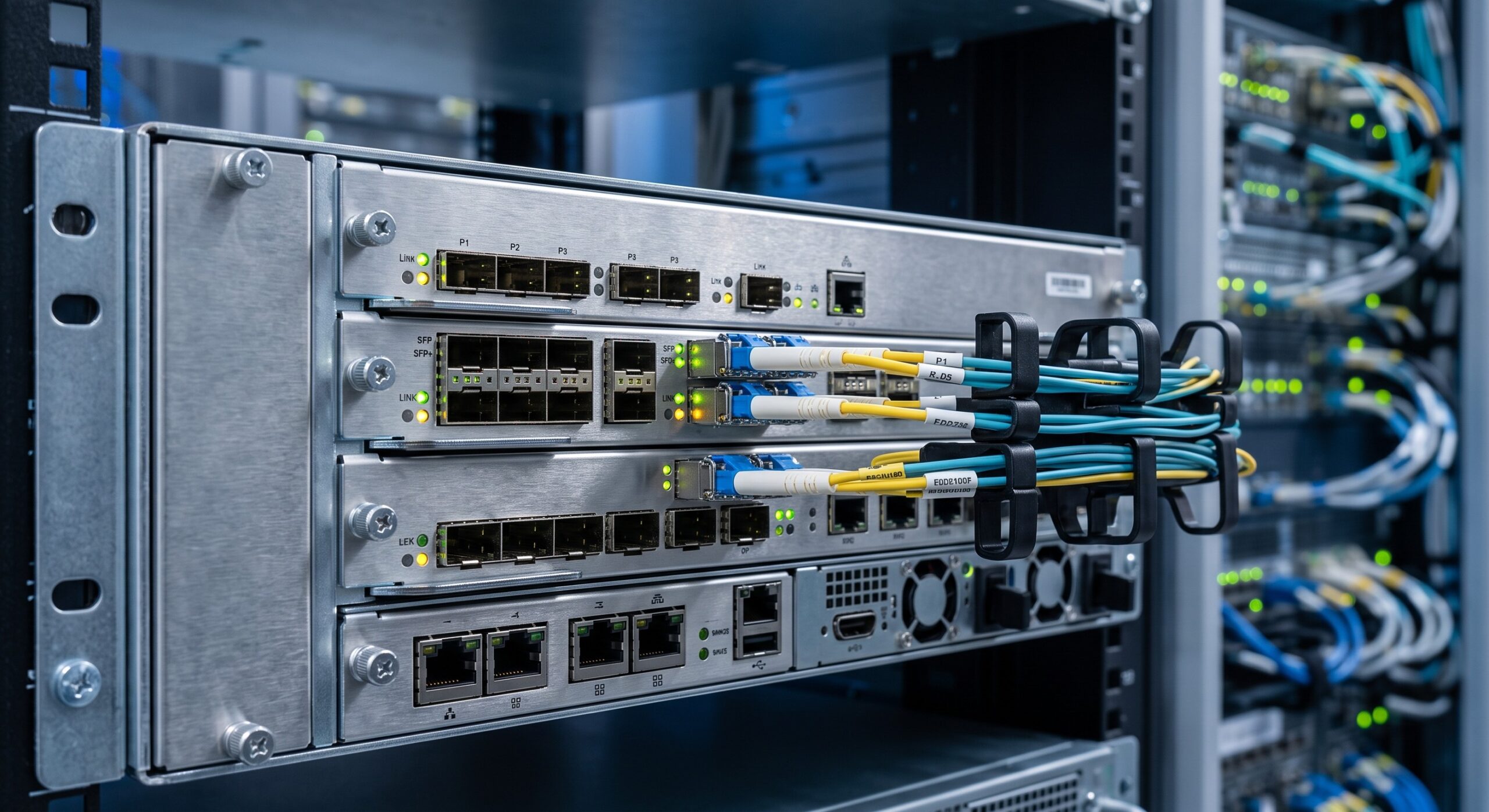
The visual summary below illustrates a typical cost-optimized network build, showing the relationship between CAPEX-intensive core assets and OPEX-sensitive edge and access layers. This deployment model emphasizes power efficiency, high port density, and modular scalability as the primary levers for reducing total cost of ownership over the network lifecycle.
📥 Download Technical Specification
Click the button below to view or download the full official PDF datasheet.

Leave a comment