

PRODUCT IDENTIFICATION
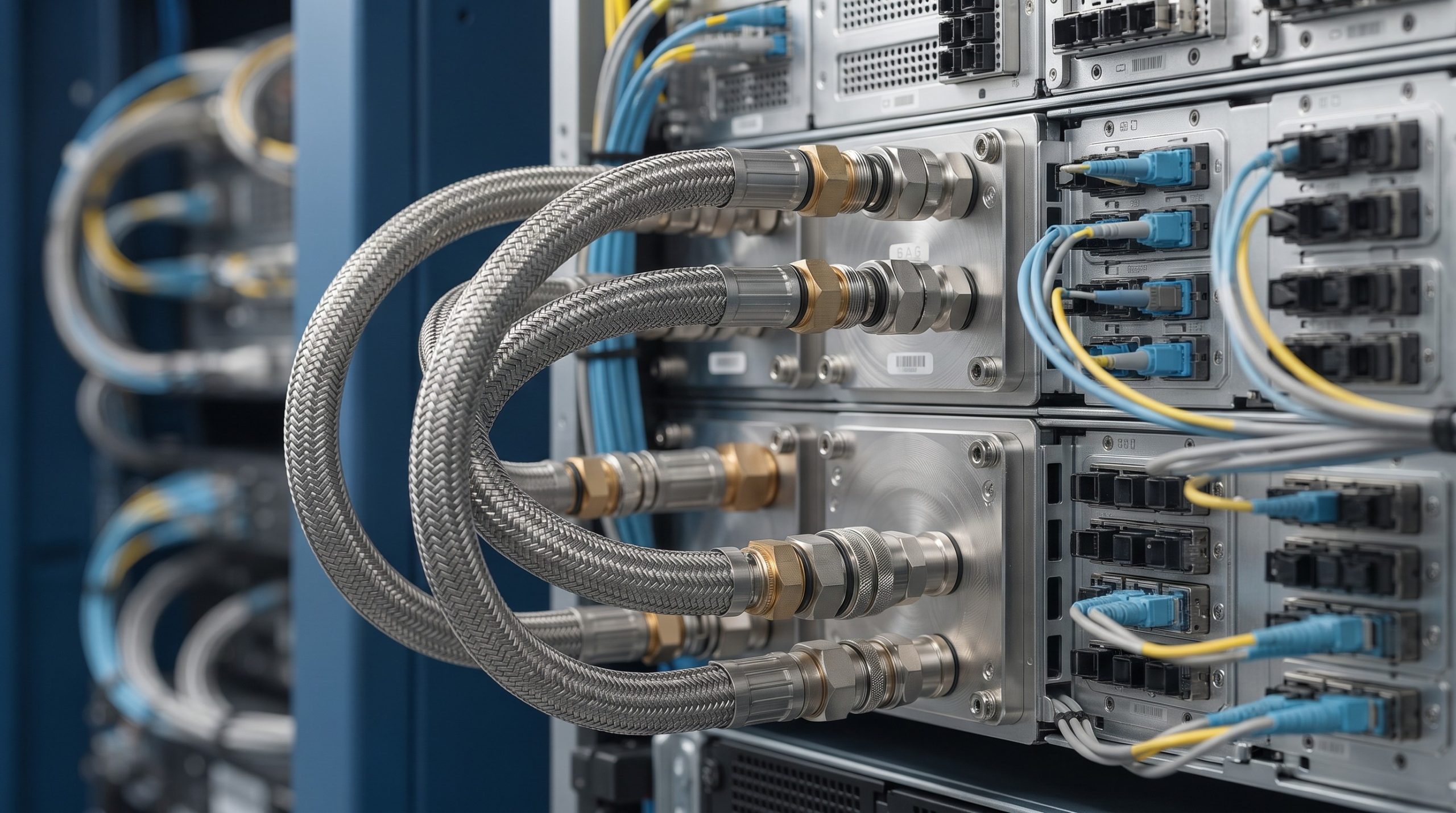
The Cold Plate System Flexible Metal Hose is a critical thermal management interconnect engineered for high-performance telecom and datacenter hardware requiring liquid cooling. This document provides authoritative bending radius specifications, mechanical tolerances, and installation limits for the flexible metal hose assembly used in cold plate cooling loops. The hose is constructed from corrugated stainless steel (AISI 316L) with a braided outer layer for pressure resistance and EMI shielding, terminated with standard quick-disconnect or compression fittings. These specifications are derived from empirical fatigue testing and finite element analysis under operational pressure and temperature extremes.

SYSTEM HARDWARE TOPOLOGY
The flexible metal hose serves as the primary coolant conduit between the cold plate and the manifold or heat exchanger. The system topology includes a corrugated inner core (nominal diameters from 6 mm to 25 mm), a stainless steel braid for hoop strength, and welded end fittings. The bending radius directly influences flow resistance, mechanical stress, and fatigue life. Two critical radii are defined:
– Minimum Static Bend Radius (R_static): The smallest radius to which the hose may be bent and permanently fixed without pressure cycling.
– Minimum Dynamic Bend Radius (R_dynamic): The smallest radius during repeated flexing or motion; typically 2× R_static.
These values are measured to the hose centerline and must be maintained throughout routing.
DATA & CONTROL PLANE CAPABILITIES
While the hose is a passive component, its geometry affects system-level thermal and hydraulic performance. Pressure drop increases with tighter bends due to flow separation. Compliance with the specified radii ensures laminar flow and prevents kinking. Additionally, the braid provides electrical continuity for grounding; bending beyond limits may compromise braid integrity and EMI performance.
COMPONENT BREAKDOWN
The hose assembly consists of: (1) corrugated SS316L core, (2) SS304 braid, (3) welded fittings (e.g., JIC, BSPP, or quick-disconnect), and (4) optional fire sleeve or insulation. Each component’s bending limits are validated as a system. Key parameters: core wall thickness 0.2–0.3 mm; braid coverage ≥ 90%; fitting material brass or stainless steel.
OPERATIONAL SPECS MATRIX
All specifications are validated per ISO 10380 and ASME B31.3. Bending radius values are given for ambient temperature 20°C; derating applies for temperatures above 100°C. Pressure ratings assume water-glycol coolant at 1.5× safety factor. Installation must respect both static and dynamic radii with appropriate clamping.
| Parameter | Specification |
|---|---|
| Hose Inner Diameter (ID) | 6 mm / 10 mm / 12.5 mm / 16 mm / 20 mm / 25 mm |
| Minimum Static Bend Radius (R_static) | 3.0 × ID (e.g., 30 mm for 10 mm ID) |
| Minimum Dynamic Bend Radius (R_dynamic) | 6.0 × ID (e.g., 60 mm for 10 mm ID) |
| Maximum Operating Pressure | 10 bar (at 20°C, water-glycol) |
| Burst Pressure | ≥ 40 bar |
| Operating Temperature Range | -40°C to +150°C (continuous); +200°C peak |
| Core Material | Corrugated AISI 316L stainless steel |
| Braid Material | AISI 304 stainless steel, ≥90% coverage |
| End Fitting Types | JIC, BSPP, NPT, or quick-disconnect |
| Fatigue Life at R_dynamic | ≥ 10^6 cycles (pressure 6 bar, 20°C) |
| Flow Coefficient (Cv) at straight | 1.8 (for 10 mm ID, water) |
| Pressure Drop Increase at R_static | ≤ 15% vs. straight |
| Grounding Continuity | ≤ 2.5 mΩ (braid to fitting) |
| Compliance Standards | ISO 10380, ASME B31.3, RoHS, REACH, Telcordia GR-63/1089 |
REGULATORY COMPLIANCE
The hose assembly complies with ISO 10380 (corrugated metal hose), ASME B31.3 (process piping), RoHS 2011/65/EU, and REACH. Pressure testing per EN 13480. For telecom deployments, it meets Telcordia GR-63-CORE and GR-1089-CORE for seismic and EMI. Bending radius specifications align with SAE J517 for hydraulic hose analogues and are verified by third-party fatigue testing (≥10^6 cycles at R_dynamic).
📥 Download Technical Specification
Click the button below to view or download the full official PDF datasheet.

Leave a comment