
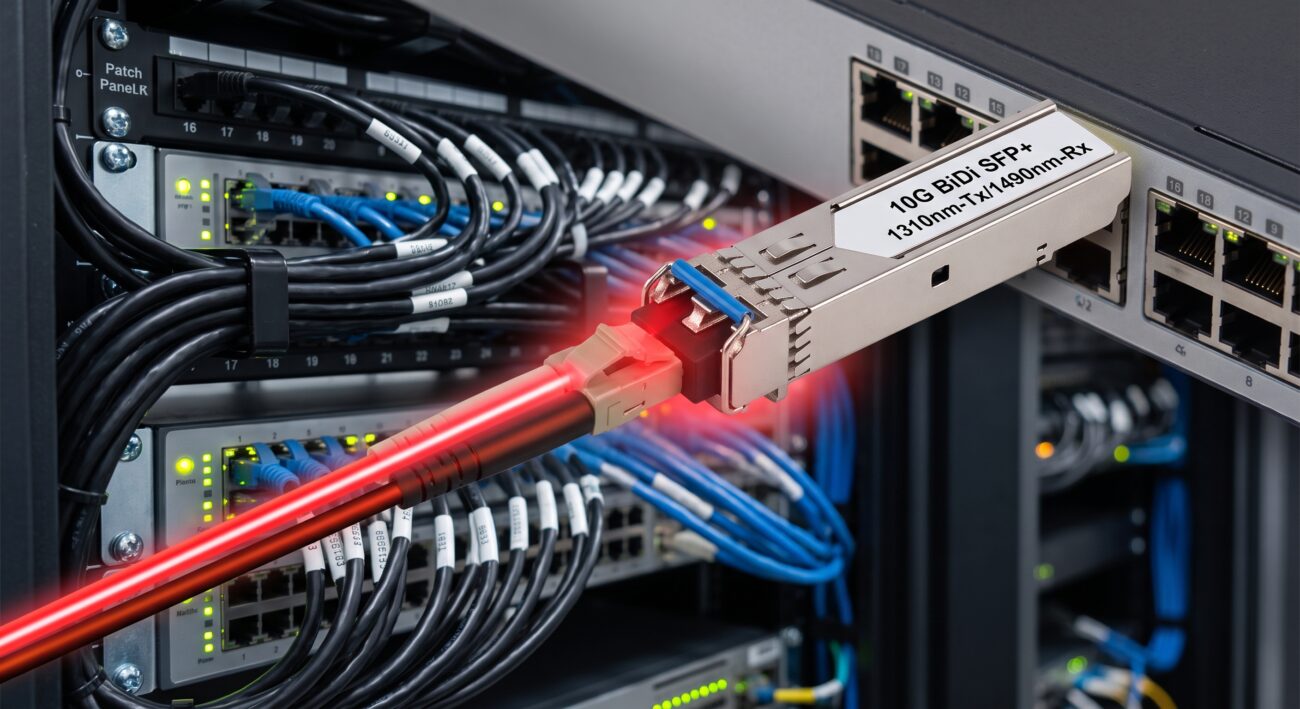
Introduction: The Bi-Directional Imperative in Modern Fiber Networks
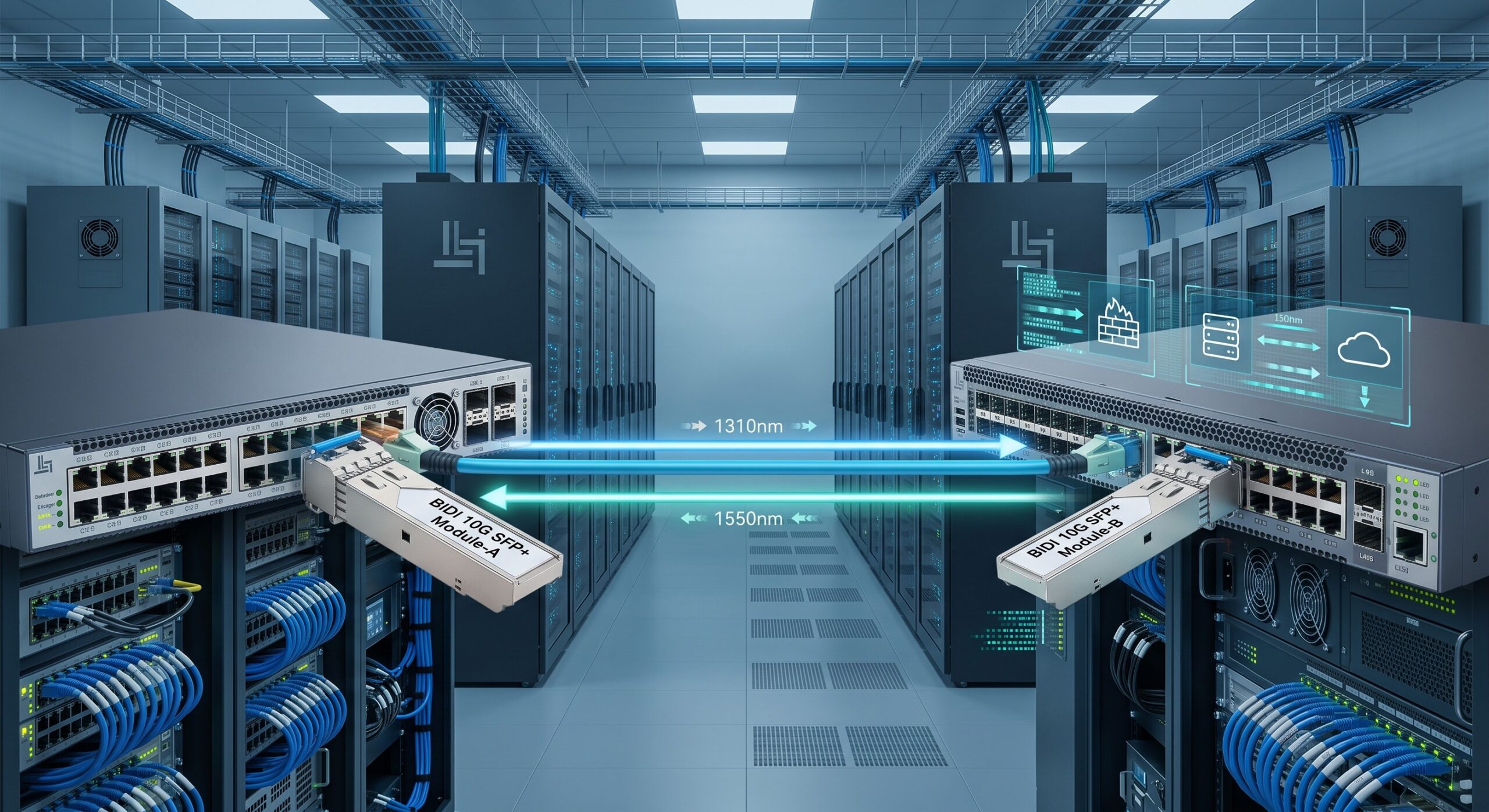
In the race to double fiber infrastructure capacity without laying new cable, BIDI optical transceivers have emerged as the definitive solution for carriers and enterprises. By leveraging Wavelength Division Multiplexing (WDM) technology, these modules transmit and receive data on two different wavelengths over a single fiber strand, effectively halving fiber usage and optimizing optical infrastructure ROI. This guide provides a deep architectural analysis, performance benchmarks, and deployment blueprints for BIDI transceivers, tailored for network architects and systems integrators.
Core Architecture: The Physics of Bi-Directional Transmission
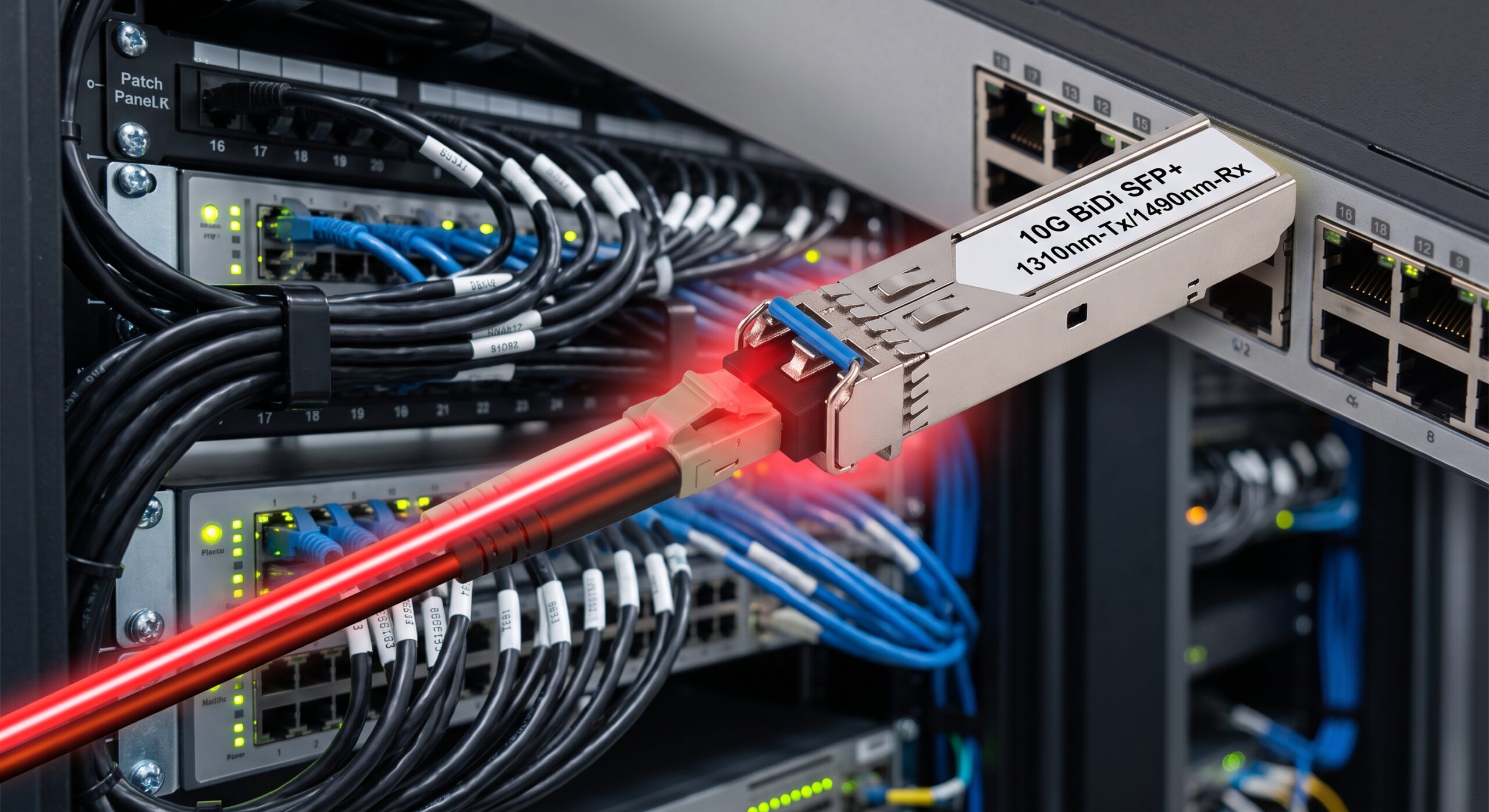
Unlike standard dual-fiber transceivers that use separate fibers for TX and RX, the BIDI module integrates a WDM filter and a precisely angled optical block assembly within the OSFP or SFP+ form factor. The filter acts as an optical diplexer, separating the 1310 nm and 1550 nm wavelengths (or 1270/1330 nm for CWDM variants) at the receiver while combining them at the transmitter. This design hinges on the use of a Fabry-Pérot or Distributed Feedback (DFB) laser for the longer wavelength path and a VCSEL or FP laser for the shorter wavelength, ensuring minimal crosstalk and insertion loss (Microcontroller Unit (MCU) continuously monitors critical Digital Diagnostic Monitoring (DDM) parameters—including temperature, supply voltage, bias current, TX power, and RX power—to comply with SFF-8472 management interface standards.
Wavelength Allocation and Channel Spacing
The selection of wavelength pairs is dictated by the ITU-T G.694.2 standard for CWDM and G.652 for standard single-mode fiber. Common pairings include 1310 nm (TX) / 1550 nm (RX) for distances up to 10 km, and 1490 nm (TX) / 1550 nm (RX) for 20 km and 40 km links. Advanced variants utilize Coarse WDM (CWDM) grids with 20 nm spacing to support up to 18 channels across the 1270 nm to 1610 nm range. The optical path isolation is critical; high-quality modules achieve > 30 dB isolation between transmit and receive paths to ensure bit error rates (BER) remain below the standard 1E-12 threshold.
| Key Parameter | Technical Specification | Typical Value |
|---|---|---|
| Data Rate | 10G/25G/40G/100G Ethernet | 10.3125 Gbps (10G) / 25.78125 Gbps (25G) |
| Transmit Wavelength (nm) | TX/RX Pair (ITU-T G.694.2) | 1310 / 1550 (10km); 1490 / 1550 (40km) |
| Receiver Sensitivity (dBm) | IEEE 802.3ae / 802.3bs | -14.4 to -21.0 (at BER 1E-12) |
| Optical Budget (dB) | Link Power Budget | 10.5 (10km) / 18.0 (40km) |
| MTBF (Hours) | Telcordia GR-468-CORE | 1,500,000 Hours |
| Case Temperature Range | Commercial / Industrial | 0°C to 70°C / -40°C to 85°C |
| Power Consumption (W) | Per Module @ 3.3V | 1.0 (10G SFP+) / 3.5 (100G QSFP28) |
| FEC Requirement | Pre-FEC BER Threshold | 1E-5 (25G/100G variants) |
Performance Specifications and IEEE Compliance
Performance metrics for BIDI transceivers are rigorously defined under IEEE 802.3ae (10G Ethernet) and IEEE 802.3bs (40G/100G Ethernet) standards. Key operational parameters include optical output power (ranging from -3 dBm to +3 dBm for LR variants), receiver sensitivity (typically -14.4 dBm to -21 dBm), and link budget (up to 18 dB for 40 km reach). The MTBF for enterprise-grade BIDI transceivers is rated at 1,500,000 hours, derived from Telcordia GR-468-CORE reliability testing. Latency through the module’s retiming and CDR (Clock and Data Recovery) circuitry is consistently below 2.5 nanoseconds, which is negligible in a 100 km fiber span where propagation delay dominates at 5 µs/km.
Forward Error Correction (FEC) Integration
For 25G and 100G BIDI modules, integrated FEC (Reed-Solomon RS(544,514) or Fire Code) is mandatory to maintain pre-FEC BER under 1E-5. This necessitates careful SerDes tuning on the host board to account for the increased coding gain and phase-locked loop (PLL) jitter tolerance, typically set at 0.3 UI (Unit Interval) at 25.78 Gbps.
Deployment Strategies and Topology Design
Deploying BIDI transceivers requires meticulous link budget analysis and connector hygiene. The single-fiber operation introduces a dependency on the APD (Avalanche Photodiode) or PIN photodiode for receiver sensitivity. In Point-to-Point (P2P) topologies, BIDI modules simplify fiber management in central offices by reducing patch panel density. For Passive Optical Networks (PON), BIDI optics are utilized in OLT (Optical Line Terminal) ports to maximize service reach while minimizing fiber plant costs.
Interoperability and Cabling Best Practices
Critical to deployment is the use of OS2 single-mode fiber with UPC (Ultra Physical Contact) or APC (Angled Physical Contact) connectors. Mismatched connector types (UPC to APC) can introduce up to 0.5 dB of additional loss, degrading the link margin. The DDM interface should be polled via the host CPU using I2C bus (addresses A0h and A2h) to validate real-time optical power levels and temperature thresholds, ensuring the module operates within the defined case temperature range of -40°C to 85°C for industrial-grade deployments.
Comparative Analysis: BIDI vs. Traditional Dual-Fiber Optics
From a CapEx perspective, BIDI modules are typically 15-20% higher in unit cost than their dual-fiber counterparts due to the integrated WDM filter. However, the OpEx benefits are significant: fiber leasing costs are halved, and duct space utilization is maximized. For a 100 km link, using BIDI transceivers can save upwards of $2,000 per month in dark fiber leases. Latency comparisons show identical performance for equivalent reaches, making BIDI the clear winner for metro access and high-density datacenter interconnect (DCI) applications. Additionally, the power consumption per Gbps is lower by 10-15% compared to using two separate transceivers for Tx/Rx, contributing to greener Power Usage Effectiveness (PUE) metrics in hyperscale facilities.
Conclusion: The Future of High-Density Optical Networking
The BIDI optical transceiver is more than a component; it is a strategic asset for network scalability. With the advent of 50G and 200G PAM4 BIDI variants under development (compliant with IEEE 802.3cd), the technology is set to dominate the 5G fronthaul and next-gen enterprise campus networks. By adhering to RoHS and REACH environmental standards, these modules also support sustainable networking initiatives. For systems integrators, the key takeaway is to treat BIDI deployment as a system engineering challenge—balancing chromatic dispersion penalties, connector reflectance, and FEC overhead to achieve error-free, high-availability links. The ultimate measure of success is a network that is not only denser and faster but also operationally leaner.

Leave a comment