

Introduction: The Imperative of a Modern Enterprise Network Optimization Strategy
In the current hyper-connected digital landscape, the enterprise network is no longer just a utility—it is the central nervous system of business operations. As organizations undergo massive digital transformations, adopting AI, IoT, and high-definition video conferencing, legacy network infrastructures are buckling under the pressure. An effective enterprise network optimization strategy is no longer optional; it is a critical business enabler that directly impacts revenue, user experience, and operational agility. This comprehensive blueprint, crafted by senior network architects with decades of experience, offers a deep technical dive into the architecture, specifications, and deployment methodologies needed to future-proof your network. We will dissect the critical components, from underlying silicon to high-level topology, ensuring your infrastructure meets the stringent demands of modern applications while optimizing for Total Cost of Ownership (TCO) and return on investment (ROI).

Core Architecture & Hardware Topology for Network Optimization
The foundation of any successful enterprise network optimization strategy lies in a robust and scalable architecture. A modern approach moves away from complex, multi-tiered legacy designs to a more streamlined, spine-and-leaf topology. This Clos architecture is essential for achieving the low-latency and high-bandwidth requirements of today’s East-West traffic patterns, where data flows predominantly between servers within the datacenter.
Spine-Leaf Architecture: The Modern Paradigm
- Leaf Switches: These serve as the Top-of-Rack (ToR) switches, connecting directly to servers and storage. They provide high-density, low-latency port configurations, typically operating at 25Gbps, 40Gbps, or 100Gbps.
- Spine Switches: These act as the aggregation layer, forming the core of the network fabric. Every leaf switch connects to every spine switch in a full-mesh topology, ensuring multiple redundant paths. This design minimizes latency (often sub-microsecond) and maximizes throughput, preventing bottlenecks by leveraging Equal-Cost Multi-Path (ECMP) routing.
From a hardware perspective, the choice of switch silicon is paramount. Enterprises must choose between merchant silicon (e.g., Broadcom Trident, Tomahawk series) and custom ASICs. While merchant silicon offers cost benefits and rapid innovation, custom ASICs provide a deterministic performance edge and the ability to embed specific protocol acceleration, a key consideration for an ultra-low-latency enterprise network optimization strategy.
| Key Architectural Parameter | Technical Specification & Standard |
|---|---|
| Topology Architecture | Spine-Leaf (Clos) Fabric, Non-Blocking |
| Switching Capacity (Per Spine) | 12.8 Tbps – 25.6 Tbps (e.g., Broadcom Tomahawk 4/5) |
| Port Density (Per Leaf) | Up to 48 x 25Gbps/40Gbps SFP28/QSFP+, 8 x 100Gbps QSFP28 |
| Forwarding Latency (Cut-Through) | |
| Oversubscription Ratio (Target) | 3:1 (Leaf to Spine) for balanced East-West traffic |
| Hardware Reliability Standard | Telcordia GR-253-CORE compliant, MTBF > 300,000 hours |
| Supported Key Protocols | BGP, OSPF, VXLAN, RoCEv2, IEEE 802.1Qbb (PFC), ITU-T G.8272 |
| Programmability Interface | REST APIs, gRPC, OpenConfig, P4 (Programmable Pipelines) |
Logic Layer Deep Dive: Forwarding, Protocols, and Intelligence
Beyond the physical topology, the logic layer—comprising the network operating system (NOS) and control plane—is where optimization truly takes shape. The goal is to offload as much intelligence as possible to the hardware to achieve line-rate performance.
ASIC and Packet Forwarding Efficiency
Modern switching ASICs are not just forwarding engines; they are sophisticated processors capable of complex operations. Advanced capabilities include:
- Programmable Pipelines: Using languages like P4, network engineers can program the packet forwarding pipeline to parse and act on custom headers, enabling new protocols without hardware replacement.
- In-Band Network Telemetry (INT): This is a game-changer for optimization. It allows the data plane itself to collect and report detailed per-packet telemetry data—such as queue depth, latency, and hop-by-hop timing—without involving the CPU, offering unparalleled visibility for real-time network optimization.
- RDMA over Converged Ethernet (RoCE): For AI and high-performance computing clusters, enabling RoCEv2 allows for lossless, ultra-low-latency data transfer, bypassing the traditional TCP/IP stack. Implementing a network optimization strategy with RoCE requires careful consideration of Priority Flow Control (PFC) and Explicit Congestion Notification (ECN), which must be supported at the hardware level.
Control Plane and Automation
The control plane has evolved from command-line interfaces (CLI) to robust, API-driven platforms. A modern NOS supports a wide range of protocols, including the critical BGP, OSPF, and VXLAN. For a green-field enterprise network optimization strategy, a standards-based approach (e.g., using open-source NOS like SONiC) provides flexibility, reduces vendor lock-in, and accelerates feature deployment. This aligns with industry standards like IEEE 802.1Q (VLANs) and ITU-T G.8272 (for timing and synchronization).
Deployment Methodology: A Phased Approach to Optimization
Deploying a new architecture is a complex endeavor requiring meticulous planning. An effective enterprise network optimization strategy should follow a phased approach to minimize disruption.
Phase 1: Assessment and Design
- Traffic Analysis: Utilize sFlow, NetFlow, or the previously mentioned INT to understand current traffic patterns. Identify elephant flows (large, long-lived) and mice flows (small, short-lived) to appropriately size buffers.
- Capacity Planning: Projecting growth is critical. The hardware must be oversubscribed in a balanced way. A general rule of thumb for a greenfield datacenter is to aim for a spine-to-leaf oversubscription ratio of no more than 3:1, ensuring the fabric can handle sudden traffic bursts.
- Hardware Selection: Based on the assessment, choose hardware. Criteria include port density, switching capacity, buffer sizes, power consumption (PUE), and MTBF. For carrier-grade reliability, components should adhere to standards like Telcordia GR-253-CORE, boasting an MTBF of over 300,000 hours.
Phase 2: Pilot Deployment
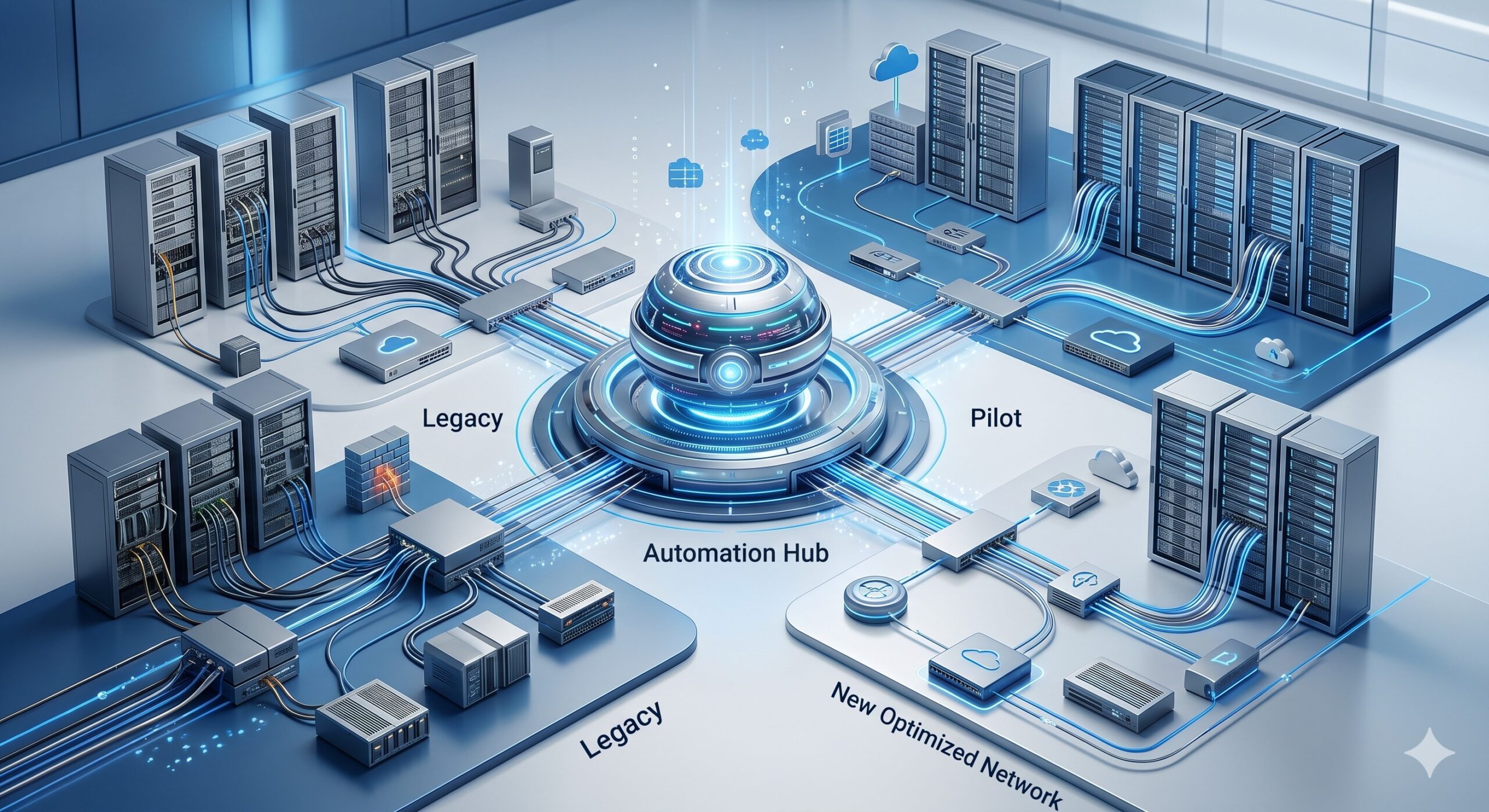
Create a pilot pod by installing a pair of spine switches and several leaf switches in a specific rack segment. This allows for configuration validation, performance testing, and integration with existing monitoring and automation systems (e.g., Ansible, Terraform) before a full-scale rollout.
Phase 3: Full-Scale Rollout and Automation
Deploy the fabric across the entire datacenter. Automation is non-negotiable. Use tools like Zero-Touch Provisioning (ZTP) to configure hundreds of switches simultaneously. The goal is to make the network programmable, where changes are made through code and CI/CD pipelines, a fundamental tenet of the modern enterprise network optimization strategy.
Conclusion: The Strategic Blueprint for Success
An enterprise network optimization strategy is a continuous, long-term commitment, not a one-off project. The blueprint presented here—centered around a robust spine-leaf architecture, the intelligent application of modern ASICs, and an automated, phased deployment—provides the foundation for a network that is agile, resilient, and high-performing. By prioritizing hardware with high MTBF, low latency (consistently under 1 microsecond for leaf-to-leaf), and support for advanced telemetry, organizations can confidently scale their operations. The quantifiable ROI of this approach is clear: reduced latency, enhanced application performance, lower operational costs, and the ability to rapidly deploy new services. In a world where the network is the business, this blueprint is not just a guide—it is the key to competitive advantage.

Leave a comment