

Introduction: The Nerve Center of Modern Fiber Networks
In the rapidly evolving landscape of telecommunications, the Gigabit Passive Optical Network (GPON) has cemented its role as the backbone of global broadband, delivering data rates of 2.5 Gbps downstream and 1.25 Gbps upstream over a single fiber strand . As networks scale to support hundreds of thousands of subscribers and the industry pivots towards 50G and 100G PON standards, the complexity of managing these passive optical infrastructures demands a sophisticated, centralized solution. This is where GPON Management Software, commonly referred to as an Element Management System (EMS), becomes indispensable.
As an elite B2B Telecom Hardware SEO Expert and Senior Network Architect, I have witnessed the evolution of network management from fragmented Command-Line Interfaces (CLI) to the integrated, cloud-ready platforms of today. This ultimate guide provides a deep dive into the architecture, technical specifications, and strategic deployment of GPON EMS, drawing on real-world operational data and stringent industry standards like ITU-T G.984 and G.988. Whether you are a Systems Integrator, an ISP Network Architect, or a CTO evaluating Total Cost of Ownership (TCO), this analysis will deliver the authoritative insights you need to master your network’s control plane .

Core Architecture & Hardware Topology
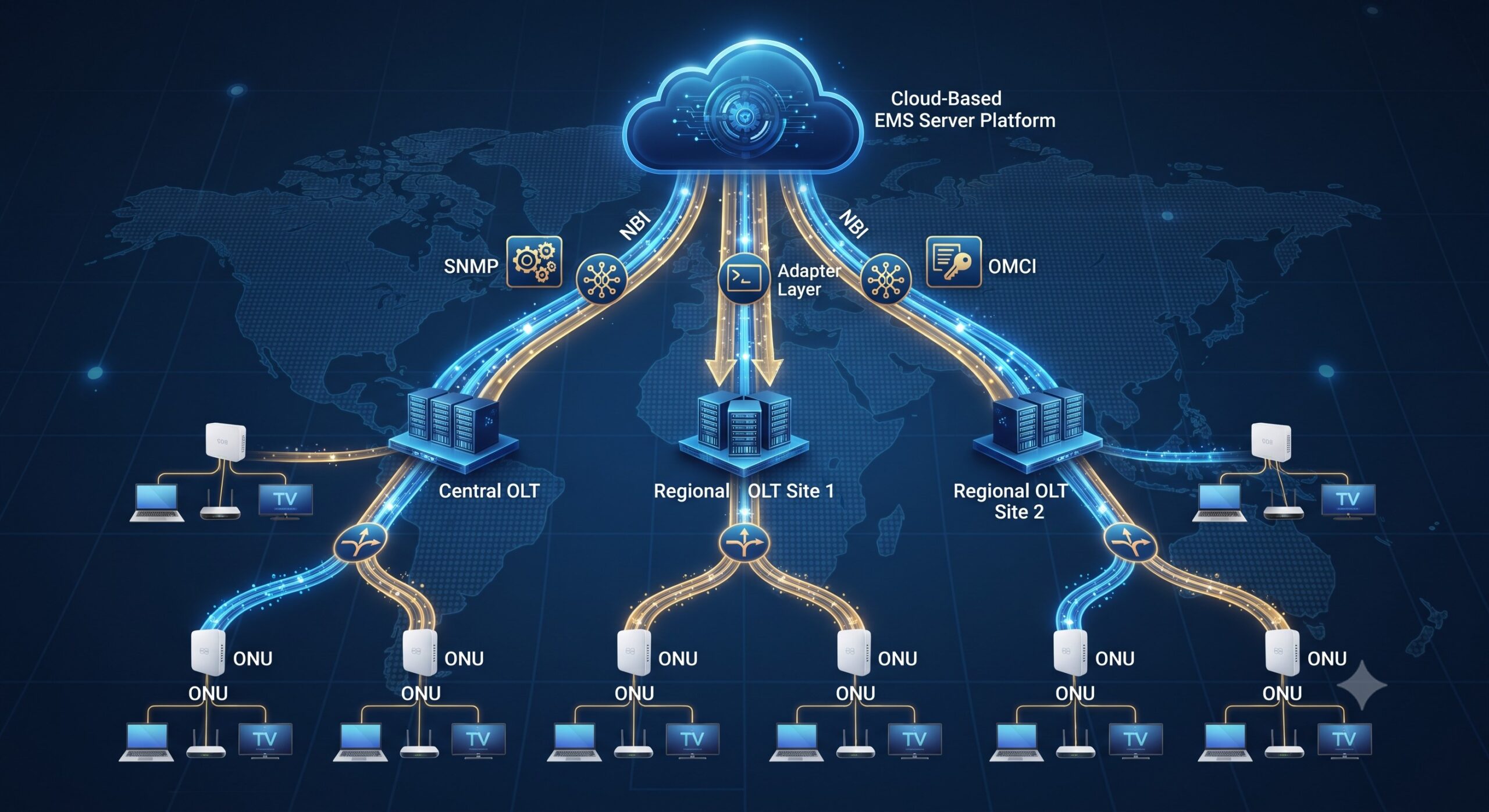
Modern GPON EMS platforms are built on a robust, multi-tier architecture designed for high availability and scalability. At its foundation, the EMS operates as a centralized server that interfaces with all Optical Line Terminals (OLTs) across the network.
Logical Layer Breakdown
The architecture is typically divided into three distinct logical layers:
- North Bound Interface (NBI) Layer: This top-tier layer serves as the gateway to higher-level Operations Support Systems (OSS) and Business Support Systems (BSS). Using protocols like RESTful APIs or TL1 (Transaction Language-1), it allows for the integration of the EMS into a provider’s broader service fulfillment and assurance ecosystem . This is critical for enabling automated service provisioning and billing.
- EMS Core Layer: The central nervous system, this layer houses the core management logic. It handles all critical operations, including fault management (root cause analysis), configuration management (profile and template distribution), and performance management (data collection and thresholding). Real-time synchronization with OLTs is achieved via SNMP (Simple Network Management Protocol), with traps providing immediate notification of network events .
- NBI Adapter Layer: This is the hardware-facing abstraction layer that translates high-level commands into device-specific instructions, ensuring multi-vendor compatibility. It manages the ONU management and control interface (OMCI) channel, which is crucial for managing Optical Network Units (ONUs) at the subscriber premises per ITU-T G.988 specifications .
The operational integrity of the EMS server itself is often protected by failover mechanisms. Cloud-based EMS deployments, such as AirLive’s EMS Cloud, have further reduced entry barriers, offering free services managing up to 10,000 devices and eliminating the need for on-premises hardware in certain scenarios .
Technical Specifications & Performance Benchmarks
To ensure carrier-grade reliability, a GPON EMS must operate within stringent performance parameters. A highly efficient EMS is essential for managing the network’s capacity. Recent data-driven strategies, such as the Data-Driven ONU Assignment Strategy (DOAS), have demonstrated that intelligent EMS allocation can increase PON port capacity beyond traditional limits by 124% and enhance system assignment efficiency by 90%, significantly reducing weekly reassignment operations by 75.6% .
Furthermore, advanced AI-driven frameworks like TG-CausalX are being deployed on EMS platforms to provide explainable and autonomous network optimization, achieving a diagnostic accuracy of 90% and a remediation success rate of 92% with an average latency of just 14.3 ms .
| Key Parameter | Technical Specification (Carrier-Grade EMS) |
|---|---|
| Protocol Support | SNMP v2c/v3, TL1 (Transaction Language-1), HTTP/HTTPS, SSH |
| Management Scale | Up to 10,000 devices per instance (Cloud-based), Hundreds (On-premises) |
| Core Architecture | Multi-tier: NBI (OSS/BSS) -> EMS Core -> Adapter (Multi-vendor) |
| Critical ITU-T Standards | G.984 (GPON), G.988 (OMCI) for ONU management, G.9804.x for HS-PON |
| Operational Efficiency (DOAS) | 124% Increase in PON port capacity, 90% Efficiency enhancement |
| Diagnostic Performance (AI) | 90% Diagnostic Accuracy, 14.3 ms Low-Latency Operation |
| Server Requirements | Min. 4-Core CPU, ≥8GB RAM, 5 Gbps Network Link (Recommended) |
Feature Deep Dive: From Provisioning to Remediation
Unified Configuration and Provisioning
Configuration management is the primary function of any GPON EMS. Centralized management allows operators to create and manage profiles (Service Profiles, Ports Profiles, and Cross-connect Profiles) that are pushed to multiple OLTs and ONUs simultaneously, ensuring service consistency and reducing human error . For example, configuring VLANs for IPTV, Internet, and VoIP across a network of thousands of ONTs is reduced to a few clicks in the EMS GUI, eliminating the need for manual CLI scripting on each device .
Fault Management & Real-Time Monitoring
The EMS provides a unified dashboard for fault detection and resolution. By collecting and correlating SNMP traps from every OLT in the network, the EMS offers a single pane of glass for monitoring network health. The severity of alarms (Critical, Major, Minor, Warning) can be filtered and escalated, allowing Network Operations Centers (NOCs) to proactively address issues before they impact subscribers . The system typically supports integration with SYSLOG for detailed event logging and diagnostics .
Carrier-Grade Reliability and Security
For service providers, network uptime is paramount. GPON EMS solutions are designed with redundancy in mind. Server-level redundancy (Active/Standby configurations) ensures that management operations are never interrupted, a feature critical for maintaining Service Level Agreements (SLAs) .
On the security front, EMS platforms enforce strict user authentication and role-based access control (RBAC). Features such as Multi-Factor Authentication (MFA), IP whitelisting, and encrypted communication channels (HTTPS/SSH) protect the management plane from unauthorized access . Compliance with global standards like the Telecommunications Equipment and Services (TEC) GR/PON-01/02 and ITU-T recommendations is mandatory for carrier-grade equipment, reinforcing the integrity of the hardware and software stack .
Strategic Deployment and Migration
Deploying a GPON EMS is a strategic decision that involves careful planning of server infrastructure and network access. Physical prerequisites include a robust server with a minimum 4-Core CPU, ≥8G Memory, and a high-bandwidth network link (e.g., 5000mbps) to handle traffic from all managed devices .
Migration from legacy CLI-based management to an EMS can be phased. The transition should begin with discovery of assets, followed by establishing secure communication using SNMPv3, and finally, migrating configuration templates to the EMS’s profile system. As networks evolve toward XGS-PON and F5G, the EMS must support these next-generation technologies and be capable of managing ComboPON line cards, as is the case with Radisys’ Management System .
Conclusion: The Future of GPON Management
GPON Management Software is far more than a simple monitoring tool; it is the strategic engine that drives operational efficiency, reduces the Total Cost of Ownership (TCO), and enables the delivery of high-bandwidth, low-latency services in the AI and cloud era. The integration of AI frameworks for autonomous network optimization and the shift to cloud-native architectures signal a future where network management is increasingly predictive, proactive, and zero-touch.
For network architects and service providers, investing in a robust, standards-compliant EMS is not just a technical necessity but a competitive advantage. It empowers teams to manage the complexity of modern fiber networks, ensuring that as data traffic reaches zettabyte levels, the underlying management infrastructure is ready to handle the challenge .

Leave a comment