
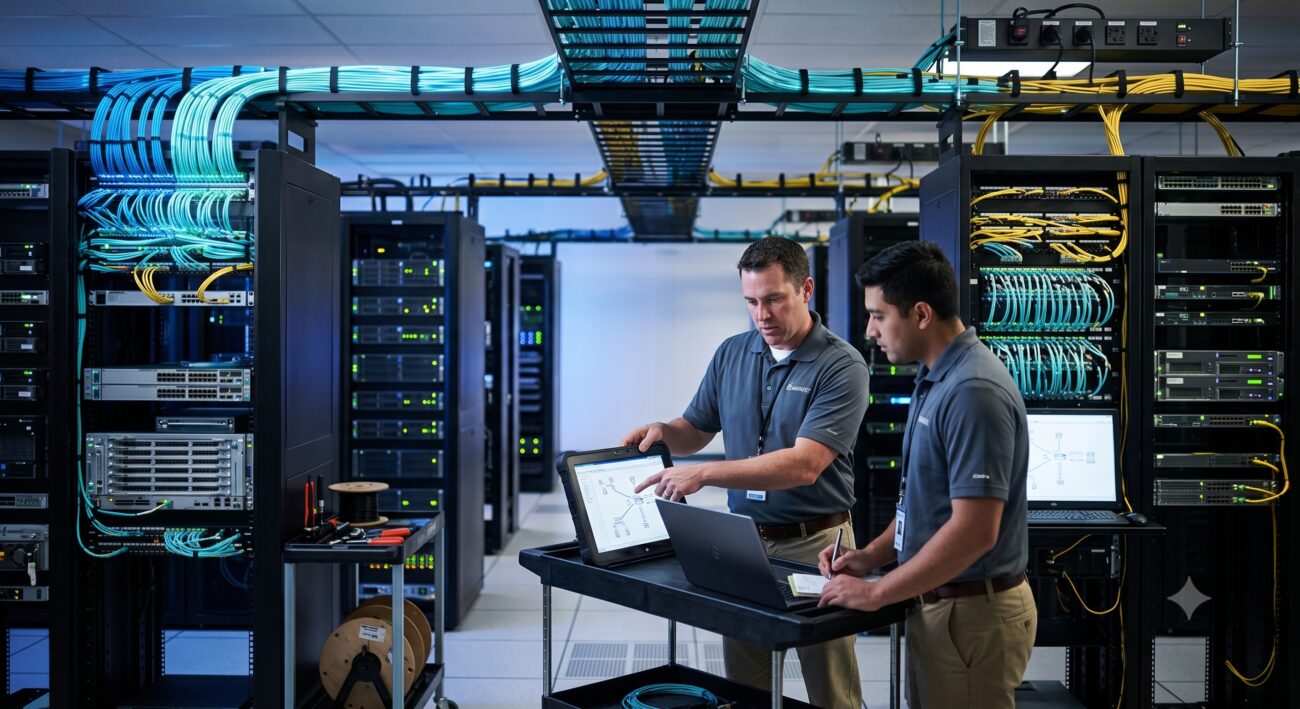
Beyond the 32-Bit Boundary: The Catalyst for Core Network Evolution
The global transition from IPv4 to IPv6 is no longer a matter of strategic choice; it is an operational imperative driven by the unequivocal exhaustion of the IPv4 address space. With the global IPv6 preference rate surpassing 37% and Asia leading at nearly 43%, the telecom industry is at a pivotal juncture. This migration, however, is a complex engineering challenge that demands meticulous architectural planning, hardware evaluation, and a phased deployment strategy. This guide serves as a comprehensive blueprint for senior network architects and systems integrators navigating this transformation, focusing on the underlying infrastructure, carrier-grade hardware requirements, and the strategic evolution from dual-stack models to an IPv6-dominant ecosystem.
The core driver for this transition is the sheer arithmetic of the Internet. While IPv4 offers just over 4.29 billion addresses, IPv6 provides a virtually inexhaustible pool of approximately 3.4 x 10^38 addresses. This scarcity has transformed IPv4 into a costly and finite commodity, with roughly 40 million IPv4 addresses changing hands annually. For a modern network architect, the transition is not just about acquiring more addresses; it is about building a foundation for future scalability, security, and operational efficiency.

Strategic Architecture: Beyond Dual-Stack to IPv6-Mostly
While dual-stack deployment has served as the traditional transition mechanism, allowing networks to process IPv4 and IPv6 traffic simultaneously, it is increasingly viewed as a waypoint rather than a destination. As Jen Linkova of Google highlighted at APRICOT 2026, maintaining a dual-stack environment expands the operational attack surface and fails to alleviate the IPv4 address crunch. The industry is coalescing around the “IPv6-mostly” architecture as the pragmatic next step. This model is designed to transition networks away from dual-stack dependencies by providing IPv4 on-demand, enabling a gradual but definitive shift toward an IPv6-only core.
Strategic Architecture: The Core Tenets of IPv6-Mostly
- IPv6 as the Primary Protocol: The network defaults to IPv6 for all endpoints and services. This establishes IPv6 as the path of least resistance for traffic, allowing operators to identify and resolve IPv6-specific issues immediately rather than having them masked by IPv4 fallback mechanisms.
- NAT64/DNS64 as the Glue: To ensure IPv6-only clients can access the legacy IPv4 internet, the network provides stateful Network Address Translation (NAT64) and DNS64 services. These technologies synthesize IPv6 addresses for IPv4 destinations, bridging the protocol gap without requiring every application to be natively dual-stacked.
- CLAT for Legacy Application Support: Customer-side translators (CLATs), operating on the end-host, allow IPv6-only clients to handle applications with hardcoded IPv4 dependencies. This ensures that legacy applications remain functional without compromising the IPv6-only nature of the network segment.
- Intelligent IPv4 Address Assignment: DHCPv4 Option 108 acts as a signal, telling IPv6-capable endpoints that they can safely forgo requesting an IPv4 address and operate in IPv6-only mode. This preserves scarce IPv4 resources for devices that truly need them.
Hardware Foundation: Evaluating Carrier-Grade Infrastructure
The success of an IPv6 migration is predicated on the capabilities of the underlying hardware. Telecom and enterprise core routers must meet rigorous performance, reliability, and scalability standards to handle the shift. A critical first step is a comprehensive network audit to assess whether existing hardware supports IPv6 natively in the forwarding plane, or if it relies on software-based processing that could introduce unacceptable latency.
When selecting or upgrading hardware for a carrier-grade IPv6 infrastructure, several key technical specifications must be evaluated. The following table outlines the crucial metrics for evaluation.
| Key Parameter | Technical Specification for IPv6 Infrastructure |
|---|---|
| Switching Capacity | Non-blocking throughput of up to 25.6 Tbps for spine-leaf architectures, enabling line-rate IPv6 forwarding. |
| Port Density | Support for high-density 100GE and 400GE interfaces to accommodate massive scale in data center core networks. |
| Latency & Forwarding Rate | Sub-500 nanosecond port-to-port latency on modern ASICs, capable of processing over 1 billion packets per second (Bpps) for IPv6 flows. |
| Hardware Security | Hardware-root-of-trust and line-rate MACsec encryption to secure the IPv6 forwarding plane. |
| Protocol Support | Native support for OSPFv3, IS-IS for IPv6, BGP-4+ (Multiprotocol BGP), EVPN (VXLANv6), and SRv6 (Segment Routing over IPv6). |
| Environmental Compliance | Compliant with RoHS, with high-efficiency 80 Plus Titanium power supplies and advanced cooling designed for a PUE of less than 1.3. |
Phased Migration Strategy: From Assessment to IPv6-Only
Adopting a structured, phased approach to migration is essential for minimizing service disruption and ensuring a smooth transition. The following roadmap, based on industry best practices and insights from RIRs and major vendors, provides a detailed methodology.
Step 1: Comprehensive Network Assessment and Inventory
Before any implementation begins, a thorough audit of the current network state is critical. This stage aims to discover exactly what hardware and software assets are in place and map out their IPv6 support capabilities.
- Hardware Inventory: Catalog all routers, switches, firewalls, and load balancers. Verify the IPv6 feature set of their firmware and ASICs.
- Software Inventory: Identify operating systems, applications, and management tools that interact with the network. Check for hard-coded IPv4 addresses that could break when IPv6 is enabled.
- Vendor Roadmap: For any hardware or software that is IPv4-only, consult the vendor’s roadmap for IPv6 support to plan for upgrades or replacements.
Step 2: Clean Up and Optimize the Existing IPv4 Network
This is an opportunity to “spring clean” the network before the added complexity of IPv6. Removing unused interfaces, redundant rules, and outdated configurations simplifies both the IPv4 and IPv6 environments.
- Remove Redundant Configurations: Clean up ACLs, route maps, and interface configurations that are no longer in use.
- Optimize IGP Routing: Review OSPFv2, IS-IS, and BGP policies to ensure they are as efficient as possible. This is a good time to plan for their IPv6 counterparts (OSPFv3, IS-IS for IPv6, and BGP IPv6 address families).
- Reclaim IPv4 Addresses: Audit DHCP scopes and static assignments to identify and reclaim unused IPv4 addresses, conserving this scarce resource.
Step 3: Acquire and Plan IPv6 Address Space
With a clean network, the next step is acquiring the address space from a Regional Internet Registry (RIR). The planning of this space is fundamentally different from IPv4.
- Address Acquisition: Contact your RIR (e.g., APNIC, ARIN, RIPE NCC) to request an IPv6 allocation. ISPs typically receive a /32 block, while an enterprise can justify a /48.
- Create an IPv6 Addressing Plan: Unlike IPv4, where subnetting is about conservation, IPv6 is about aggregation. Adopt a hierarchical approach: allocate a /44 per region, a /56 per virtual network or site, and a /64 per subnet segment. A /64 is the industry-standard minimum subnet size, providing over 18 quintillion host addresses.
Step 4: Secure and Enable IPv6 on the Internet Edge
The first step in deployment is to make the network’s Internet gateway IPv6-capable. This allows external users to access public-facing services over IPv6 and establishes a path for internal traffic to reach the wider IPv6 internet.
- Upgrade Border Routers: Ensure all core and edge routers are running a software version that supports IPv6 and are configured with the appropriate routing protocols (e.g., BGP for IPv6).
- Firewall and Security Configuration: Security teams must be involved from the start. A critical step is to configure firewall policies for IPv6 with the same rigor as IPv4. Pay special attention to ICMPv6, as it is vital for IPv6 network operations (e.g., Neighbor Discovery).
- Update DNS: Add AAAA records for all public-facing servers, such as websites and mail exchangers, to establish a visible IPv6 presence.
Step 5: Dual-Stack the Data Center and Core
With the edge ready, the focus shifts to the data center. This is the “inside-out” approach, where the core infrastructure is enabled before endpoints.
- Enable IPv6 on Core Routers and Switches: Activate IPv6 on the network core, moving from an IPv4-only underlay to a dual-stack (or eventually an IPv6-only) underlay. For EVPN-VXLAN fabrics, this involves upgrading the fabric to dual-stack VXLAN (VXLANv4v6) to ensure seamless migration of endpoints.
- Dual-Stack Servers: Enable IPv6 on critical servers, both physical and virtual. This allows the team to begin verifying application access and connectivity over IPv6.
- Internal Application Testing: Begin testing internal applications in a controlled environment to identify and remediate any IPv6-related issues.
Step 6: Deploy NAT64, DNS64, and IPv6-Mostly
Once the core is stable and applications are verified, deploy the mechanisms that enable the IPv6-mostly model for client networks.
- Deploy NAT64 and DNS64: Introduce stateful NAT64 devices and DNS64 services to translate between the IPv6 network and the remaining IPv4-only destinations.
- Enable DHCPv4 Option 108: Configure the DHCPv4 server to advertise the IPv6-Only Preferred option. This signals to modern clients that they can safely operate without an IPv4 address, thereby conserving IPv4 addresses and simplifying their stack.
- Enable PREF64: Use Router Advertisements (RAs) to advertise the NAT64 prefix (PREF64) to clients, allowing them to synthesize IPv6 addresses for IPv4 destinations without DNS involvement.
Step 7: Migrate User VLANs to IPv6-Mostly
With the supporting infrastructure in place, user-facing network segments can be transitioned to an IPv6-mostly model.
- Client Network Activation: For each user VLAN or wireless SSID, enable IPv6 and configure the network as IPv6-mostly.
- Monitor and Remediate: As clients connect, monitor the network for issues. Use NetFlow or sFlow to identify any clients or applications that are still reliant on IPv4. Use technologies like Happy Eyeballs to ensure that if IPv6 fails, the transition to IPv4 is seamless for the end-user, while the failure is logged and corrected.
- Iterate and Expand: Over time, as confidence grows and more clients support IPv6-only modes, expand the IPv6-mostly network to all segments.

Conclusion: A Future-Proofed Foundation
The transition from IPv4 to IPv6 is the defining infrastructure challenge of the current decade. For network architects and systems integrators, it represents a unique opportunity to build a more scalable, secure, and operationally efficient network. The path, while clear, requires careful planning, hardware validation, and a willingness to move beyond the legacy of IPv4.
By adopting an IPv6-mostly architecture, organizations can begin to reclaim their most precious IPv4 resources, eliminate the complexity of managing two protocols on every endpoint, and future-proof their infrastructure for decades to come. The journey is not merely about upgrading protocols; it is about re-architecting the network to be ready for the demands of an increasingly connected world. As IETF standards and operational experience continue to evolve, the most successful strategies will prioritize a pragmatic, phased approach that balances the urgent need for IPv6 with the realities of legacy system compatibility.

Leave a comment