

Introduction: The Bandwidth Imperative and the Multi-Gigabit Solution
In the contemporary digital landscape, enterprise networks are under relentless pressure. The proliferation of bandwidth-intensive applications, the widespread adoption of Wi-Fi 6 and Wi-Fi 7, and the increasing density of IoT and smart building devices are collectively rendering traditional 1 Gigabit Ethernet (1G) infrastructure a critical bottleneck . However, a wholesale migration to 10 Gigabit Ethernet (10G) presents a significant challenge, often requiring costly and disruptive upgrades to structured cabling, specifically to Cat6a or fiber optics .
The strategic solution to this conundrum lies in the multi-gigabit switch upgrade. Operating within the IEEE 802.3bz and NBASE-T standards, these switches deliver speeds of 2.5Gbps and 5Gbps over existing Cat5e and Cat6 cabling, offering a pragmatic, cost-effective path to enhanced network performance . This ultimate guide provides a deep technical exploration of the architecture, specifications, and deployment strategies for multi-gigabit switches, serving as an essential resource for network architects, systems integrators, and IT decision-makers.

Core Architecture and Hardware Topology
At the heart of a multi-gigabit switch is a sophisticated ASIC (Application-Specific Integrated Circuit) architecture designed to handle multiple data rates on a single port. Unlike legacy switches that are often fixed-speed, the multi-gigabit ASIC employs advanced digital signal processing (DSP) and equalization techniques to overcome the physical limitations of copper cabling . This allows the switch to auto-negotiate speeds of 1G, 2.5G, 5G, and 10G on a per-port basis, determining the optimal throughput based on the link quality and the capabilities of the connected device .
Modern multi-gigabit switches are designed with a robust internal architecture that includes a high-bandwidth backplane and a non-blocking switching fabric. For instance, an 8-port 10G multi-gigabit switch typically boasts a switching capacity of 160 Gbps, ensuring that all ports can operate at line rate simultaneously without packet loss . This topology is critical for maintaining consistent low latency and jitter, essential for real-time applications like voice and video.
Key Architectural Components
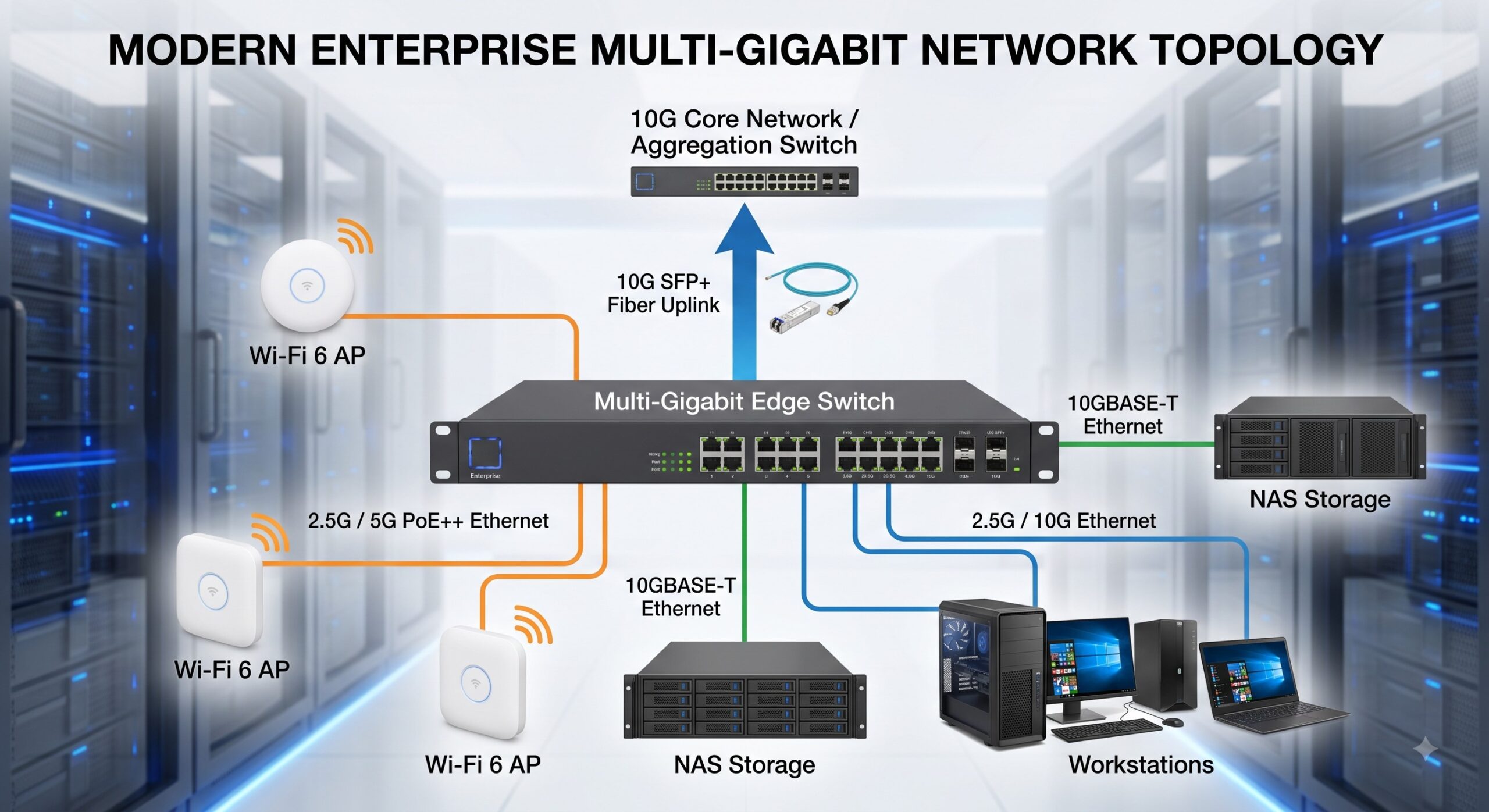
- High-Speed Ports: These are typically 10GBASE-T RJ-45 ports capable of supporting 100M/1G/2.5G/5G/10G speeds. They are often complemented by dedicated SFP+ uplink ports for fiber backbone connections .
- Power over Ethernet (PoE) Integration: Many multi-gigabit switches incorporate PoE+ (802.3at) and even UPOE+ (802.3bt Type 4) capabilities, delivering up to 90W of power per port to high-demand endpoints such as Wi-Fi 6/7 access points and advanced PTZ security cameras .
- Management Plane: Enterprise-grade switches feature a comprehensive management plane, supporting Layer 2/Layer 3 switching, VLANs, QoS, and robust security features like MAC layer security, port security, and DoS prevention .
Technical Specifications and Performance Metrics
For a data-driven evaluation, key performance indicators (KPIs) are essential. The table below consolidates critical parameters typical of a high-performance enterprise multi-gigabit switch.
| Key Parameter | Technical Specification |
|---|---|
| Switching Capacity | Up to 160 Gbps (Non-Blocking) |
| Port Density | 8 to 48 ports of 1/2.5/5/10GBASE-T |
| Latency | |
| Power over Ethernet (PoE) | IEEE 802.3at (PoE+) up to 30W, 802.3bt (UPOE+) up to 90W |
| Management | Layer 2+/Layer 3 Lite, VLAN, QoS, SNMP |
| Mean Time Between Failures (MTBF) | > 150,000 hours |
| Forwarding Rate | Up to 238 Mpps (for a 48-port 10G switch) |
| Compliance | IEEE 802.3bz, 802.3an, 802.3ab, 802.3az, RoHS |
Beyond the headline figures, operational metrics such as Mean Time Between Failures (MTBF) are paramount for carrier-grade reliability. High-quality enterprise switches, like the NETGEAR XS724EMv2, offer an MTBF of over 160,000 hours, ensuring long-term operational stability . Additionally, features like Energy Efficient Ethernet (IEEE 802.3az) are increasingly standard, reducing power consumption during periods of low network activity and contributing to a lower Total Cost of Ownership (TCO) .
Deployment Scenarios and Migration Strategy
Deploying a multi-gigabit switch upgrade is a strategic move for various environments. The primary drivers include high-density office environments, educational campuses, healthcare facilities, and expanding SMEs . The most common use case is connecting Wi-Fi 6/6E/7 access points, where a 1G uplink creates a significant bottleneck, wasting the potential of the wireless network .
A phased migration strategy is often the most effective. A step-by-step approach is as follows:
- Assessment: Conduct a thorough audit of existing cabling infrastructure (Cat5e, Cat6, Cat6a) and identify high-traffic bottlenecks.
- Topology Planning: Design a network topology that places multi-gigabit switches at the edge (access layer) to support high-performance endpoints and aggregate them to a 10G or 40G core via SFP+ uplinks .
- Phased Rollout: Begin by upgrading critical areas, such as IDF (Intermediate Distribution Frame) closets serving dense user populations or departments with high-bandwidth requirements like engineering or media .
- Configuration & Policy Enforcement: Leverage the advanced management capabilities to configure VLANs for traffic segmentation, implement Quality of Service (QoS) policies to prioritize mission-critical traffic, and enable security features to harden the network .
Conclusion: The Strategic Value of a Multi-Gigabit Upgrade
The multi-gigabit switch upgrade represents a strategic inflection point for modern enterprise networking. By intelligently bridging the gap between legacy 1G and the high-speed demands of contemporary applications and Wi-Fi standards, it provides a future-proof, cost-efficient solution. The ability to leverage existing copper cabling while delivering a fivefold or tenfold increase in bandwidth, coupled with advanced management and robust security features, makes it an indispensable asset for any organization seeking to maximize network ROI and operational efficiency. As the technology continues to evolve, the multi-gigabit switch will remain a cornerstone of the resilient, high-performance network.

Leave a comment